Within Airbase Zones
How Airbases Clear Microwave Firing Zones
Microwave exclusion zones work best when airspace and ground areas are divided into sectors that can be cleared, held or reopened in real time.
On this page
- Why one fixed perimeter is not enough
- How sectors support real time clearance
- Failure points that should trigger a hold
Page outline Jump by section
Introduction
High-power microwave (HPM) weapons are attractive for airbase defence because they can disable multiple drones with a single burst. The same characteristic that makes them effective, however, creates a control problem: the area affected by a microwave shot is not simply a point target. Operators must know which runways, taxiways, aprons, communications sites, vehicles and aircraft fall within the planned engagement volume before firing. As a result, modern microwave exclusion zones are increasingly managed through dynamic sector control rather than a single static perimeter. Dynamic sector control divides the airbase and surrounding airspace into manageable sectors that can be cleared, restricted and reopened in real time, allowing commanders to employ HPM systems while reducing risks to friendly personnel and equipment. High-power microwave systems are specifically designed to affect electronics across an area rather than a single point, making such control measures operationally important.[DroneShield+2Journal of Electromagnetic Dominance]droneshield.comDrone Shield A Counter to Drone Swarms: High-Power MicrowaveA Counter to Drone Swarms: High-Power Microwave…July 22, 2025 — Military forces must prioritise a counter to drone swarming…

Why One Fixed Perimeter Is Not Enough
A fixed exclusion ring assumes that the operational environment remains unchanged during an engagement. Airbases rarely function that way. Aircraft taxi, maintenance teams move between shelters, fuel trucks cross service roads, and communications equipment may be activated or relocated within minutes.
Microwave counter-drone systems also vary in how they project energy. Some are designed to cover relatively broad sectors against drone swarms, while others can shape or direct energy into narrower engagement areas. Because the beam geometry, target direction and operational circumstances change from shot to shot, a single permanent safety boundary can either become overly restrictive or fail to account for changing exposure risks.[Journal of Electromagnetic Dominance+2AFRL]jedonline.comJournal of Electromagnetic DominanceHigh-Power Microwave Systems – Getting (Much…24 Jan 2023 — In this article, we're going to look at…
A practical airbase therefore treats the microwave effect area as a temporary operational volume. Instead of asking whether a location is always safe or unsafe, controllers ask whether a particular sector is clear at the moment a shot is requested.
How Sectors Support Real-Time Clearance
Dynamic sector control divides the operating area into predefined zones linked to airfield maps, surveillance systems and command-and-control procedures. A sector may correspond to:
- A runway segment.
- A taxiway network.
- An aircraft parking apron.
- A maintenance area.
- A fuel and logistics route.
- A communications or radar site.
- A low-altitude airspace corridor near the base.
When a drone threat appears, the projected engagement area is overlaid onto these sectors. Controllers can then determine which sectors must be temporarily restricted before authorising a microwave shot.
Sector Status Management
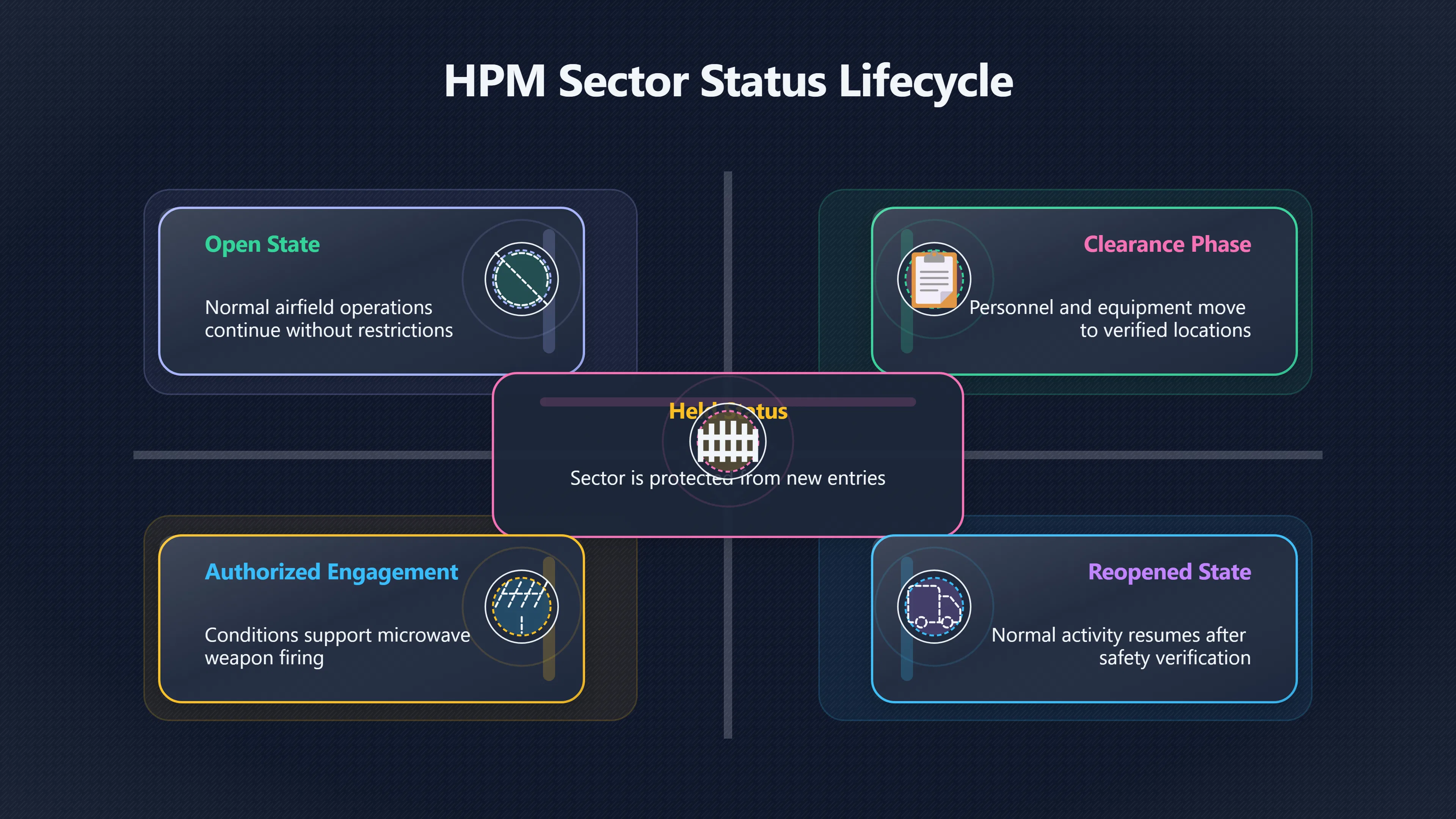
In practice, sectors typically move through several states:
- Open – normal operations continue.
- Clearance in progress – personnel and equipment are being verified or moved.
- Held – the sector is protected from new entries.
- Engagement authorised – conditions support microwave firing.
- Reopened – normal activity resumes after verification.
This approach allows commanders to close only the areas affected by a planned engagement rather than freezing operations across an entire airbase.
Linking Surveillance to Sector Control
Effective sector management depends on continuous situational awareness. Radar, optical sensors, airfield monitoring systems and local command networks help determine whether friendly aircraft, vehicles or personnel remain inside the engagement footprint.
This is particularly important because modern HPM systems can engage multiple drones simultaneously through a broad-area electromagnetic effect. Demonstrations of systems such as THOR have highlighted their ability to disable multiple airborne targets rapidly using wide-beam microwave energy, reinforcing the need to know exactly what lies inside the intended engagement zone before firing.[AFRL+2Air Force Research Laboratory]afrl.af.milrl conducts swarm technology demonstrationRL conducts swarm technology demonstration16 May 2023 — “THOR was exceptionally effective at disabling the swarm with its wide beam…

Matching Sectors to Operational Priorities
Not every sector carries the same risk.
For example:
- A vacant overrun area beyond a runway may be cleared rapidly.
- An active aircraft maintenance apron may require additional verification.
- A communications node supporting air traffic operations may be designated a protected sector requiring special approval before any engagement affecting that area.
Dynamic control therefore allows safety measures to reflect mission importance rather than applying identical restrictions everywhere.
How Airbases Decide a Sector Is Clear
Sector clearance is usually less about geography than about verification. A sector may be physically empty but still contain active electronic systems that require protection.
Before authorisation, controllers typically need confidence that:
- No aircraft are taking off, landing or taxiing through the sector.
- No maintenance activities involving sensitive electronics are underway.
- No temporary communications equipment has been established inside the area.
- Ground vehicles carrying mission-critical electronics have exited the zone.
- Airspace users have been identified and deconflicted.
The goal is not to eliminate all uncertainty but to reduce uncertainty to an acceptable operational level before release authority is granted.
Failure Points That Should Trigger a Hold
Dynamic sector systems are valuable because they create clear conditions under which an engagement must stop.
Loss of Position Awareness
If operators lose confidence in the location of aircraft, vehicles or personnel within a sector, clearance assumptions become unreliable. A sector that cannot be accurately tracked should generally revert to a hold condition until visibility is restored.
Communications Breakdown
Sector control depends on rapid coordination between airfield operations, air defence personnel and microwave weapon operators. If status updates cannot be confirmed, controllers may no longer know whether a sector remains clear.
Unexpected Movement Into the Sector
An authorised engagement can become unsafe if a fuel vehicle, maintenance crew or aircraft enters the protected area after clearance has been granted. Dynamic systems therefore require continuous monitoring rather than one-time approval.

Sensor Degradation
Weather, equipment faults or network failures can reduce confidence in surveillance data. If the engagement area cannot be reliably monitored, sector status may need to revert to restricted or hold conditions.
Changes in Beam Geometry or Engagement Direction
Many HPM systems can shape, steer or redirect their energy output. If the target manoeuvres or operators alter the planned engagement direction, the affected sectors may change as well. Previously cleared sectors may no longer be sufficient, requiring a reassessment before firing.[Journal of Electromagnetic Dominance]jedonline.comJournal of Electromagnetic DominanceHigh-Power Microwave Systems – Getting (Much…24 Jan 2023 — In this article, we're going to look at…
The Operational Value of Sector Control
Dynamic sector control allows airbases to balance two competing requirements: defeating drone threats quickly while maintaining safe operation of a complex electronic environment. Instead of relying on a large permanent exclusion zone, commanders can temporarily isolate only the sectors that intersect the projected microwave engagement area.
For HPM counter-drone systems, this approach is often the difference between a theoretically available capability and one that can be employed routinely during active airbase operations. By treating the airfield as a set of controllable sectors rather than a single protected perimeter, operators gain a practical method for clearing, holding and reopening microwave firing zones as conditions change in real time.[DroneShield+2Journal of Electromagnetic Dominance]droneshield.comDrone Shield A Counter to Drone Swarms: High-Power MicrowaveA Counter to Drone Swarms: High-Power Microwave…July 22, 2025 — Military forces must prioritise a counter to drone swarming…
Amazon book picks
Further Reading
Books and field guides related to How Airbases Clear Microwave Firing Zones. Use these as the next step if you want deeper reading beyond the article.
The Kill Chain
Explains the operational shift toward networked, sensor-driven, unmanned and electronic battle systems.
Army of None
Covers autonomous weapons and drone warfare context that makes airbase counter-drone microwave systems commercially intelligible.
Wired for War
Provides broader context for robotic and unmanned threats that airbase microwave defences are built to counter.

The E-bomb
Focuses on directed-energy and electromagnetic weapons, matching the page’s microwave exclusion-zone theme.
eBay marketplace picks
Marketplace Samples
Example marketplace items related to this page. Use the search link to explore similar finds on eBay.



Endnotes
1.
Source: droneshield.com
Title: Drone Shield A Counter to Drone Swarms: High-Power Microwave
Link:https://www.droneshield.com/blog/a-counter-to-drone-swarms-high-power-microwave-weapons
Source snippet
A Counter to Drone Swarms: High-Power Microwave...July 22, 2025 — Military forces must prioritise a counter to drone swarming...
Published: July 22, 2025
2.
Source: jedonline.com
Link:https://www.jedonline.com/2023/01/24/high-power-microwave-systems-getting-much-much-closer-to-operational-status/
Source snippet
Journal of Electromagnetic DominanceHigh-Power Microwave Systems – Getting (Much...24 Jan 2023 — In this article, we're going to look at...
3.
Source: afrl.af.mil
Title: rl conducts swarm technology demonstration
Link:https://www.afrl.af.mil/News/Article-Display/Article/3396995/afrl-conducts-swarm-technology-demonstration/
Source snippet
RL conducts swarm technology demonstration16 May 2023 — “THOR was exceptionally effective at disabling the swarm with its wide beam...
Published: May 2023
4.
Source: afresearchlab.com
Link:https://afresearchlab.com/counter-swarm-high-power-weapon/
Source snippet
A target is identified, the silent weapon discharges in a nanosecond and the...Read more...
Additional References
5.
Source: envcare.net
Link:https://www.envcare.net/international-microwave-leakage-standard.html
Source snippet
International microwave leakage standardThe microwave leakage measured at 5 cm outside the door of the microwave equipment shall not exce...
6.
Source: rtx.com
Link:https://www.rtx.com/raytheon/what-we-do/integrated-air-and-missile-defense/phaser-high-power-microwave
Source snippet
Phaser High-Power Microwave System | RaytheonDefending at the speed of light. The Phaser high-power microwave system uses directed energy...
7.
Source: asianmilitaryreview.com
Link:https://www.asianmilitaryreview.com/2025/03/atlas-high-power-microwave-device-advancing-rd-for-cost-effective-counter-drone-systems-nsbt/
Source snippet
ATLA's High-Power Microwave Device: Advancing R&D for...10 Mar 2025 — JMOD views the HPM system, which uses high-powered [microwaves]({{ 'microwaves/' | relative_url }}) to d...
8.
Source: icnirp.org
Link:https://www.icnirp.org/cms/upload/publications/ICNIRPrfgdl2020.pdf
Source snippet
GUIDELINESThe main objective of this publication is to establish guidelines for limiting exposure to EMFs that will provide a high...
9.
Source: incompliancemag.com
Title: air force unveils new microwave weapon named thor that can kill drones
Link:https://incompliancemag.com/air-force-unveils-new-microwave-weapon-named-thor-that-can-kill-drones/
Source snippet
Air Force Unveils New Microwave Weapon Named 'Thor'...2 Jul 2019 — Using an inaudible and invisible magnetic wave, the high-powered devi...
10.
Source: youtube.com
Title: THOR (Tactical High-power Operational Responder) Destroys Swarms of Enemy Drones
Link:https://www.youtube.com/watch?v=QjHGxKb6W1c
Source snippet
"America’s “THOR” Shoots Drones With High-power Microwaves | Has US Found the Answer to Drone Swarms?[https://www.youtube.com/watch?v=r8SYb..."](https://www.youtube.com/watch?v=r8SYb...")...
11.
Source: youtube.com
Title: Leonidas Counter-Electronics System — [Generation]({{ ‘generation-ii/’ | relative_url }}) 0 – Customer Demonstration
Link:https://www.youtube.com/watch?v=8lZoSI1LauI
Source snippet
Epirus Leonidas software defined high power microwave counter [drone swarm]({{ 'swarm-limits/' | relative_url }}) Epirus’ Leonidas High-Power Microwave Neutralizes 61-of-61 Dron...
12.
Source: fortunebusinessinsights.com
Title: high power microwave counter drone market 117042
Link:https://www.fortunebusinessinsights.com/high-power-microwave-counter-drone-market-117042
Source snippet
High Power Microwave Counter Drone Market Size, Share...9 Jun 2026 — The global high power microwave counter-drone market size is projec...
13.
Source: researchgate.net
Title: Near fields at various distance and power ratings are presented.Read more
Link:https://www.researchgate.net/publication/358274981_C277_Recent_Trends_in_High_Power_Microwave_Counter_Measure_Against_Drone_Swarm_Attack
Source snippet
(PDF) C277: Recent Trends in High Power Microwave...C277: Recent Trends in High Power Microwave Counter Measure Against Drone Swarm Attack...
14.
Source: aft-microwave.com
Link:https://www.aft-microwave.com/en/industry-sectors/industry/
Source snippet
cularly high-quality circulators, isolators, loads and arc detectors...
Topic Tree