Within Electronics Risk
The Friendly Drone Problem in Swarm Defence
A counter-drone shot can also threaten friendly reconnaissance drones, relay aircraft and interceptors unless identification is disciplined.
On this page
- Why mixed drone airspace complicates firing decisions
- Identification and timing before a wide beam shot
- How friendly unmanned systems can become collateral damage
Page outline Jump by section
Introduction
High-power microwave (HPM) weapons are often promoted as an answer to drone swarms because they can affect multiple unmanned aircraft in a single engagement rather than destroying them one at a time. That same advantage creates a difficult operational problem when friendly drones are sharing the airspace. A microwave engagement intended for hostile drones may also expose friendly reconnaissance platforms, communications relays, loitering sensors, or interceptor drones to disruptive electromagnetic energy. The challenge is not simply technical; it is a command-and-control problem involving identification, timing, airspace management, and risk acceptance. Government and defence assessments repeatedly note that wider-beam microwave systems can affect everything within their engagement area, not just the intended target.[GAO]gao.govgao 23 106717Science & Tech Spotlight: Directed Energy Weapons25 May 2023 — For example, wider beam DEWs, such as high power microwave or millimete…
 As military forces increasingly operate large numbers of their own unmanned systems, the risk of friendly drone losses becomes one of the key constraints on the use of microwave-based swarm defence.
Why Mixed Drone Airspace Complicates Firing Decisions
The traditional air-defence model assumes a relatively clear distinction between friendly and hostile aircraft. Modern drone warfare increasingly breaks that assumption. Small reconnaissance drones, autonomous sensors, communications relays, decoys, and counter-drone interceptors may all be operating simultaneously above a defended force.
Microwave counter-drone systems are attractive because they can generate effects across a volume of airspace rather than requiring precise engagement of individual targets. The US Government Accountability Office highlights the resulting challenge: wider-beam directed-energy systems may affect all assets within an area “whether friend or foe”.[GAO]gao.govgao 23 106717Science & Tech Spotlight: Directed Energy Weapons25 May 2023 — For example, wider beam DEWs, such as high power microwave or millimete…
For commanders, this means that the question before firing is no longer simply “Is the target hostile?” It becomes:
- Which friendly drones are currently airborne?
- Which friendly drones are expected to enter the engagement volume?
- Are any autonomous systems operating beyond direct operator awareness?
- Will the defensive shot create a larger operational loss than the hostile drones themselves?
The issue becomes particularly acute during swarm attacks. Defenders may have only seconds to react, yet the airspace may already contain friendly surveillance drones feeding targeting information to the force being defended.
Identification and Timing Before a Wide-Beam Shot
The Identification Problem
Friendly drones can be physically similar to hostile drones. Commercially derived quadcopters, fixed-wing reconnaissance aircraft, and loitering systems often share comparable sizes, flight profiles, and radar signatures.
Counter-UAS doctrine increasingly relies on layered detection and identification systems rather than visual recognition alone. Radar, electro-optical sensors, radio-frequency detection, and data fusion are used to establish whether a detected drone belongs to friendly forces before a mitigation system is activated. Research on counter-UAS operations consistently identifies identification and classification as central challenges because mitigation actions can affect legitimate aircraft as well as threats.[arXiv]arxiv.orgCounter-Unmanned Aircraft System(s) (C-UAS): State of the Art, Challenges and Future TrendsAugust 28, 2020…
The problem is more severe for microwave weapons than for narrowly focused kinetic interceptors because the effect area may encompass several aircraft simultaneously.
Timing the Engagement Window
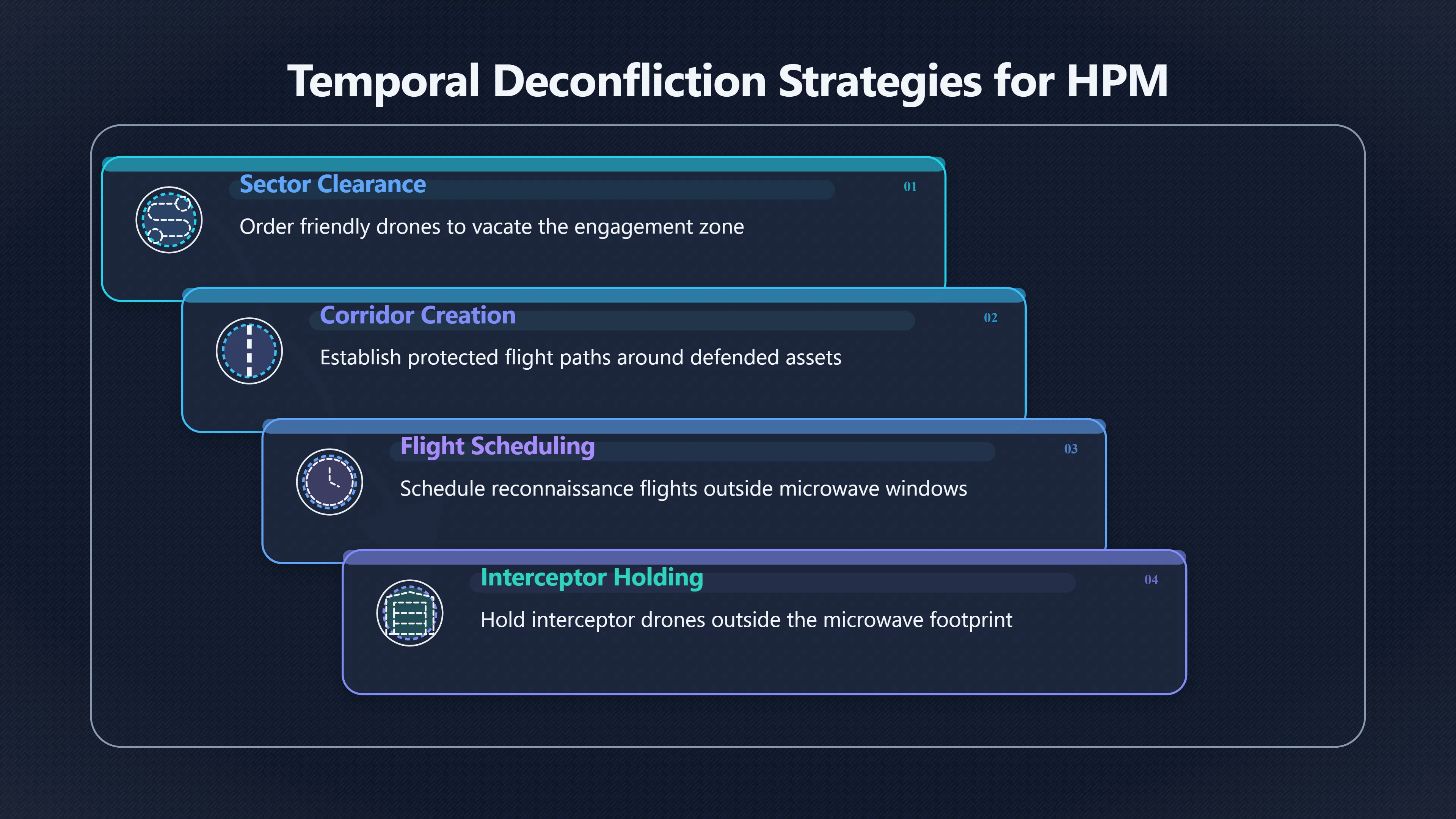
One common mitigation strategy is temporal deconfliction: delaying the microwave shot until friendly drones leave the hazard area.
In practice, this can involve:
- Ordering friendly drones to clear a designated engagement sector.
- Creating protected flight corridors around defended assets.
- Scheduling reconnaissance flights outside expected engagement windows.
- Holding friendly interceptor drones outside the microwave footprint until the shot is complete.
These measures sound straightforward but become difficult during fast-moving attacks. A reconnaissance drone collecting critical battlefield information may be more valuable than destroying a small hostile drone immediately. Commanders must weigh competing operational priorities rather than treating every hostile contact as an automatic firing decision.
How Friendly Unmanned Systems Become Collateral Damage
Microwave weapons are designed to couple electromagnetic energy into electronic systems. The same mechanisms that can disable hostile drones can also affect friendly unmanned aircraft if they are exposed to sufficient energy. The Office of Naval Research describes HPM systems as weapons intended to interact with electronics by causing disruption or damage.[Office of Naval Research]navy.milOffice of Naval Research Directed Energy Weapons: High Power Microwaves HPM weapons create beams of electromagnetic energy over a broad sOffice of Naval ResearchDirected Energy Weapons: High Power MicrowavesHPM weapons create beams of electromagnetic energy over a broad spe…
The consequences for friendly drones can vary significantly.
Temporary disruption. A drone may suffer navigation errors, sensor malfunction, flight-control instability, or communication loss before recovering.
Mission kill without physical destruction. The aircraft may remain structurally intact but become unable to complete its mission because critical electronics are disrupted.
Permanent component damage. Sensitive circuitry, processors, or communications hardware may be damaged beyond recovery.[Office of Naval Research]navy.milOffice of Naval Research Directed Energy Weapons: High Power Microwaves HPM weapons create beams of electromagnetic energy over a broad sOffice of Naval ResearchDirected Energy Weapons: High Power MicrowavesHPM weapons create beams of electromagnetic energy over a broad spe…
The outcome depends on many factors, including distance from the emitter, shielding quality, antenna orientation, wiring design, and the characteristics of the microwave pulse. Even drones of the same model may not respond identically because small differences in orientation and exposure can change how energy couples into internal electronics.[Office of Naval Research]navy.milOffice of Naval Research Directed Energy Weapons: High Power Microwaves HPM weapons create beams of electromagnetic energy over a broad sOffice of Naval ResearchDirected Energy Weapons: High Power MicrowavesHPM weapons create beams of electromagnetic energy over a broad spe…

Friendly Interceptors Create a New Trade-Off
A particularly interesting complication arises when defenders deploy their own drones as part of the counter-drone system.
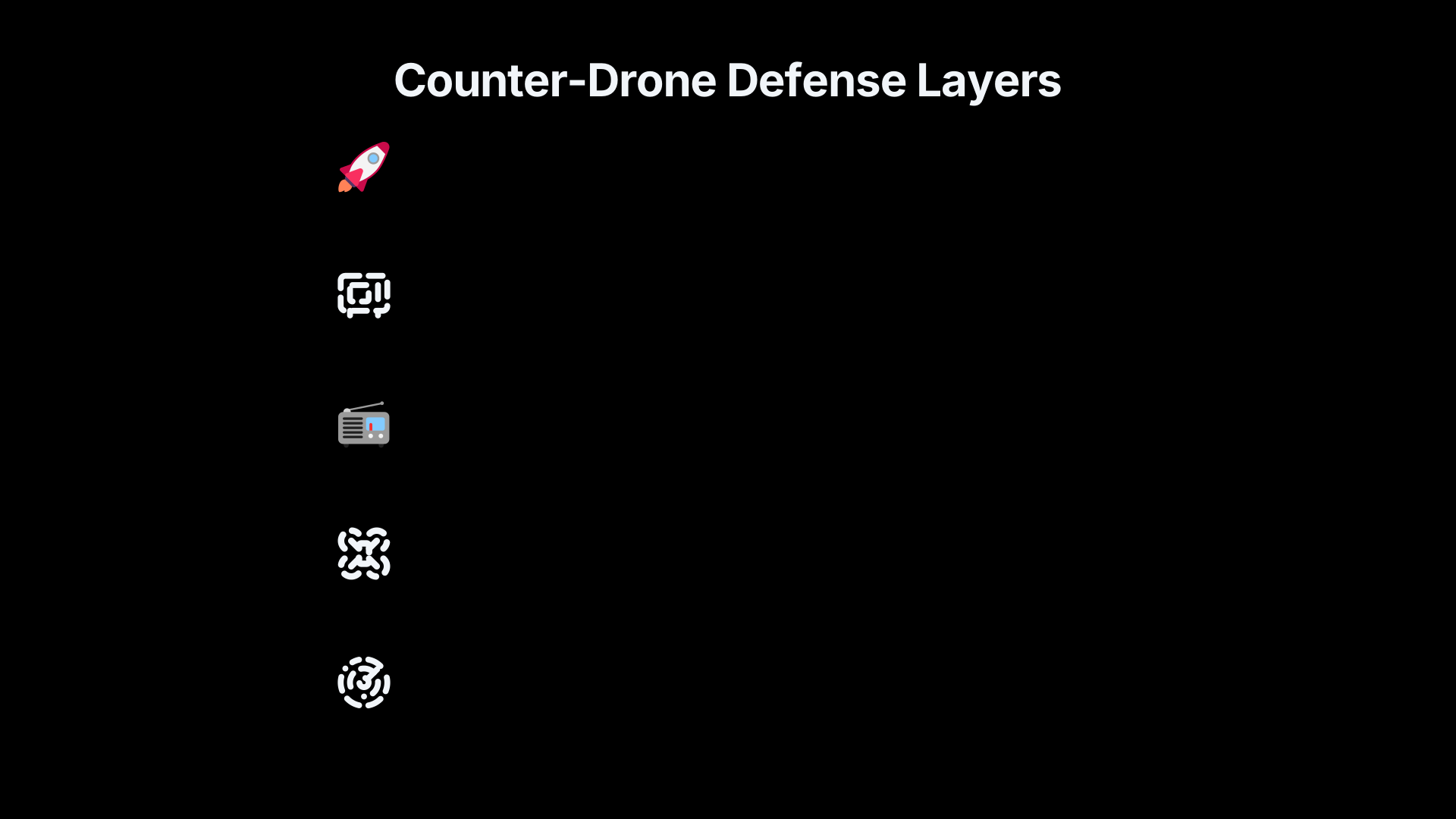
Many modern defence concepts envision layers of protection:
- Detection and tracking sensors.
- Friendly interceptor drones.
- Electronic warfare systems.
- High-power microwave weapons.[gao.gov]gao.govgao 23 106717Science & Tech Spotlight: Directed Energy Weapons25 May 2023 — For example, wider beam DEWs, such as high power microwave or millimete…
- Kinetic weapons as a final layer.
The interceptor layer can conflict directly with microwave engagement. If friendly interceptors are pursuing hostile drones inside the same volume of airspace, a microwave shot risks disabling both sets of aircraft.
This creates a sequencing problem. Commanders may need to decide whether to:
- Allow interceptors more time to complete their mission.
- Withdraw friendly drones and then fire the microwave weapon.
- Accept losses among friendly unmanned systems in exchange for stopping a larger hostile swarm.
As microwave systems become more capable against large drone groups, these trade-offs become increasingly important. Systems such as THOR, Leonidas, RapidDestroyer, and similar counter-swarm concepts derive much of their value from affecting many drones at once rather than engaging them individually.[Tom's Hardware+3Wikipedia+3Epirus]WikipediaTHOR (weaponTHOR (weapon
Why Friendly Reconnaissance Drones Are Especially Vulnerable
Among all friendly unmanned systems, reconnaissance drones often face the greatest risk.
These aircraft are frequently:
- Forward of friendly positions.
- Operating autonomously.
- Flying continuously during periods of heightened threat.
- Carrying sensors that commanders depend upon for situational awareness.
A microwave engagement that removes hostile drones but also blinds the defending force can produce a mixed tactical outcome. The immediate threat may disappear, yet commanders may lose surveillance coverage precisely when they need it most.
This problem is amplified in highly networked operations where drones function as airborne communications relays. A relay drone that is unintentionally disabled may interrupt data links between units, degrading the broader defence effort even though the microwave weapon successfully defeated its intended targets.
The Shift from Weapons Employment to Airspace Management
The friendly-drone problem illustrates a broader reality about microwave-based swarm defence: the limiting factor is often not the weapon itself but the management of the surrounding airspace.
Modern high-power microwave systems can neutralise multiple drones simultaneously and have demonstrated increasingly large counter-swarm effects in testing and demonstrations.[Tom's Hardware+2K-State Libraries]tomshardware.comTom's Hardware High-power microwave system downs 49 drones in one shotelectronics warfare company, successfully demonstrated a major advancement in counter-drone technology with its Leonidas high-power micro…
However, their usefulness depends on maintaining a sufficiently clean engagement volume. As friendly unmanned aircraft become more numerous and more important to military operations, microwave weapons must be integrated with identification systems, airspace control measures, and deconfliction procedures. Without that discipline, a successful counter-swarm engagement can unintentionally remove the very drones that provide reconnaissance, communications, targeting support, or interception for the defending force.
The central challenge is therefore not whether a microwave weapon can defeat hostile drones. It is whether it can do so while preserving the friendly unmanned systems that share the same sky.
Amazon book picks
Further Reading
Books and field guides related to The Friendly Drone Problem in Swarm Defence. Use these as the next step if you want deeper reading beyond the article.
The Kill Chain
Covers networked warfare, autonomy, sensors, and command-and-control problems central to swarm defence decisions.
Army of None
Explains autonomy, human control, targeting, and escalation issues that overlap with mixed friendly-hostile drone environments.
Drone Warfare
Frames the military, ethical, and operational implications of drones, useful background for friendly-drone risk in contested airspace.
Wired for War
Gives broader context on military robotics, unmanned systems, and the operational complications of robotic warfare.
eBay marketplace picks
Marketplace Samples
Example marketplace items related to this page. Use the search link to explore similar finds on eBay.


Endnotes
1.
Source: gao.gov
Title: gao 23 106717
Link:https://www.gao.gov/products/gao-23-106717
Source snippet
Science & Tech Spotlight: Directed Energy Weapons25 May 2023 — For example, wider beam DEWs, such as high power microwave or millimete...
Published: May 2023
2.
Source: arxiv.org
Link:https://arxiv.org/abs/2008.12461
Source snippet
Counter-Unmanned Aircraft System(s) (C-UAS): State of the Art, Challenges and Future TrendsAugust 28, 2020...
Published: August 28, 2020
3.
Source: Wikipedia
Title: THOR (weapon)
Link:https://en.wikipedia.org/wiki/THOR_%28weapon%29
4.
Source: Wikipedia
Title: Rapid Destroyer
Link:https://en.wikipedia.org/wiki/RapidDestroyer
5.
Source: Wikipedia
Title: Epirus Leonidas
Link:https://en.wikipedia.org/wiki/Epirus_Leonidas
Source snippet
Epirus LeonidasThe Leonidas is a high-power microwave (HPM) weapon developed to disable unmanned aerial vehicle (UAV) swarms. It was n...
6.
Source: Wikipedia
Title: Directed energy weapon
Link:https://en.wikipedia.org/wiki/Directed-energy_weapon
Source snippet
Directed-energy weaponA directed-energy weapon (DEW) is a ranged weapon that damages its target with highly focused energy without a s...
7.
Source: gao.gov
Link:https://www.gao.gov/video/directed-energy-weapons-dod-should-focus-transition-planning
Source snippet
Directed Energy Weapons DOD Should Focus on Transition...DOD spends about $1 billion annually on directed energy--concentrated electroma...
Source snippet
Office of Naval ResearchDirected Energy Weapons: High Power MicrowavesHPM weapons create beams of electromagnetic energy over a broad spe...
9.
Source: epirusinc.com
Link:https://www.epirusinc.com/electronic-warfare
Source snippet
Epirus Leonidas High-Power Microwave: Directed Energy...Leonidas is a solid-state, high-power HPM system, utilizing Gallium Nitride (GaN...
10.
Source: tomshardware.com
Title: Tom’s Hardware High-power microwave system downs 49 drones in one shot
Link:https://www.tomshardware.com/tech-industry/high-power-microwave-system-downs-49-drones-in-one-shot-weaponized-electromagnetic-interference-erases-drone-swarms-en-masse
Source snippet
electronics warfare company, successfully demonstrated a major advancement in counter-drone technology with its Leonidas high-power micro...
11.
Source: kstatelibraries.pressbooks.pub
Title: K-State Libraries11
Link:https://kstatelibraries.pressbooks.pub/drone-delivery/chapter/11-microwaves/
Source snippet
DE Weapons & Microwavesby C Carter · 2022 — In 2018, according to the company's website, “Raytheon's high-power microwave system engaged...
12.
Source: airpower.airforce.gov.au
Title: airforce.gov.au Directed Energy Weapons
Link:https://airpower.airforce.gov.au/sites/default/files/2021-03/BPAF03_Directed-Energy-Weapons.pdf
Source snippet
Energy Weapons - Air and Space Power CentreA DEW is a weapon system that uses an energy source and a pointing system to control the deliv...
Additional References
13.
Source: researchgate.net
Link:https://www.researchgate.net/publication/4229403_Research_on_high_power_microwave_weapons
Source snippet
(PDF) Research on high power microwave weaponsOne direction of the study is specifically testing non-lethal microwave weapons to interfer...
14.
Source: youtube.com
Link:https://www.youtube.com/watch?v=X1toVupe_R8
Source snippet
U.S. Directed Energy Weapons SystemsThe Government Accountability Office explains what are Directed Energy Weapons and takes a look at ho...
15.
Source: realcleardefense.com
Title: a counter to drone swarms high power microwave weapons 1109557
Link:https://www.realcleardefense.com/articles/2025/05/12/a_counter_to_drone_swarms_high-power_microwave_weapons_1109557.html
Source snippet
A Counter to Drone Swarms: High-Power Microwave...12 May 2025 — Military forces must prioritise a counter to drone swarming tactics with...
Published: May 2025
16.
Source: coherentmarketinsights.com
Title: directed energy weapons in counter drone missile defense 3576
Link:https://www.coherentmarketinsights.com/blog/aerospace-and-defense/directed-energy-weapons-in-counter-drone-missile-defense-3576
Source snippet
Directed Energy Weapons in CounterDrone Missile Defense4 May 2026 — These include energy beams like laser, microwave, or radio frequency...
Published: May 2026
17.
Source: robinradar.com
Link:https://www.robinradar.com/resources/10-counter-drone-technologies-to-detect-and-stop-drones-today
Source snippet
Drone-deployed nets have a long range and low risk of [collateral]({{ 'collateral-risk/' | relative_url }}) damage...
18.
Source: electronicsforu.com
Title: directed energy weapons high power microwaves
Link:https://www.electronicsforu.com/market-verticals/directed-energy-weapons-high-power-microwaves
Source snippet
Electronics For YouDirected Energy Weapons: High Power Microwaves4 Oct 2016 — HPM weapons generate an intense blast of microwave energy s...
19.
Source: droneshield.com
Link:https://www.droneshield.com/blog/a-counter-to-drone-swarms-high-power-microwave-weapons
Source snippet
sive, mass-produced drones can overwhelm defences.Read more...
20.
Source: defencefinancemonitor.com
Title: directed energy weapons in 20252035
Link:https://www.defencefinancemonitor.com/p/directed-energy-weapons-in-20252035
Source snippet
Directed Energy Weapons in 2025–2035: Development...23 May 2025 — It surveys the current capabilities of confirmed high-energy laser and...
Published: May 2025
21.
Source: armscontrolcenter.org
Title: fact sheet directed energy weapons
Link:https://armscontrolcenter.org/fact-sheet-directed-energy-weapons/
Source snippet
Fact Sheet: Directed Energy Weapons14 Jun 2024 — High Power Microwave Weapons generate microwaves with longer [wavelengths]({{ 'wavelengths/' | relative_url }}). They're capabl...
22.
Source: defencefinancemonitor.com
Title: non kinetic counter uas with high
Link:https://www.defencefinancemonitor.com/p/non-kinetic-counter-uas-with-high
Source snippet
Non-Kinetic Counter-UAS with High Power Microwave8 Dec 2025 — This report examines the operational, technical and industrial implications...
Topic Tree