Within Fog Range
Can Technology Beat Foggy Laser Weather?
Adaptive optics and beam control can reduce some atmospheric penalties, but they cannot remove the basic energy loss caused by fog.
On this page
- What adaptive optics can correct
- What scattering and absorption still remove
- Why mitigation is not the same as all weather lethality
Page outline Jump by section
Introduction
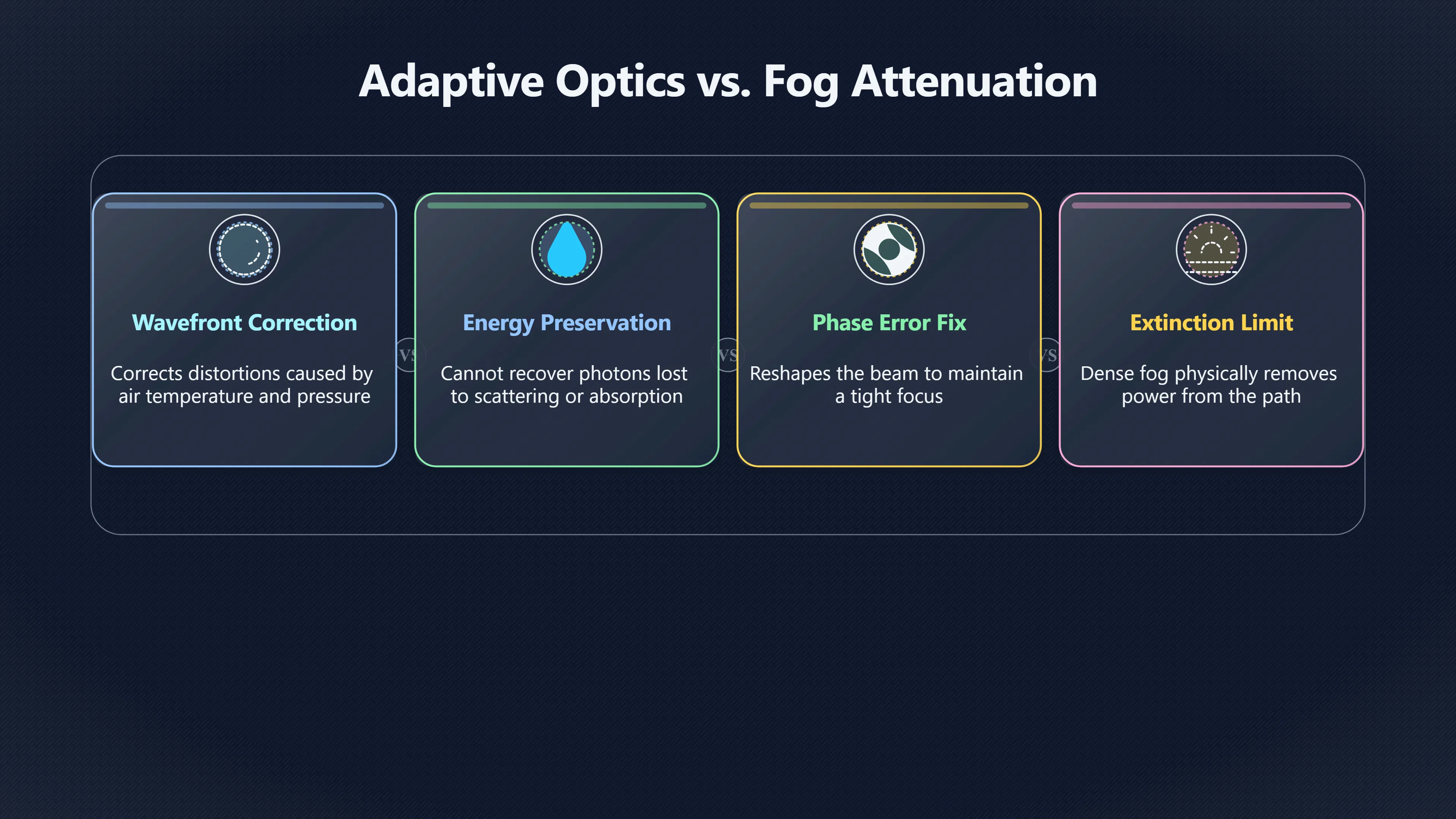
Adaptive optics can help laser systems in poor atmospheric conditions, but they cannot “beat” fog in the way popular discussions sometimes imply. Beam-control technologies are designed to correct distortions that blur or spread a laser beam as it travels through the atmosphere. They are highly effective against turbulence-induced wavefront errors, helping a laser maintain a tighter focus and deliver more energy to a target. However, fog introduces a different problem: it physically removes energy from the beam through scattering and absorption by water droplets. Once that energy has been scattered away or absorbed, adaptive optics cannot restore it. As a result, modern directed-energy programmes treat adaptive optics as an important mitigation tool rather than a solution that makes laser weapons fully all-weather systems.[SPIE+2publications.sto.nato.int]spie.orgNovel scheme for enhancing beam control in adaptive opticsThe AO system pre-compensates the outgoing high-energy laser for the wavefr…
 Within the broader question of why fog shortens laser weapon range, this distinction is critical. Beam control can improve performance in degraded conditions, but fog remains one of the hardest atmospheric limits for high-energy laser propagation.[mobilityengineeringtech.com+2Army]mobilityengineeringtech.comArmy Developing Lasers That Pierce Fog, Dust to DestroyDecember 5, 2017 — 5 Oct 2020 — The key to making HELs work in poor atmospheric conditions is something called "adaptive optics," he said…
What Adaptive Optics Can Correct
Adaptive optics (AO) is a technology that measures distortions in an outgoing laser beam and rapidly adjusts mirrors or other optical elements to compensate for them. The goal is to keep the beam concentrated into the smallest possible spot at the target. Similar techniques are used in astronomy to counteract atmospheric distortion and produce sharper images.[Wikipedia]WikipediaAdaptive opticsAdaptive optics
For high-energy lasers, the main atmospheric problem addressed by AO is turbulence. Variations in temperature, pressure, and air density create refractive-index fluctuations that bend and distort the beam. Without correction, the beam spreads, reducing the energy density delivered to the target. Adaptive optics can measure these distortions and reshape the beam in real time, often significantly improving target irradiance.[Naval Postgraduate School+2Wikipedia]nps.eduNaval Postgraduate SchoolIntegration of adaptive optics into high energy laser modeling…We investigate the corrective effect of adapti…
In practical beam-control systems, adaptive optics is often combined with:[Wikipedia]WikipediaAdaptive opticsAdaptive optics
- Fast steering mirrors for precise pointing.
- Beam stabilisation systems that compensate for platform vibration.
- Coherent beam combining, which merges multiple laser sources into a more effective beam.
- Real-time atmospheric sensing and predictive control algorithms.[Rafael+2inss.ndu.edu]rafael.co.ilOvercoming Turbulence: Adaptive Optics for High-Energy…28 Feb 2026 — Discover how Coherent Beam Combining & Adaptive Optics allo…
These technologies can make the difference between a beam that misses its intended energy density and one that remains operationally useful. They are therefore a major focus of current directed-energy development programmes.[inss.ndu.edu]inss.ndu.eduLaser-focusing Defense CapabilitiesInvestment in real-time adaptive optics, AI-enabled beam focusing, and multi-spectral laser architectu…
What Scattering and Absorption Still Remove
The key limitation is that adaptive optics corrects wavefront distortion, not energy loss.[Wikipedia]WikipediaAdaptive opticsAdaptive optics
Fog consists of enormous numbers of suspended water droplets. As a laser beam passes through them, a substantial fraction of the light is scattered away from the intended path. Some energy is also absorbed by the droplets themselves. These losses reduce the power that remains available to reach the target. Once light has been redirected or absorbed, no deformable mirror can recover it. publications.sto.nato.int+2ece.mcmaster.ca[publications.sto.nato.int]publications.sto.nato.intence of air molecules and aerosols…
This distinction is often described as the difference between correcting phase errors and overcoming extinction. Adaptive optics can improve beam quality by fixing phase distortions in the surviving light. It cannot recreate photons that never reach the target because they were scattered elsewhere.[SPIE+2preprints.opticaopen.org]spie.orgNovel scheme for enhancing beam control in adaptive opticsThe AO system pre-compensates the outgoing high-energy laser for the wavefr…
A useful analogy is driving through heavy fog. Better steering helps keep a vehicle in its lane, but it does not remove the fog itself. Similarly, adaptive optics helps a laser use its remaining energy more efficiently, but it does not eliminate the fundamental transmission penalty imposed by dense fog.[publications.sto.nato.int]publications.sto.nato.intence of air molecules and aerosols…
Research in free-space optical communications reaches a similar conclusion. Adaptive optics can improve performance under atmospheric distortion, yet fog remains the dominant attenuation mechanism because scattering physically removes signal power from the transmission path.[MDPI]mdpi.comOptical Signal Attenuation through Smog in Controlled…by H Khalid · 2024 · Cited by 6 — Atmospheric conditions such as fog, rain…

Why Mitigation Is Not the Same as All-Weather Lethality
Because adaptive optics can improve performance, it is sometimes portrayed as a technology that allows lasers to “pierce” fog. That characterisation is only partly correct.
In light fog or mixed atmospheric conditions, beam-control improvements may extend effective range, reduce required dwell time, and preserve enough energy density for useful engagement. Military developers have repeatedly highlighted adaptive optics as a means of improving performance in dust, haze, humidity, and other degraded environments.[mobilityengineeringtech.com+2Army]mobilityengineeringtech.comArmy Developing Lasers That Pierce Fog, Dust to DestroyDecember 5, 2017 — 5 Oct 2020 — The key to making HELs work in poor atmospheric conditions is something called "adaptive optics," he said…
However, improvement does not mean immunity. As fog density increases, attenuation grows rapidly. Eventually the energy lost to scattering and absorption becomes so large that even a perfectly corrected beam cannot deliver sufficient power to the target. At that point, adaptive optics offers diminishing returns because the dominant problem is no longer beam distortion but insufficient transmitted energy.[publications.sto.nato.int+2ResearchGate]publications.sto.nato.intence of air molecules and aerosols…
Recent research on adaptive-optics performance also emphasises that there are fundamental limits to how much correction can be achieved even in turbulence alone. Real systems face sensor limitations, correction-speed constraints, and incomplete knowledge of atmospheric conditions. Fog adds another layer of difficulty on top of those existing limits.[preprints.opticaopen.org+2PubMed]preprints.opticaopen.orgAdaptive optics limitations for laser beam propagation along slant pathsAdaptive-optics limitations for laser beam propagation…by M Kalensky · 2025 · Cited by 9 — In this paper, we use wave-optics simulatio…
The Technologies Being Explored Beyond Adaptive Optics
The fact that adaptive optics cannot fully solve fog explains why researchers continue investigating additional approaches.
Some efforts focus on selecting wavelengths that experience somewhat lower atmospheric attenuation under specific conditions. Others examine more advanced beam-combining architectures or predictive atmospheric compensation. Experimental work in optical communications has even explored actively clearing transmission paths using ultrashort laser filaments that displace or shatter droplets, creating temporary channels with improved transmission. These concepts demonstrate that engineers recognise the limits of conventional beam correction in dense fog environments.[arXiv+4Rafael+4inss.ndu.edu]rafael.co.ilOvercoming Turbulence: Adaptive Optics for High-Energy…28 Feb 2026 — Discover how Coherent Beam Combining & Adaptive Optics allo…
The existence of such research is itself revealing. If adaptive optics alone could overcome fog, there would be little need to investigate techniques aimed at physically reducing the number of droplets in the beam path.[arXiv]arxiv.orgarXiv Atmospheric aerosol clearing by femtosecond filamentsarXiv Atmospheric aerosol clearing by femtosecond filaments

The Practical Bottom Line
Adaptive optics is one of the most important enabling technologies for modern high-energy laser systems because it can correct atmospheric distortion, maintain beam quality, and increase the amount of energy delivered to a target. In marginal weather, these improvements can be operationally significant.[SPIE+2Naval Postgraduate School]spie.orgNovel scheme for enhancing beam control in adaptive opticsThe AO system pre-compensates the outgoing high-energy laser for the wavefr…
Yet fog presents a challenge that beam correction alone cannot defeat. Adaptive optics can sharpen the portion of the beam that survives the trip through the atmosphere, but it cannot recover energy lost through scattering and absorption by water droplets. Consequently, beam control improves laser performance in foggy conditions without eliminating fog as a fundamental range and lethality constraint. For directed-energy weapons, that makes adaptive optics a powerful mitigation technology rather than a path to true all-weather effectiveness. publications.sto.nato.int+2preprints.opticaopen.org[publications.sto.nato.int]publications.sto.nato.intence of air molecules and aerosols…
Amazon book picks
Further Reading
Books and field guides related to Can Technology Beat Foggy Laser Weather?. Use these as the next step if you want deeper reading beyond the article.

Introduction to adaptive optics
Directly explains what adaptive optics can and cannot correct.

Directed Energy Weapons
Shows how beam-control technologies fit into laser weapon systems.

Laser beam propagation through random media
Provides context for turbulence effects that adaptive optics targets.
eBay marketplace picks
Marketplace Samples
Example marketplace items related to this page. Use the search link to explore similar finds on eBay.


Endnotes
1.
Source: spie.org
Link:https://spie.org/news/0443-novel-scheme-for-enhancing-beam-control-in-adaptive-optics
Source snippet
Novel scheme for enhancing beam control in adaptive opticsThe AO system pre-compensates the outgoing high-energy laser for the wavefr...
2.
Source: publications.sto.nato.int
Link:https://publications.sto.nato.int/publications/STO%20Educational%20Notes/STO-EN-SCI-340/EN-SCI-340-06.pdf
Source snippet
ence of air molecules and aerosols...
3.
Source: inss.ndu.edu
Link:https://inss.ndu.edu/Research-and-Commentary/View-Publications/Article/4412653/laser-focusing-defense-capabilities/
Source snippet
Laser-focusing Defense CapabilitiesInvestment in real-time adaptive optics, AI-enabled beam focusing, and multi-spectral laser architectu...
4.
Source: mobilityengineeringtech.com
Title: Army Developing Lasers That Pierce Fog, Dust to Destroy
Link:https://www.mobilityengineeringtech.com/component/content/article/28063-army-developing-lasers-that-pierce-fog-dust-to-destroy-targets
Source snippet
December 5, 2017 — 5 Oct 2020 — The key to making HELs work in poor atmospheric conditions is something called "adaptive optics," he said...
Published: December 5, 2017
5.
Source: army.mil
Title: developing lasers that pierce fog dust to destroy targets
Link:https://www.army.mil/article/195650/army_developing_lasers_that_pierce_fog_dust_to_destroy_targets
Source snippet
Army developing lasers that pierce fog, dust to destroy targets23 Oct 2017 — A lot of people think that high-energy lasers, or HELs, can'...
6.
Source: Wikipedia
Title: Adaptive optics
Link:https://en.wikipedia.org/wiki/Adaptive_optics
7.
Source: Wikipedia
Title: Starfire Optical Range
Link:https://en.wikipedia.org/wiki/Starfire_Optical_Range
8.
Source: ece.mcmaster.ca
Link:https://www.ece.mcmaster.ca/~hranilovic/woc/resources/local/spie2000b.pdf
Source snippet
Mie scattering calculations reveal that 1550 nm, 850 nm and 785 nm are all in fact equally attenuated in...Read more...
9.
Source: preprints.opticaopen.org
Title: Adaptive optics limitations for laser beam propagation along slant paths
Link:https://preprints.opticaopen.org/articles/preprint/Adaptive-optics_limitations_for_laser_beam_propagation_along_slant_paths/28340402
Source snippet
Adaptive-optics limitations for laser beam propagation...by M Kalensky · 2025 · Cited by 9 — In this paper, we use wave-optics simulatio...
10.
Source: mdpi.com
Link:https://www.mdpi.com/2304-6732/11/2/172
Source snippet
Optical Signal Attenuation through Smog in Controlled...by H Khalid · 2024 · Cited by 6 — Atmospheric conditions such as fog, rain...
11.
Source: researchgate.net
Link:https://www.researchgate.net/publication/403676537Laser-Based_Directed_Energy_Weapons_Technological_Capabilities_Material_Interaction_and_Strategic[Deployment
Source snippet
(PDF) Laser-Based Directed Energy WeaponsReported attenuation in dense fog and battlefield smoke can exceed 30 dB/km, significantly limit...
12.
Source: arxiv.org
Title: arXiv Atmospheric aerosol clearing by femtosecond filaments
Link:https://arxiv.org/abs/2203.00196
13.
Source: arxiv.org
Title: arXiv Free space laser telecommunication through fog
Link:https://arxiv.org/abs/1810.09800
14.
Source: arxiv.org
Title: arXiv Molecular Quantum Wakes for Clearing Fog
Link:https://arxiv.org/abs/2004.04056
15.
Source: researchgate.net
Link:https://www.researchgate.net/profile/Roshdy-Abdelrassoul/publication/333533150_Adaptive_Free_Space_Optic_System_Based_on_Visibility_Detector_to_Overcome_Atmospheric_Attenuation/links/5cf9075d4585153c3db75086/Adaptive-Free-Space-Optic-System-Based-on-Visibility-Detector-to-Overcome-Atmospheric-Attenuation.pdf
Source snippet
In this paper, a new idea to overcome the atmospheric attenuation is dis- cussed using adaptive...Read more...
16.
Source: nps.edu
Link:https://nps.edu/web/nps-video-portal/-/omb7yyfs9lm0lj1pqibd7w-gy8nuxk-j
Source snippet
Naval Postgraduate SchoolIntegration of adaptive optics into high energy laser modeling...We investigate the corrective effect of adapti...
17.
Source: rafael.co.il
Link:https://www.rafael.co.il/blog/bending-light-back-into-shape-adaptive-optics-for-high-energy-lasers/
Source snippet
Overcoming Turbulence: Adaptive Optics for High-Energy...28 Feb 2026 — Discover how Coherent Beam Combining & Adaptive Optics allo...
18.
Source: pubmed.ncbi.nlm.nih.gov
Link:https://pubmed.ncbi.nlm.nih.gov/40792775/
Source snippet
nih.govAdaptive-optics limitations for laser beam propagation...by M Kalensky · 2025 · Cited by 9 — In this paper, we use wave-optics si...
Additional References
19.
Source: navysbir.us
Link:https://navysbir.us/n13_1/N131-076.htm
Source snippet
Advanced Adaptive Optics (AO) for Laser Weapons in...OBJECTIVE: Develop a beaconless adaptive optic system capable of correcting moderat...
20.
Source: elib.dlr.de
Link:https://elib.dlr.de/223338/1/132637_DO_SUL_DA_MOTA_TORRES_2025_archivage.pdf
Source snippet
Belling- ham, WA: SPIE Press. Andrews, Larry C, Ronald L Phillips, and Cynthia Y Young (2000)...Read more...
21.
Source: eureka.patsnap.com
Title: adaptive optics in laser beam control benefits and applications
Link:https://eureka.patsnap.com/article/adaptive-optics-in-laser-beam-control-benefits-and-applications
Source snippet
optics in laser beam control: Benefits and...26 Jun 2025 — In astronomical telescopes using laser guide stars, adaptive optics compensat...
22.
Source: reddit.com
Link:https://www.reddit.com/r/40kLore/comments/5kj43w/why_are_laser_weapons_not_nullified_by_smoke/
Source snippet
counter acted by using a combination of varying wavelength, power, and Snell's...Read more...
23.
Source: e-space.mmu.ac.uk
Title: PTL accepted paper
Link:https://e-space.mmu.ac.uk/642655/1/PTL_accepted_paper.pdf
Source snippet
Wave Strategy to Enhance Free-Space Optics Link...by A Cameron · 2025 — Several techniques have been proposed and investigated to overco...
24.
Source: youtube.com
Title: The Truth About Military Lasers (And the Biggest Myths) | SME 017
Link:https://www.youtube.com/watch?v=Vq47WabmlqQ
Source snippet
Adaptive Optics: Real-time correction of atmospheric turbulence...
25.
Source: youtube.com
Title: Iron Beam In Fog: Can Laser Weapons Work Without Visibility?
Link:https://www.youtube.com/watch?v=7J2NJLBVER8
Source snippet
The Truth About Military Lasers (And the Biggest Myths) | SME 017...
26.
Source: defencesciencereview.com.pl
Title: pdf 216776 135052
Link:https://www.defencesciencereview.com.pl/pdf-216776-135052?filename=Laser-Based-[Directed-Ener
Source snippet
DEFENCE SCIENCE REVIEWby A Karkadakattil · 2026 · Cited by 1 — Objectives: This review aims to evaluate the current capabilities of laser...
27.
Source: advanced.onlinelibrary.wiley.com
Link:https://advanced.onlinelibrary.wiley.com/doi/10.1002/adpr.202400204
Source snippet
Progress on Atmospheric Turbulence Perception...27 Mar 2025 — This work presents a systematic review of atmospheric turbulence fundament...
28.
Source: dspace.mit.edu
Title: 31359954 MIT
Link:https://dspace.mit.edu/bitstream/handle/1721.1/35978/31359954-MIT.pdf
Source snippet
Optics for High Energy Laser Systemsby JE Wall · 1994 · Cited by 2 — The model produces peak intensity and the laser profile on target in...
Topic Tree