Within Directed Energy
Why Directed Energy Will Not Replace Missiles
Directed energy is best understood as one layer in air defence, not a full replacement for missiles and guns.
On this page
- Where energy weapons fit in layered defence
- Targets still suited to conventional interceptors
- Detection, tracking and kill assessment

Page outline Jump by section
Introduction
Directed energy will not replace missiles and guns because air defence is not a single-shot problem. It is a layered contest of detection, identification, command decisions, weather, range, magazine depth and target type. High-energy lasers and high-power microwave systems can add a valuable defensive layer, especially against drones and some short-range threats, because they may offer rapid engagement and a much lower marginal cost per shot. But they depend on power, cooling, line of sight, beam control and enough time on target, while conventional interceptors remain better suited to many fast, hardened, distant or high-consequence threats. That is why the most realistic policy choice is not “laser or missile”, but how to integrate directed energy into existing air and missile defence architectures without overpromising what it can do. GAO notes that directed energy systems are less effective at longer ranges and can be limited by atmospheric conditions and cooling requirements, while RAND describes them as a potential new layer alongside traditional kinetic weapons rather than a wholesale substitute.[GAO]gao.govScience & Tech Spotlight: Directed Energy Weapons | U.S. GAOScience & Tech Spotlight: Directed Energy Weapons | U.S. GAO…
Where energy weapons fit in layered defence
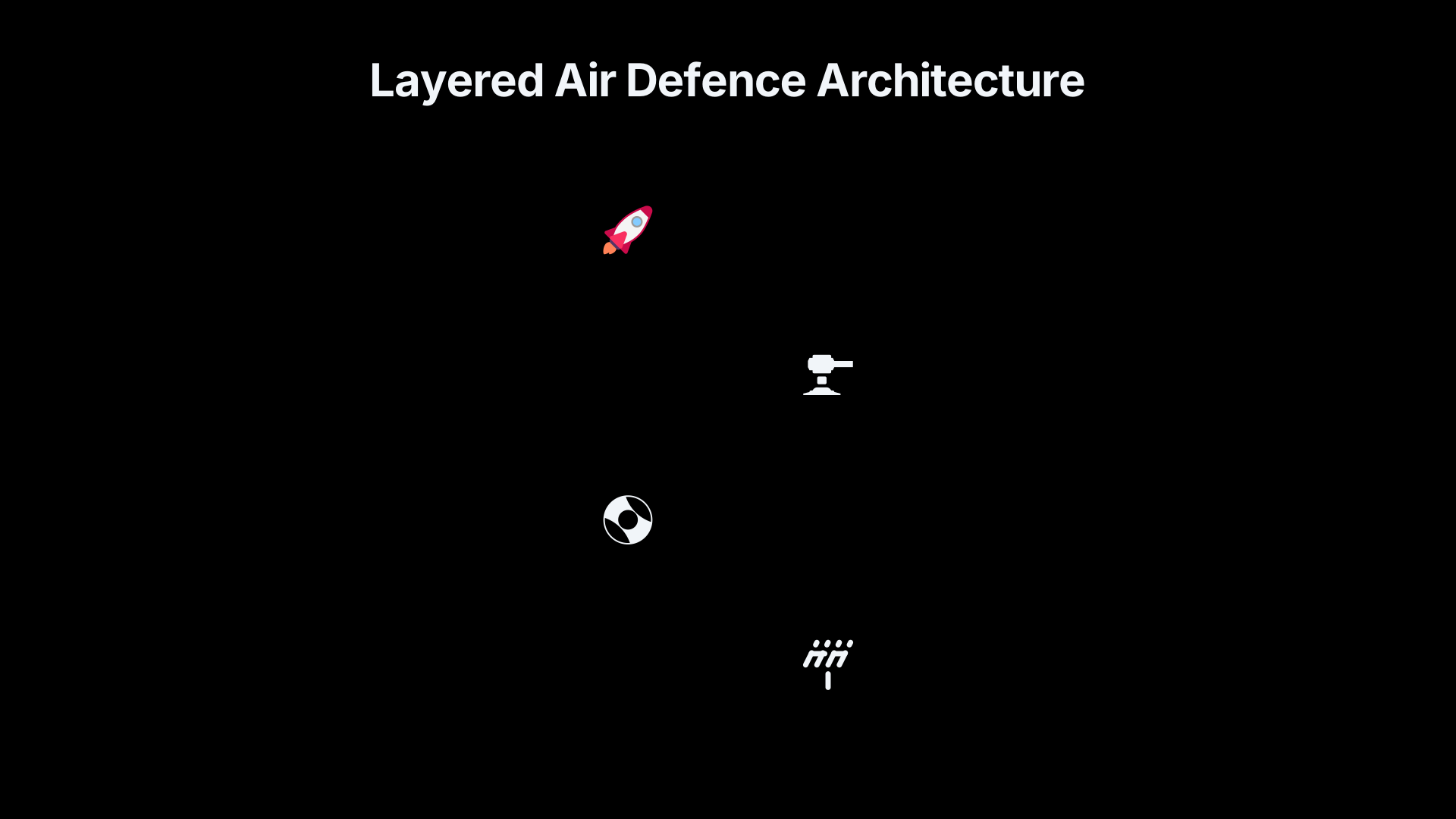
Layered air defence exists because no effector is ideal against every threat. A modern defended ship, base or manoeuvre force may need radars, electro-optical sensors, electronic warfare, guns, short-range missiles, longer-range missiles, decoys and command-and-control systems all working together. Directed energy fits best as an additional close-to-medium defensive layer that can engage selected threats without spending scarce interceptors every time a small unmanned aircraft appears.
The clearest near-term role is counter-drone and point defence. A laser can be attractive when the defender has already detected and identified a small target, has a clear line of sight, and can keep the beam on a vulnerable aim point long enough to damage a motor, sensor, wing, casing or electronics. A high-power microwave system may be more attractive where the problem is not one drone but a group of drones, because it can affect electronics over a wider area. That same breadth, however, creates a governance and operational problem: GAO warns that wider-beam systems can affect assets in an area whether friend or foe, which makes rules of engagement, electromagnetic safety and deconfliction essential rather than administrative afterthoughts.[GAO]gao.govScience & Tech Spotlight: Directed Energy Weapons | U.S. GAOScience & Tech Spotlight: Directed Energy Weapons | U.S. GAO…
The UK’s DragonFire programme illustrates the “new layer” logic well. The Royal Navy has described the system as something to be added to an air defence mix that already includes Sea Viper and Sea Ceptor missiles, not as a replacement for them. Its claimed appeal is cost and magazine depth: the Navy said a burst of the DragonFire beam costs no more than £10 in energy, while the system is intended to engage drones, missiles and aircraft at the speed of light. In 2025, the Royal Navy announced a £316 million deal for its first laser weapon after high-velocity drone trials, with the first naval installations planned for the Type 45 destroyer force.[royalnavy.mod.uk]royalnavy.mod.uk240412 powerful laser to be installed on royal navy warship by 2027Powerful laser to be installed on Royal Navy warship by 2027…
The same logic appears in US Army programmes, although with a more cautionary lesson. GAO’s 2025 review says the Army is developing directed-energy variants of its Indirect Fire Protection Capability for fixed and semi-fixed sites, with high-energy laser and high-power microwave variants intended to protect assets against aerial threats. The Army’s IFPC Increment 2 is meant to provide 360-degree protection against simultaneous threats arriving from different altitudes and directions; directed energy is one way to add capacity inside that broader architecture, not a stand-alone shield.[GAO Files]files.gao.govBenefit from Applying Leading Practices…
For defence planners, the policy value is therefore practical. Directed energy can help preserve expensive interceptors for threats that truly require them, reduce logistical pressure where electricity is easier to supply than missile reloads, and give commanders more graduated options between jamming, warning, dazzling and hard kill. RAND makes this point directly: directed energy could free traditional kinetic weapons for other purposes and ease pressure on stretched munitions production lines, especially in contexts like Ukraine and Red Sea defence.[RAND Corporation]rand.orgCorporation Directed Energy: The Focus on Laser Weapons Intensifies | RANDRAND CorporationDirected Energy: The Focus on Laser Weapons Intensifies | RAND…
Why missiles and guns still matter
The strongest argument against “laser replacement” thinking is that directed energy transfers energy differently from a missile or shell. A missile carries its destructive mechanism to the target; a laser has to transmit energy through the atmosphere and keep enough power on a small aim point for long enough. GAO explains that laser lethality depends on delivered energy and time on target, which in turn depend on power output, beam quality, range, physical or atmospheric obstruction, and the ability to track a specific aim point while controlling jitter.[GAO]gao.govgao 23 105868GAO-23-105868, DIRECTED ENERGY WEAPONS: DOD Should Focus on Transition Planning…
That makes some target sets better suited to conventional interceptors. Fast manoeuvring missiles, ballistic threats, hardened targets, targets masked by weather or terrain, and threats that must be destroyed at greater range may still demand missiles. Guns also retain value for close-in defence where the engagement window is short, visual conditions are poor, or a kinetic effect is simpler and more certain. Directed energy may lower cost per engagement when conditions are favourable, but it does not remove the need for weapons that physically intercept, fragment, blast or penetrate.
The issue is not simply technical performance; it is risk management. A commander may accept a laser engagement against a low-cost reconnaissance drone where a failed shot gives time for another layer to engage. The same commander may choose a missile against an incoming anti-ship missile, aircraft or ballistic target because the consequence of failure is too high. In layered defence, the cheapest shot is not automatically the right shot. The right shot is the one that matches the target, available time, rules of engagement, environmental conditions and defended asset.
The US Army’s DE M-SHORAD experience shows why this caution matters. DOT&E reported that three DE M-SHORAD prototypes took part in a 2025 training and live-fire exercise intended to develop tactics, techniques and procedures for directed energy and kinetic effector systems. But the Army demilitarised several prototypes and was no longer pursuing DE M-SHORAD as a programme of record, using lessons instead to inform an Enduring High Energy Laser procurement decision. That does not mean battlefield lasers are doomed; it means fielding a useful defensive layer is different from demonstrating a promising technology.[Dote]dote.osd.mil2025de m shoradDOT&E FY2025 Annual Report - Army - Directed Energy Maneuver-Short Range Air Defense (DE M-SHORAD)…
There is also a platform problem. Lasers and microwave systems need electrical generation, thermal management, beam directors, sensors, software and maintenance capacity. A large ship, fixed base or semi-fixed site may have more space, power and cooling margin than a small vehicle. That is why near-term deployments are likely to cluster around ships, bases and defended installations before they become routine on every tactical vehicle.
Detection, tracking and kill assessment are the real bottlenecks
Directed energy debates often focus on the beam, but the defensive layer works only if the system can find the target, classify it, point accurately, assess effect and hand off to another layer if needed. In practice, the “weapon” is not only the laser or microwave source. It is the sensor-to-shooter chain around it.
Detection is difficult because many of the most attractive directed-energy targets are small, low-flying and cheap. Small drones can have low radar signatures, fly among clutter, approach from multiple directions and appear in civilian airspace or around friendly electronics. A laser engagement also requires more than a rough track. It may need a precise aim point on a moving object, stabilised beam control and a dwell time long enough to create damage. GAO’s discussion of laser lethality highlights this dependence on tracking and jitter control: the weapon must follow the target and keep the beam focused on the selected area.[GAO]gao.govgao 23 105868GAO-23-105868, DIRECTED ENERGY WEAPONS: DOD Should Focus on Transition Planning…
Kill assessment is equally important and often harder than it sounds. A missile interception may produce an obvious explosion or debris field. A laser may silently damage a control surface, sensor window, battery pack or motor, while the target continues flying for several seconds. A microwave effect may disrupt electronics without a visible flash. Command systems therefore need to decide whether the target has been defeated, whether it is still a threat, whether another directed-energy shot is required, or whether the engagement should be handed to a gun or missile.
This creates a governance challenge for acquisition as well as operations. Programmes should not be judged only by spectacular trials against cooperative targets. They need tests that measure detection quality, target identification, tracking stability, engagement timelines, weather resilience, false positives, kill assessment and integration with existing command-and-control networks. GAO’s 2023 report stressed that full system testing is important to understand component limitations outside the laboratory, particularly because environmental conditions can change laser effects.[GAO]gao.govgao 23 105868GAO-23-105868, DIRECTED ENERGY WEAPONS: DOD Should Focus on Transition Planning…
NATO’s broader integrated air and missile defence concept points in the same direction. It treats integration as essential because available capabilities must be coordinated, interoperable and trained together. NATO also emphasises sensors, command-and-control systems, exercises and readiness, not just interceptors. Directed energy only becomes a meaningful defensive layer when it can plug into that kind of architecture rather than operating as an isolated demonstration system.[NATO]nato.intIntegrated Air and Missile Defence | NATO TopicNATO Integrated Air and Missile Defence | NATO Topic…

The governance choice is integration, not hype
The main policy mistake would be to treat directed energy as a miracle substitute for expensive missiles. The second mistake would be to dismiss it because it cannot defeat everything. The practical middle ground is to define the layer clearly: what targets it should engage, under what environmental conditions, with what safety constraints, and when the system must hand over to a kinetic weapon.
That requires several governance choices:
- Target allocation rules. Commanders need doctrine for when a laser, microwave system, gun, missile or electronic warfare tool is the preferred effector. Cost per shot should matter, but so should target value, defended asset value, escalation risk and confidence of kill.
- Testing against realistic clutter. Trials should include poor weather, sea spray, dust, manoeuvring targets, mixed friendly and hostile drone traffic, and realistic sensor confusion where safe and lawful to do so.
- Kill assessment standards. Defence organisations need agreed thresholds for when a directed-energy engagement counts as a successful defeat, a mission kill, a temporary disruption or a failed engagement.
- Safety and deconfliction. Lasers raise eye-safety and aviation-safety issues; microwave systems raise electromagnetic compatibility issues around friendly systems and civilian infrastructure.
- Budget balance. Directed energy may reduce marginal engagement costs, but the systems themselves require research, integration, maintenance, operators, training and supply chains. RAND notes that directed energy’s implications extend beyond battlefield effect into budgets and defence industry planning.[RAND Corporation]rand.orgOpen source on rand.org.
The best near-term use is therefore selective. Directed energy should be used to thicken the defensive stack against drones, some rockets, artillery and mortar threats, and certain close-in air threats where the geometry and environment suit the system. Missiles and guns should remain in the stack for fast, distant, hardened, complex or high-consequence targets. Electronic warfare and decoys should remain important where disruption or deception is safer and cheaper than destruction.
What a credible defensive layer looks like
A credible directed-energy layer has a defined job. It is not sold as an all-weather dome, and it is not evaluated only by the energy cost of a single shot. It is judged by whether it improves the whole defensive system: more defended shots before magazines run low, fewer expensive missiles spent on cheap drones, better options for commanders, and fewer gaps between detection and defeat.
For a naval force, that may mean using a laser as an inner layer against drones or small boats while preserving missiles for anti-ship missiles, aircraft and more demanding threats. For an air base, it may mean combining radar, electro-optical tracking, electronic warfare, high-power microwave systems, guns and interceptors so that drone raids do not exhaust missile stocks. For manoeuvre forces, it may mean waiting until power, cooling and ruggedisation problems are solved well enough for vehicles, rather than forcing immature prototypes into service.
The most important test is not whether a directed-energy weapon can hit a target on a range. It is whether it can sit inside a live defensive architecture and make the commander’s choices better. When it does, it becomes a useful layer. When it is treated as a replacement for the rest of air defence, it becomes a procurement risk.

Amazon book picks
Further Reading
Books and field guides related to Why Directed Energy Will Not Replace Missiles. Use these as the next step if you want deeper reading beyond the article.
The Kill Chain
Explains how networks, sensors, autonomy and precision weapons reshape defence architectures, matching the page’s focus on layered defenc...
Army of None
Covers drones, autonomy, targeting and battlefield decision-making, all closely adjacent to directed-energy roles against unmanned and fa...
The Pentagon's Brain
Traces DARPA and advanced military technology development, giving context for why emerging weapons often supplement rather than replace e...

The future of war
Places new military technologies inside broader strategic, political and operational limits, aligning with the article’s caution against...
eBay marketplace picks
Marketplace Samples
Example marketplace items related to this page. Use the search link to explore similar finds on eBay.




Endnotes
1.
Source: gao.gov
Title: Science & Tech Spotlight: Directed Energy Weapons | U.S. GAO
Link:https://www.gao.gov/products/gao-23-106717
Source snippet
Science & Tech Spotlight: Directed Energy Weapons | U.S. GAO...
2.
Source: rand.org
Title: Corporation Directed Energy: The Focus on Laser Weapons Intensifies | RAND
Link:https://www.rand.org/pubs/commentary/2024/01/directed-energy-the-focus-on-laser-weapons-intensifies.html
Source snippet
RAND CorporationDirected Energy: The Focus on Laser Weapons Intensifies | RAND...
3.
Source: royalnavy.mod.uk
Title: 240412 powerful laser to be installed on royal navy warship by 2027
Link:https://www.royalnavy.mod.uk/news/2024/april/12/240412-powerful-laser-to-be-installed-on-royal-navy-warship-by-2027
Source snippet
Powerful laser to be installed on Royal Navy warship by 2027...
4.
Source: royalnavy.mod.uk
Link:https://www.royalnavy.mod.uk/news/2025/november/20/20251120-dragonfire-trials
5.
Source: files.gao.gov
Link:https://files.gao.gov/reports/GAO-25-107491/index.html
Source snippet
Benefit from Applying Leading Practices...
6.
Source: gao.gov
Title: gao 23 105868
Link:https://www.gao.gov/assets/gao-23-105868.pdf
Source snippet
GAO-23-105868, DIRECTED ENERGY WEAPONS: DOD Should Focus on Transition Planning...
7.
Source: nato.int
Title: Integrated Air and Missile Defence | NATO Topic
Link:https://www.nato.int/en/what-we-do/deterrence-and-defence/nato-integrated-air-and-missile-defence
Source snippet
NATO Integrated Air and Missile Defence | NATO Topic...
8.
Source: rand.org
Link:https://www.rand.org/pubs/commentary/2024/02/directed-energy-dilemmas-industrial-implications-of.html
9.
Source: rand.org
Link:https://www.rand.org/topics/directed-energy-weapons.html
10.
Source: gao.gov
Title: U.S. GAO
Link:https://www.gao.gov/products/gao-23-105868
11.
Source: gao.gov
Title: gao 25 107491
Link:https://www.gao.gov/assets/gao-25-107491.pdf
12.
Source: onr.navy.mil
Link:https://www.onr.navy.mil/organization/departments/code-35/division-353/directed-energy-weapons-cdew-and-high-energy-lasers
13.
Source: army.mil
Link:https://www.army.mil/article/286309/de_m_shorad_inducted_into_fort_sill_museum_marking_a_new_era_in_air_defense_tactical_innovation
14.
Source: medium.com
Link:https://medium.com/%40rishabh.mittal_89787/the-10-laser-shot-that-is-quietly-redefining-modern-warfare-2ae3ff21b983
15.
Source: dote.osd.mil
Title: 2025de m shorad
Link:https://www.dote.osd.mil/Portals/97/pub/reports/FY2025/army/2025de_m-shorad.pdf?ver=tszrCdkaQD5mswjzElXuMA%3D%3D
Source snippet
DOT&E FY2025 Annual Report - Army - Directed Energy Maneuver-Short Range Air Defense (DE M-SHORAD)...
16.
Source: rtx.com
Link:https://www.rtx.com/raytheon/what-we-do/integrated-air-and-missile-defense/lasers
17.
Source: lockheedmartin.com
Link:https://www.lockheedmartin.com/en-us/capabilities/directed-energy.html
18.
Source: airpower.airforce.gov.au
Title: airforce.gov.au Directed Energy Weapons
Link:https://airpower.airforce.gov.au/sites/default/files/2021-03/BPAF03_Directed-Energy-Weapons.pdf
19.
Source: Wikipedia
Title: Laser weapon
Link:https://en.wikipedia.org/wiki/Laser_weapon
20.
Source: GOV.UK
Title: boost for armed forces as new laser weapon takes down [high speed]({{ ‘650-km-h/’ | relative_url }}) drones
Link:https://www.gov.uk/government/news/boost-for-armed-forces-as-new-laser-weapon-takes-down-high-speed-drones
21.
Source: uk.leonardo.com
Link:https://uk.leonardo.com/en/innovation/dragonfire
Additional References
22.
Source: youtube.com
Title: C-UAS Warfare: U.S. Military’s New Layered Drone Defense Revealed!
Link:https://www.youtube.com/watch?v=MTFsg_EouWc
Source snippet
Eurosatory Day 2: Laser Weapons Go Operational & France Unveils B-Strike Missiles Eurosatory Day 2: Laser Weapons Go Operational & France...
23.
Source: youtube.com
Link:https://www.youtube.com/watch?v=VZePkyj0C44
Source snippet
THOR (Tactical High-power Operational Responder) Destroys [Swarms]({{ 'swarms/' | relative_url }}) of Enemy Drones...
24.
Source: youtube.com
Link:https://www.youtube.com/watch?v=FANfV27gD1E
Source snippet
Energy evolution: How laser defence systems are powering the next phase of air defence...
25.
Source: usa.gov
Link:https://www.usa.gov/about-the-us
26.
Source: researchgate.net
Link:https://www.researchgate.net/publication/403676537_Laser-Based_Directed_Energy_Weapons_Technological_Capabilities_Material_Interaction_and_Strategic_Deployment_Pathways
27.
Source: news.lockheedmartin.com
Link:https://news.lockheedmartin.com/2023-10-10-US-Army-Selects-Lockheed-Martin-to-Deliver-300-kW-class-Solid-State-Laser-Weapon-System
28.
Source: researchgate.net
Link:https://www.researchgate.net/publication/401707891_Cost-Effectiveness_Analysis_of_Counter-Unmanned_Aircraft_Systems_Technologies_A_Comparative_Study_of_Kinetic_Electronic_Warfare_and_Directed_Energy_Countermeasures
29.
Source: facebook.com
Link:https://www.facebook.com/TheDallasExpress/posts/after-the-january-raid-targeting-nicolas-maduro-the-department-of-war-confirmed-/1369642828508759/
30.
Source: militarnyi.com
Link:https://militarnyi.com/en/news/britain-orders-first-dragonfire-laser-air-defense-systems/
31.
Source: cuashub.com
Link:https://cuashub.com/wp-content/uploads/2024/12/MarketReport25_V7.pdf
Topic Tree
Follow this branch
Parent topic
Directed EnergyRelated pages 11
- Atmosphere Why Bad Weather Matters for Laser Weapons
- Dragon Fire What Dragon Fire Reveals About Battlefield Lasers
- Electronics Risk When Counter Drone Energy Hits the Wrong Electronics
- Engineering What the Beam Needs Behind the Scenes
- HELIOS Can Shipboard Lasers Defend at Sea?
- Laser vs Microwave Lasers or Microwaves: Which Threat Fits Which Beam?
- Lasers Why Laser Weapons Are Precise but Demanding
- Leonidas Why Anti Drone Microwaves Attract Investment
- +3 more in sidebar