Within Directed Energy
Why Laser Weapons Are Precise but Demanding
Military lasers promise precise, low-cost shots, but they must hold enough energy on one vulnerable point to matter.
On this page
- How laser weapons damage or dazzle targets
- Why dwell time and aim point tracking matter
- Targets that make laser kills harder
Page outline Jump by section
Introduction
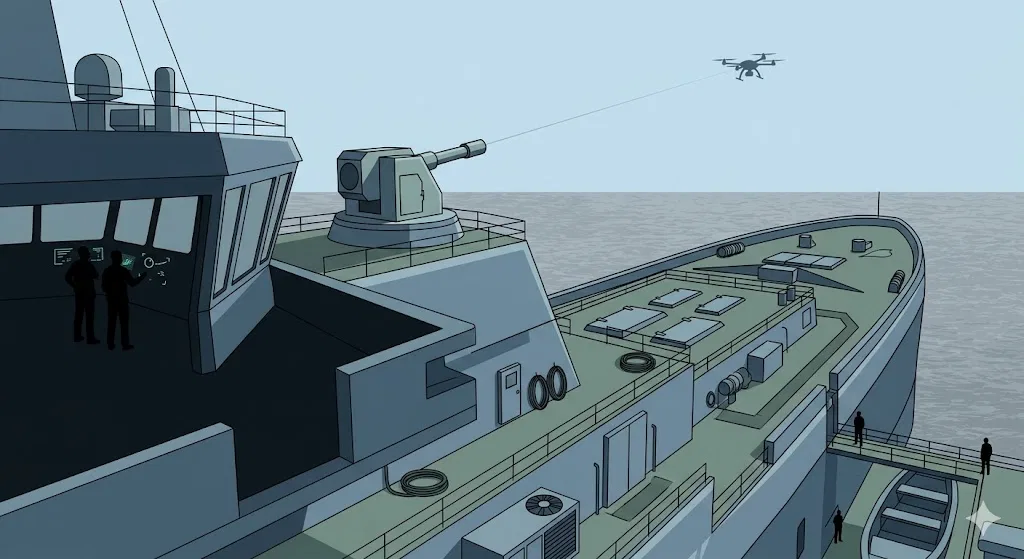
High-energy laser weapons are precise because they concentrate light onto a small spot at the speed of light; they are demanding because the spot has to stay on the right part of the target long enough to cause a useful effect. That is the central precision tradeoff. A laser may dazzle an optical sensor, heat a drone component, damage a casing, or burn through a vulnerable point, but it is not a magic “instant ray”. Its performance depends on power, beam quality, atmospheric conditions, target material, range, and the weapon’s ability to keep a stable aim point on a moving target. Official US and UK sources now treat high-energy lasers as serious counter-drone and short-range air-defence tools, but they also describe limits that make lasers a defensive layer rather than a universal replacement for missiles and guns.[GAO+2Every CRS Report]gao.govScience & Tech Spotlight: Directed Energy Weapons | U.S. GAOScience & Tech Spotlight: Directed Energy Weapons | U.S. GAO…
Why laser weapons are precise but not effortless
A conventional projectile carries stored energy to a target and releases it through impact, blast or fragments. A high-energy laser delivers energy continuously through a beam. This creates a very different tactical bargain: the shot can be extremely accurate and relatively cheap in electrical energy, but the system must keep enough irradiance, meaning power per unit area, on the chosen spot until the target reaches a damage threshold. A declassified US Defense Intelligence Agency primer described the basic purpose of a high-energy laser weapon as placing and maintaining a focused beam on a target aim point for enough time to cause the desired heating effect.[Defense Intelligence Agency]dia.milDefense Intelligence Agency
This is why laser precision is both a strength and a burden. The Congressional Research Service notes that high-energy lasers can irradiate an area from several millimetres to several inches across, generally without directly affecting nearby objects. That small footprint helps explain the appeal for ship, base and convoy defence, where a defender may want to hit a drone sensor or structure without showering an area with fragments. The same CRS appendix also notes that a laser has to remain focused on a particular spot to cause disabling damage within seconds, depending on power.[Every CRS Report]everycrsreport.comEvery CRS Reportwww.everycrsreport.comEvery CRS Reportwww.everycrsreport.com
The UK’s DragonFire programme is a useful public example because official statements emphasise both accuracy and the need for real tracking performance. The Ministry of Defence said DragonFire’s latest trials involved drones flying up to 650 km/h, including a UK first for above-the-horizon tracking, targeting and shoot-down of such drones; it also claimed the system is accurate enough to hit a £1 coin from a kilometre away and costs about £10 per shot in use. Those claims show the promise, but they also point to the demanding part: the achievement is not merely producing a bright beam, but finding, tracking, aiming and holding the beam on a fast aerial target.[GOV.UK]GOV.UKBoost for Armed Forces as new laser weapon takes down high-speed dronesBoost for Armed Forces as new laser weapon takes down high-speed drones
How laser weapons damage or dazzle targets
High-energy lasers can produce different levels of effect. At the lower or reversible end, they may dazzle an optical sensor by overwhelming its ability to see. At the destructive end, they can heat material until it melts, deforms, burns, cracks, or fails. GAO describes this range clearly: a high-energy laser can temporarily overwhelm a person or sensor’s ability to see by producing glare, and with greater force it can damage or destroy assets by using a wavelength that the target material absorbs effectively. GAO gives examples such as focusing on a drone sensor, fuel tank or battery.[GAO]gao.govScience & Tech Spotlight: Directed Energy Weapons | U.S. GAOScience & Tech Spotlight: Directed Energy Weapons | U.S. GAO…
The practical effect is often less cinematic than a visible explosion. A drone may be defeated because a sensor is blinded, a control surface fails, a battery compartment overheats, wiring insulation degrades, or a structural element weakens. A munition may be vulnerable at a seam, fuze, radome, motor casing or optical window. The laser operator’s problem is therefore not just “hit the target”; it is “hit the right part of the target with enough energy for long enough”. That is why target recognition, aim-point selection and beam control matter as much as raw laser power.
Dazzling and damage also sit on a continuum of escalation. CRS notes that high-energy lasers may offer “graduated responses”, from detecting and monitoring targets to reversible interference with electro-optical sensors, limited damage, and finally disabling damage. This makes lasers attractive for some situations where commanders want more options than either doing nothing or firing a missile, although the exact legal and operational use of dazzling depends on target type, rules of engagement and treaty constraints.[Every CRS Report]everycrsreport.comEvery CRS Reportwww.everycrsreport.comEvery CRS Reportwww.everycrsreport.com

Why dwell time changes everything
Dwell time is the period during which the beam must remain on the aim point to build up enough heat or optical effect. It is the hidden cost of precision. A projectile may miss because of wind, gravity or target manoeuvre; a laser avoids many of those ballistic problems because light reaches the target almost instantly. But after arrival, the laser has to keep working on the same place while the target and platform move, air distorts the beam, and the target may be trying to turn, tumble, mask or leave the engagement window.
The dwell-time requirement explains why small drones are such an important early target set. Many small unmanned aircraft are slow enough, fragile enough and exposed enough for a laser to concentrate energy on a vulnerable part. That does not make the engagement easy, especially in wind, clutter, sea spray or urban backgrounds, but the physics is more favourable than against a large, hardened, fast or distant target. CRS lists counter-unmanned aircraft systems, short-range air defence, and counter-rocket, artillery and mortar missions among potential high-energy laser roles for ground forces.[Every CRS Report]everycrsreport.comEvery CRS Reportwww.everycrsreport.comEvery CRS Reportwww.everycrsreport.com
The same requirement makes saturation attacks difficult. CRS states that a high-energy laser can attack only one target at a time, may require several seconds to disable a target, and needs time to redirect to another; this limits a single laser’s ability to handle many incoming threats arriving at once. Extra lasers, better power and faster beam directors can reduce the problem, but they do not remove the basic fact that a narrow beam is highly selective by design.[Every CRS Report]everycrsreport.comEvery CRS Reportwww.everycrsreport.comEvery CRS Reportwww.everycrsreport.com
Aim-point tracking is the real weapon system
A laser weapon is not just a laser. It is a chain of sensors, fire-control software, beam-shaping optics, steering mirrors, a stabilised turret or beam director, power supply, cooling system and safety controls. The DIA primer’s system description is revealing: after the beam is generated, it must be shaped, relayed through the optical train, centred with sensors and mirrors, expanded and focused by a pointing telescope, while an imaging system acquires and tracks the target and points the transmitting telescope at the desired aim point.[Defense Intelligence Agency]dia.milDefense Intelligence Agency
This makes tracking quality a direct contributor to lethality. A beam that jitters across the target may heat a wider area weakly rather than a small area decisively. A beam held on the wrong part may produce smoke, surface scorching or sensor glare but not the desired defeat. A beam that loses lock during a sharp manoeuvre may have to reacquire the target and start building heat again. In practical terms, the “weapon” includes the ability to decide which aim point matters and keep it under the beam under vibration, platform motion and target movement.
Current programmes reflect that. MBDA says DragonFire trials demonstrated the ability to track and engage air and sea targets with exceptional precision, and official UK reporting on recent trials highlights not just the firing, but tracking and targeting against high-speed drones. In the US, CRS describes the Navy’s High Energy Laser Counter-ASCM Project as addressing atmospheric turbulence, automatic target identification, aim-point selection, precision tracking with low jitter in clutter, advanced beam control and higher laser power.[MBDA Systems+2GOV.UK]mbda-systems.comMBDA Systems DRAGONFIRE | MBDAMBDA Systems DRAGONFIRE | MBDA
The atmosphere is part of the target path
Laser weapons are line-of-sight systems. If the target is behind terrain, the horizon, buildings, smoke or cloud, the beam cannot curve round to reach it. CRS notes that high-energy laser weapons are limited to line-of-sight engagements and cannot counter over-the-horizon targets or targets obscured by intervening objects. That is a major reason lasers are most often discussed as short-range defensive systems rather than stand-alone replacements for longer-range air and missile defence.[Every CRS Report]everycrsreport.comEvery CRS Reportwww.everycrsreport.comEvery CRS Reportwww.everycrsreport.com
Even when the target is visible, the atmosphere can reduce the energy delivered. Water vapour, sand, dust, salt particles, smoke and other pollution can absorb or scatter light, while turbulence can defocus the beam. Marine environments are especially challenging because of water vapour and salt-laden air, although laser wavelengths can be chosen to exploit atmospheric “sweet spots” where absorption is lower. Adaptive optics can compensate for some turbulence by making rapid fine adjustments to the beam, but CRS still cautions that lasers may not work well, or at all, in rain or fog.[Every CRS Report]everycrsreport.comEvery CRS Reportwww.everycrsreport.comEvery CRS Reportwww.everycrsreport.com
There is also a self-induced effect called thermal blooming. A powerful laser heats the air along its path, changing the air’s refractive properties and defocusing the beam. CRS notes that this can be especially relevant for targets coming straight towards the laser on a constant bearing, because the beam keeps passing through the same heated channel. That makes engagement geometry matter: a crossing drone, a diving munition and a head-on missile do not present the same propagation problem.[Every CRS Report]everycrsreport.comEvery CRS Reportwww.everycrsreport.comEvery CRS Reportwww.everycrsreport.com
Targets that make laser defeats harder
The easiest public discussion of laser weapons often treats all drones or missiles as similar. They are not. A laser’s effectiveness depends on what the target is made of, how it moves, what vulnerable parts are exposed, and how long it remains in view. CRS specifically identifies shielding, ablative material, highly reflective surfaces, tumbling or rapid rotation, smoke and other obscurants as countermeasures or hardening features that can reduce laser effectiveness, although these measures may add cost or weight to the target.[Every CRS Report]everycrsreport.comEvery CRS Reportwww.everycrsreport.comEvery CRS Reportwww.everycrsreport.com
Several target features are especially important:
Fast crossing motion. A target moving quickly across the field of view forces the beam director and tracker to hold a precise aim point despite angular motion. This is one reason official DragonFire statements stress tracking and engaging high-speed drones, not only firing at static objects.[GOV.UK]GOV.UKBoost for Armed Forces as new laser weapon takes down high-speed dronesBoost for Armed Forces as new laser weapon takes down high-speed drones
Rotation or tumbling. If a target spins, the beam may not dwell on one physical spot for long. That spreads heat over more surface area and can increase the time needed for a damaging effect. CRS explicitly notes that rapidly tumbling or rotating targets can make less powerful kilowatt-class lasers less effective because the spot does not remain continuously on one location.[Every CRS Report]everycrsreport.comEvery CRS Reportwww.everycrsreport.comEvery CRS Reportwww.everycrsreport.com
Reflective or ablative surfaces. Reflective coatings can reduce absorption, while ablative materials can carry heat away as they char or vapourise. These do not make a target invulnerable, but they can increase the energy and dwell time required. The tradeoff shifts back to the target designer: hardening usually costs weight, volume, money or performance.[Every CRS Report]everycrsreport.comEvery CRS Reportwww.everycrsreport.comEvery CRS Reportwww.everycrsreport.com
Poor aim-point access. Some vulnerable components are not always exposed. A drone’s battery, flight controller or sensor may be shielded by the airframe; a missile’s seeker may only face the defender in certain geometries; a mortar round may offer little time and little surface area. The laser’s precision is valuable only if the system can see and hold a meaningful aim point.
Multiple simultaneous targets. A narrow laser beam is excellent for discrimination, but that selectivity can become a bottleneck. In a swarm or salvo, each engagement consumes tracking time, dwell time and retargeting time. This is why laser weapons are usually discussed as one part of layered defence, alongside guns, missiles, electronic warfare and, in some roles, high-power microwave systems. RAND makes this layered point in strategic terms, describing directed energy as a potential new layer that could free traditional weapons for other purposes rather than replace them outright.[RAND Corporation]rand.orgCorporation Directed Energy: The Focus on Laser Weapons Intensifies | RANDRAND CorporationDirected Energy: The Focus on Laser Weapons Intensifies | RAND…
Why low cost per shot does not mean low difficulty
The attraction of laser weapons is easy to understand. If a defender can use electrical energy instead of an interceptor missile, the marginal cost of an engagement can be much lower and the “magazine” can be deeper as long as power and cooling are available. CRS says high-energy lasers may offer lower logistics requirements, lower costs per shot and, with sufficient power supply, deeper magazines; it also notes that for solid-state lasers the cost per shot is essentially the cost of electrical power required to fire.[Every CRS Report]everycrsreport.comEvery CRS Reportwww.everycrsreport.comEvery CRS Reportwww.everycrsreport.com
DragonFire illustrates both sides of the claim. The UK Ministry of Defence says the system costs about £10 per shot and compares that with traditional missile systems costing hundreds of thousands of pounds per shot. Yet the same announcement describes a £316 million contract to deliver systems to the Royal Navy from 2027. The cheap “shot” is therefore not the same as a cheap capability: the full system requires development, integration, sensors, combat-system links, safety certification, trained operators, maintenance, ship power, cooling and spares.[GOV.UK]GOV.UKBoost for Armed Forces as new laser weapon takes down high-speed dronesBoost for Armed Forces as new laser weapon takes down high-speed drones
This distinction matters because it prevents two common mistakes. The first is dismissing lasers because they are not all-weather, all-target superweapons. The second is overselling them because the energy cost of one firing looks tiny beside the price of a missile. The useful question is narrower: in which engagement windows can a laser reliably deliver a good effect at lower marginal cost while preserving missile stocks for harder targets?
The precision tradeoff in one sentence
High-energy lasers are precise because they can put electromagnetic energy onto a very small aim point almost instantly; they are demanding because the beam must remain stable, focused and powerful enough through the atmosphere and onto the target for long enough to matter. That makes them especially promising against exposed drones, sensors and selected short-range threats, but less reliable against obscured, hardened, rapidly rotating, distant, saturated or poor-weather targets. Their future role is therefore not to make air defence simple, but to add a discriminating, low-marginal-cost layer where the geometry, weather and target vulnerability are favourable.
Amazon book picks
Further Reading
Books and field guides related to Why Laser Weapons Are Precise but Demanding. Use these as the next step if you want deeper reading beyond the article.
The Kill Chain
Provides operational context for precision engagement and modern defense systems.

Laser Fundamentals
Explains beam quality, focusing, and precision effects central to laser weapons.

Directed Energy Weapons
Discusses laser beam control, propagation, and weapon performance.

eBay marketplace picks
Marketplace Samples
Example marketplace items related to this page. Use the search link to explore similar finds on eBay.

Endnotes
1.
Source: gao.gov
Title: Science & Tech Spotlight: Directed Energy Weapons | U.S. GAO
Link:https://www.gao.gov/products/gao-23-106717
Source snippet
Science & Tech Spotlight: Directed Energy Weapons | U.S. GAO...
2.
Source: GOV.UK
Title: Boost for Armed Forces as new laser weapon takes down high-speed drones
Link:https://www.gov.uk/government/news/boost-for-armed-forces-as-new-laser-weapon-takes-down-high-speed-drones
3.
Source: dia.mil
Title: Defense Intelligence Agency
Link:https://www.dia.mil/FOIA/FOIA-Electronic-Reading-Room/FileId/237622/
4.
Source: mbda-systems.com
Title: MBDA Systems DRAGONFIRE | MBDA
Link:https://www.mbda-systems.com/products/force-protection/dragonfire
5.
Source: rand.org
Title: Corporation Directed Energy: The Focus on Laser Weapons Intensifies | RAND
Link:https://www.rand.org/pubs/commentary/2024/01/directed-energy-the-focus-on-laser-weapons-intensifies.html
Source snippet
RAND CorporationDirected Energy: The Focus on Laser Weapons Intensifies | RAND...
6.
Source: gao.gov
Title: gao 23 105868
Link:https://www.gao.gov/products/gao-23-105868
7.
Source: gao.gov
Link:https://www.gao.gov/assets/gao-23-106717.pdf
8.
Source: gao.gov
Title: gao 23 105868
Link:https://www.gao.gov/assets/gao-23-105868.pdf
9.
Source: dia.mil
Title: File Id
Link:https://www.dia.mil/FOIA/FOIA-Electronic-Reading-Room/FileId/170045/
10.
Source: onr.navy.mil
Link:https://www.onr.navy.mil/organization/departments/code-35/division-353/directed-energy-weapons-cdew-and-high-energy-lasers
11.
Source: history.navy.mil
Link:https://www.history.navy.mil/research/library/online-reading-room/title-list-alphabetically/n/navy-shipboard-lasers.html
12.
Source: dst.defence.gov.au
Title: defence.gov.au INSIGHT S PAPER
Link:https://www.dst.defence.gov.au/sites/default/files/events/documents/Insights%20Paper%20-%20Direct%20Energy%20F1.pdf
13.
Source: airpower.airforce.gov.au
Title: airforce.gov.au Directed Energy Weapons
Link:https://airpower.airforce.gov.au/sites/default/files/2021-03/BPAF03_Directed-Energy-Weapons.pdf
14.
Source: everycrsreport.com
Title: Every CRS Reportwww.everycrsreport.com
Link:https://www.everycrsreport.com/files/2024-07-11_R46925_4c1e5a38ad3d6906a3ea03e0972e08d8979659f3.html
15.
Source: lockheedmartin.com
Link:https://www.lockheedmartin.com/en-us/capabilities/directed-energy.html
16.
Source: everycrsreport.com
Link:https://www.everycrsreport.com/files/2022-09-13_R46925_3cec298682f62bdf9aad62dc48a2a063e1e6556e.html
17.
Source: everycrsreport.com
Link:https://www.everycrsreport.com/reports/R46925.html
18.
Source: everycrsreport.com
Link:https://www.everycrsreport.com/files/20120614_R41526_ce8f170edaf66a26b5d6441bf2b2e219d8622dbf.html
19.
Source: rp-photonics.com
Title: thermal blooming
Link:https://www.rp-photonics.com/thermal_blooming.html
20.
Source: rtx.com
Link:https://www.rtx.com/raytheon/what-we-do/integrated-air-and-missile-defense/lasers
Additional References
21.
Source: youtube.com
Link:https://www.youtube.com/watch?v=8fv-QnhV3k0
Source snippet
March 31, 2026 — The U.S. Navy is entering a new era of warfare with powerful laser weapons that are changing how battles are foug...
Published: March 31, 2026
22.
Source: youtube.com
Title: Why HELIOS is set to be a key defensive asset for US Navy warships?
Link:https://www.youtube.com/watch?v=hVnIiE2W2a0
Source snippet
UK's DragonFire Weapon Just Made Drones Completely USELESS...
23.
Source: youtube.com
Title: UK’s Dragon Fire Weapon Just Made Drones Completely USELESS
Link:https://www.youtube.com/watch?v=r1ajx66gVis
Source snippet
DragonFire: The UK's $13 Laser Weapon That Shoots Down Drones Instantly...
24.
Source: youtube.com
Link:https://www.youtube.com/watch?v=0gs5igY4xoQ
Source snippet
The Pentagon's Laser Problem and The Company To Fix it...
25.
Source: youtube.com
Title: The Pentagon’s Laser Problem and The Company To Fix it
Link:https://www.youtube.com/watch?v=iyBkTwFyIqY
Source snippet
Why HELIOS is set to be a key defensive asset for US Navy warships?...
26.
Source: instagram.com
Title: The U.S
Link:https://www.instagram.com/reel/DYddppJij8Q/?hl=en
Source snippet
Navy has successfully tested advanced laser weapon...May 17, 2026 —... drones, small boats, and incoming threats at a much lower cost p...
Published: May 17, 2026
27.
Source: facebook.com
Title: The U.S
Link:https://www.facebook.com/unboxfactory/videos/the-us-navy-has-successfully-tested-advanced-laser-weapon-systems-capable-of-des/963858029691616/
Source snippet
Navy has successfully tested advanced laser weapon...May 18, 2026 — The U.S. Navy has successfully tested advanced laser weapon systems...
Published: May 18, 2026
28.
Source: researchgate.net
Link:https://www.researchgate.net/publication/277749588_High-power_lasers_for_directed-energy_applications
29.
Source: researchgate.net
Link:https://www.researchgate.net/publication/403676537Laser-Based_Directed_Energy_Weapons_Technological_Capabilities_Material_Interaction_and_Strategic[Deployment
30.
Source: researchgate.net
Link:https://www.researchgate.net/publication/339220386_Modeling_the_Impact_of_High_Energy_Laser_Weapon_on_the_Mission_Effectiveness_of_Unmanned_Combat_Aerial_Vehicles
Topic Tree
Follow this branch
Parent topic
Directed EnergyRelated pages 11
- Atmosphere Why Bad Weather Matters for Laser Weapons
- Defence Layer Why Directed Energy Will Not Replace Missiles
- Dragon Fire What Dragon Fire Reveals About Battlefield Lasers
- Electronics Risk When Counter Drone Energy Hits the Wrong Electronics
- Engineering What the Beam Needs Behind the Scenes
- HELIOS Can Shipboard Lasers Defend at Sea?
- Laser vs Microwave Lasers or Microwaves: Which Threat Fits Which Beam?
- Leonidas Why Anti Drone Microwaves Attract Investment
- +3 more in sidebar