Within Beam Control
Why Better Beam Shape Cannot Beat Lost Energy
Adaptive optics can sharpen a distorted beam, but it cannot restore laser power scattered or absorbed by fog, smoke, dust, or sea spray.
On this page
- How scattering and absorption remove power from the beam
- Why deformable mirrors only correct the surviving wavefront
- When attenuation matters more than optical distortion
Page outline Jump by section
Introduction
Adaptive optics can make a weather-degraded laser beam sharper, but it cannot recover energy that the atmosphere has already removed. This distinction is critical in discussions of directed energy weapons. Atmospheric turbulence mainly distorts the phase, or shape, of a laser wavefront. Adaptive-optics systems use sensors and deformable mirrors to correct those distortions and refocus the surviving light. By contrast, fog, smoke, dust, sea spray, haze, and some atmospheric gases physically remove energy from the beam through scattering and absorption. Once photons have been absorbed or scattered away from the intended path, no wavefront correction system can recreate them. The result is a fundamental limit: adaptive optics can improve how efficiently the remaining energy is delivered to a target, but it cannot restore power that never arrives.[NATO Publications+2RP Photonics]publications.sto.nato.intNATO Publications6.0 PROPAGATION AND ADAPTIVE OPTICSVirtually all the atmospheric effects on laser weapon systems can be traced to three…

How Scattering and Absorption Remove Power From the Beam
Atmospheric attenuation is not simply a focusing problem. It is an energy-loss problem.
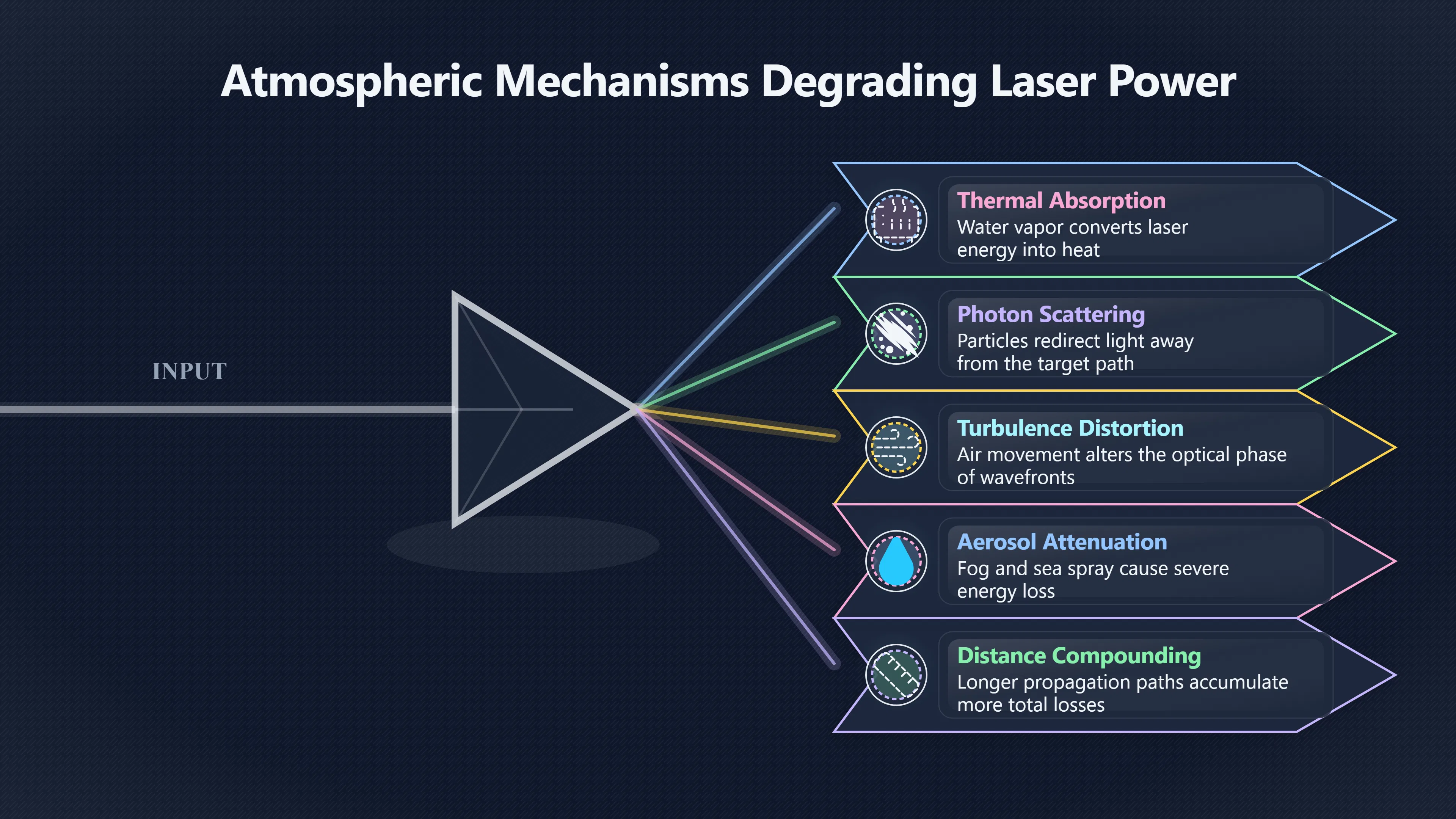
When a high-energy laser propagates through air, three broad effects matter: turbulence, absorption, and scattering. Turbulence alters the beam’s optical phase and can cause spreading or beam wander. Absorption occurs when atmospheric constituents such as water vapour or other molecules convert part of the laser energy into heat. Scattering occurs when particles or droplets redirect photons away from the intended beam path. NATO educational material on laser propagation identifies absorption and scattering as distinct atmospheric mechanisms that degrade laser weapon performance alongside turbulence.[NATO Publications]publications.sto.nato.intNATO Publications6.0 PROPAGATION AND ADAPTIVE OPTICSVirtually all the atmospheric effects on laser weapon systems can be traced to three…
The crucial point is that scattering and absorption reduce the amount of optical power still travelling toward the target.
- Absorption destroys useful beam energy by converting it into thermal energy within the atmosphere.
- Scattering redirects photons into other directions, preventing them from contributing to the target spot.
- Dense aerosols, including fog, smoke, dust, and sea spray, can produce severe attenuation over comparatively short distances.
- Longer propagation paths accumulate more losses because attenuation compounds with distance.[repositum.tuwien.at+2Sejong University]repositum.tuwien.atAtmospheric Impact on Laser Beam PropagationMost of the power is absorbed by water vapor. In addition, small particles in the air deflect the laser…Read more…
A useful analogy is a leaking hose. Adaptive optics can straighten and aim the water stream that remains, but it cannot recover water that has already leaked out through holes along the hose.
This is why weather can reduce laser effectiveness even when beam-control systems are functioning perfectly. If only a fraction of the original optical power survives the atmospheric path, the target can receive only that surviving fraction, regardless of how accurately the beam is focused.[NATO Publications]publications.sto.nato.intNATO Publications6.0 PROPAGATION AND ADAPTIVE OPTICSVirtually all the atmospheric effects on laser weapon systems can be traced to three…
Why Deformable Mirrors Only Correct the Surviving Wavefront
Adaptive optics operates on wavefront errors, not on missing energy.
A typical adaptive-optics system measures distortions in the incoming or reflected optical wavefront and commands a deformable mirror to introduce an opposite distortion. The goal is to flatten the wavefront and concentrate the surviving light into the smallest possible spot. This can dramatically improve beam quality and irradiance when turbulence is the dominant problem.[RP Photonics+2Axiom Optics]rp-photonics.comOpen source on rp-photonics.com.
However, deformable mirrors manipulate the phase of light that still exists within the beam. They do not generate new photons.
If atmospheric scattering has redirected part of the beam away from the propagation axis, those photons are no longer available for correction. Likewise, photons absorbed by water droplets, aerosols, or gases have been converted into other forms of energy and are gone from the optical beam. A mirror can reshape the phase distribution of the remaining light, but it cannot restore energy that has already left the beam.[repositum.tuwien.at+2Sejong University]repositum.tuwien.atAtmospheric Impact on Laser Beam PropagationMost of the power is absorbed by water vapor. In addition, small particles in the air deflect the laser…Read more…
This limitation is reflected in the way adaptive optics is described across laser and optical engineering literature. Adaptive-optics systems are repeatedly characterised as tools for compensating aberrations, turbulence, and wavefront distortion. Their purpose is to improve beam quality, image quality, or focus quality—not to reverse atmospheric extinction.[RP Photonics+2Axiom Optics]rp-photonics.comOpen source on rp-photonics.com.
Even studies exploring the theoretical limits of adaptive optics focus on how well phase distortions can be corrected under given turbulence conditions. They do not suggest that adaptive optics can recover energy removed by absorption or scattering processes.[Optica Open]preprints.opticaopen.orgAdaptive optics limitations for laser beam propagation along slant pathsOptica OpenAdaptive-optics limitations for laser beam propagation…by M Kalensky · 2025 · Cited by 9 — In this paper, we use wave-optic…

Sharper Does Not Mean More Powerful
This distinction often causes confusion because adaptive optics can increase the intensity measured at a target.
Suppose atmospheric turbulence spreads a beam over a large spot. Correcting the wavefront may concentrate the surviving energy into a much smaller area, producing a higher energy density. The target may therefore experience greater heating or damage even though the total surviving power has not increased. The system has improved delivery efficiency, not restored lost energy.[Axiom Optics+2ResearchGate]axiomoptics.comAxiom OpticsFrom Blur To Clarity: A Deep Dive Into Adaptive OpticsAdaptive Optics: What it is, how deformable mirrors can be used to corr…
In other words:
- Adaptive optics can increase power density at the target.
- Adaptive optics cannot increase the total surviving optical power after atmospheric attenuation.
- Severe attenuation can leave too little power for even perfect focusing to matter.[NATO Publications+2Semantic Scholar]publications.sto.nato.intNATO Publications6.0 PROPAGATION AND ADAPTIVE OPTICSVirtually all the atmospheric effects on laser weapon systems can be traced to three…
When Attenuation Matters More Than Optical Distortion
The practical importance of adaptive optics depends on which atmospheric effect dominates.
In relatively clear air, turbulence may be the primary source of performance degradation. Under those conditions, wavefront correction can produce substantial improvements because most of the beam energy still survives the journey. Correcting the phase of that surviving light can significantly tighten the spot and raise irradiance on the target.[Axiom Optics+2RP Photonics]axiomoptics.comAxiom OpticsFrom Blur To Clarity: A Deep Dive Into Adaptive OpticsAdaptive Optics: What it is, how deformable mirrors can be used to corr…
Dense fog presents a very different situation. The atmosphere is no longer mainly distorting the beam; it is removing energy from it. Water droplets scatter and absorb light so strongly that the available power reaching the target may collapse regardless of wavefront quality. In such circumstances, the dominant limitation becomes transmission loss rather than optical aberration.[repositum.tuwien.at+2Sejong University]repositum.tuwien.atAtmospheric Impact on Laser Beam PropagationMost of the power is absorbed by water vapor. In addition, small particles in the air deflect the laser…Read more…
The same logic applies to smoke, dust clouds, maritime aerosols, and other particle-rich environments. A perfectly corrected wavefront carrying only a small fraction of the original laser power may still be ineffective because the target receives insufficient energy for the intended effect. This is one reason why weather remains a central operational constraint for laser weapons despite advances in adaptive-optics technology.[NATO Publications+2Semantic Scholar]publications.sto.nato.intNATO Publications6.0 PROPAGATION AND ADAPTIVE OPTICSVirtually all the atmospheric effects on laser weapon systems can be traced to three…

The Core Limitation
The fundamental limitation is conservation of energy. Adaptive optics can redistribute and concentrate the optical energy that survives atmospheric propagation, but it cannot recreate photons that have been absorbed or scattered away. As atmospheric attenuation increases, a point is reached where improving beam shape yields diminishing returns because the dominant problem is no longer distortion—it is the absence of energy. For directed energy weapons operating through fog, smoke, dust, or sea spray, this distinction explains why better wavefront correction cannot overcome severe atmospheric losses.[NATO Publications+2Semantic Scholar]publications.sto.nato.intNATO Publications6.0 PROPAGATION AND ADAPTIVE OPTICSVirtually all the atmospheric effects on laser weapon systems can be traced to three…
Amazon book picks
Further Reading
Books and field guides related to Why Better Beam Shape Cannot Beat Lost Energy. Use these as the next step if you want deeper reading beyond the article.

Introduction to adaptive optics
Clarifies that wavefront correction improves surviving light but cannot recreate lost photons.
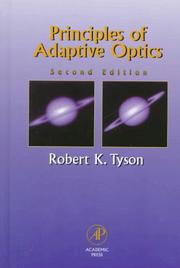
Principles of adaptive optics
Details correction limits when attenuation dominates over phase distortion.
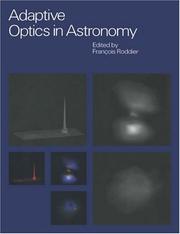
Adaptive Optics in Astronomy
First published 1999. Subjects: Optique, Adaptive Optics, Imaging systems in astronomy, Astronomie, [études diverses].

Laser beam propagation through random media
Explains absorption, scattering, attenuation, and why lost beam energy cannot be recovered.
eBay marketplace picks
Marketplace Samples
Example marketplace items related to this page. Use the search link to explore similar finds on eBay.
Endnotes
1.
Source: publications.sto.nato.int
Link:https://publications.sto.nato.int/publications/STO%20Educational%20Notes/STO-EN-SCI-340/EN-SCI-340-06.pdf
Source snippet
NATO Publications6.0 PROPAGATION AND ADAPTIVE OPTICSVirtually all the atmospheric effects on laser weapon systems can be traced to three...
2.
Source: rp-photonics.com
Link:https://www.rp-photonics.com/adaptive_optics.html
3.
Source: repositum.tuwien.at
Title: Atmospheric Impact on Laser Beam Propagation
Link:https://repositum.tuwien.at/bitstream/20.500.12708/14294/2/Atmospheric%20impact%20on%20laser%20beam%20propagation.pdf
Source snippet
Most of the power is absorbed by water vapor. In addition, small particles in the air deflect the laser...Read more...
4.
Source: researchgate.net
Link:https://www.researchgate.net/publication/282410226_Adaptive_optics_system_for_real-time_wavefront_correction
Source snippet
The degree of correction of an adaptive...Read more...
5.
Source: researchgate.net
Link:https://www.researchgate.net/publication/358049406_Wide-Aperture_Bimorph_Deformable_Mirror_for_Beam_Focusing_in_42_PW_TiSa_Laser
Source snippet
(PDF) Wide-Aperture Bimorph Deformable Mirror for Beam...20 Jan 2022 — This paper reports a large-aperture adaptive optical system with...
6.
Source: pdfs.semanticscholar.org
Link:https://pdfs.semanticscholar.org/a00d/0f25b849c5790ac84f50f297a60ad57102f3.pdf
Source snippet
Beam Atmospheric Propagation Modelling for...by T Fahey · 2021 · Cited by 109 — The underlying causes of laser beam attenuation in the a...
7.
Source: sjuairi.com
Link:https://www.sjuairi.com/bbs_shop/file_download.php?board_code=view&board_idx=1596433&sel_no=
Source snippet
Sejong UniversityUntitledabsorption and scattering—which leads to power loss and waveform distortion. Atmospheric attenuation τATM can be...
8.
Source: axiomoptics.com
Link:https://www.axiomoptics.com/application/adaptive-optics/
Source snippet
Axiom OpticsFrom Blur To Clarity: A Deep Dive Into Adaptive OpticsAdaptive Optics: What it is, how deformable mirrors can be used to corr...
9.
Source: preprints.opticaopen.org
Title: Adaptive optics limitations for laser beam propagation along slant paths
Link:https://preprints.opticaopen.org/articles/preprint/Adaptive-optics_limitations_for_laser_beam_propagation_along_slant_paths/28340402
Source snippet
Optica OpenAdaptive-optics limitations for laser beam propagation...by M Kalensky · 2025 · Cited by 9 — In this paper, we use wave-optic...
Additional References
10.
Source: eso.org
Link:https://www.eso.org/sci/facilities/eelt/owl/Blue_Book/8_Adaptive_optics.pdf
Source snippet
8. Adaptive OpticsAdaptive Optics is absolutely essential for OWL, to concentrate the light for spectroscopy and imaging and to reach the...
11.
Source: biophotonics.illinois.edu
Link:https://biophotonics.illinois.edu/research/optical-coherence-imaging/aberration-correction-and-adaptive-optics
Source snippet
Aberration correction and adaptive opticsOptical aberrations can be corrected by using reconfigurable optical elements such as deformable...
12.
Source: issp.ac.ru
Link:https://www.issp.ac.ru/ebooks/books/open/Topics_in_Adaptive_Optics.pdf
Source snippet
Topics in Adaptive OpticsThe first widely used application of adaptive optics was for compensating atmospheric turbulence effects in astr...
13.
Source: eureka.patsnap.com
Title: report atmospheric effects on long range laser power transmission
Link:https://eureka.patsnap.com/report-atmospheric-effects-on-long-range-laser-power-transmission
Source snippet
PatSnap EurekaAtmospheric Effects On Long-Range Laser Power...28 Aug 2025 — Discover how atmospheric conditions impact laser power trans...
14.
Source: youtube.com
Title: Why Laser Weapons Cannot Replace Missiles In Modern Warfare | WION Podcast
Link:https://www.youtube.com/watch?v=v-UCPlVWidM
Source snippet
How Iron Beam Turns Electricity Into a Weapon in Milliseconds | WION Podcast...
15.
Source: youtube.com
Title: How Iron Beam Turns Electricity Into a Weapon in Milliseconds | WION Podcast
Link:https://www.youtube.com/watch?v=VZuU2VzR548
Source snippet
Laser Weapons Are Becoming Reality Faster Than You Think...
16.
Source: pmc.ncbi.nlm.nih.gov
Link:https://pmc.ncbi.nlm.nih.gov/articles/PMC10162714/
Source snippet
by B Gu · 2022 · Cited by 5 — To assess the performance of adaptive optics and predict an optimal wavefront correction, we built a wav...
17.
Source: youtube.com
Title: The Pentagon’s Laser Problem and The Company To Fix it
Link:https://www.youtube.com/watch?v=iyBkTwFyIqY
Source snippet
Why Laser Weapons Cannot Replace Missiles In Modern Warfare | WION Podcast...
18.
Source: adsabs.harvard.edu
Link:https://adsabs.harvard.edu/full/1992ESOC…40..245M
Source snippet
In the case of active optics, it is the compensation of wavefront aberrations due to...Read m...
19.
Source: researchportal.hw.ac.uk
Link:https://researchportal.hw.ac.uk/files/88355566/s00340_023_07991_3.pdf
Source snippet
simulating the beam shaping capabilities of...by S Scholes · 2023 · Cited by 9 — Predominately, deformable mirrors have been used in ada...
Topic Tree