Within Directed Energy
What the Beam Needs Behind the Scenes
Directed-energy weapons need serious engineering behind the beam, including power, cooling, stabilization and tracking.
On this page
- Power supply and electrical demand
- Cooling and heat management
- Tracking, stabilization and fire control

Page outline Jump by section
Introduction
Directed-energy weapons are often described by the beam they put on target, but the harder engineering is everything that lets that beam exist, stay cool and remain accurately pointed. A high-energy laser is not just a “gun” with a light source. It needs a power supply able to deliver large amounts of electrical energy on demand, power-conditioning hardware to shape that energy, cooling systems to remove waste heat, optics that can survive high flux, and a fire-control chain that can track, stabilise and focus the beam on a chosen aim point. Those supporting systems determine whether a laser can fire once in a demonstration, fire repeatedly in bad weather, or survive integration on a ship, vehicle or aircraft. Official and technical sources repeatedly identify power, cooling, beam directors, tracking and platform integration as core limits on turning directed-energy prototypes into fielded weapons.[GAO+2GAO]gao.govgao 23 105868The Department of Defense (DOD) is currently developing directed energy weapons with the goal of defeating a range of threats…Read more…
Why the Beam Is Only the Visible Part
A laser weapon’s visible effect is simple to picture: concentrated light is directed at a target and heats, dazzles, damages or destroys it. The system behind that effect is much less simple. The Office of Naval Research defines directed-energy weapons as electromagnetic systems that convert chemical or electrical energy into radiated energy and focus it on a target to degrade, neutralise, defeat or destroy an adversary capability. That definition matters because it makes clear that a weapon-grade laser is a conversion-and-control system, not merely a bright optical device.[onr.navy.mil]onr.navy.milThe U.SDirected Energy Weapons: Ultra-Short Pulse Laser and…Navy DEWs include systems that use high-energy lasers (HEL) that emit photons and…
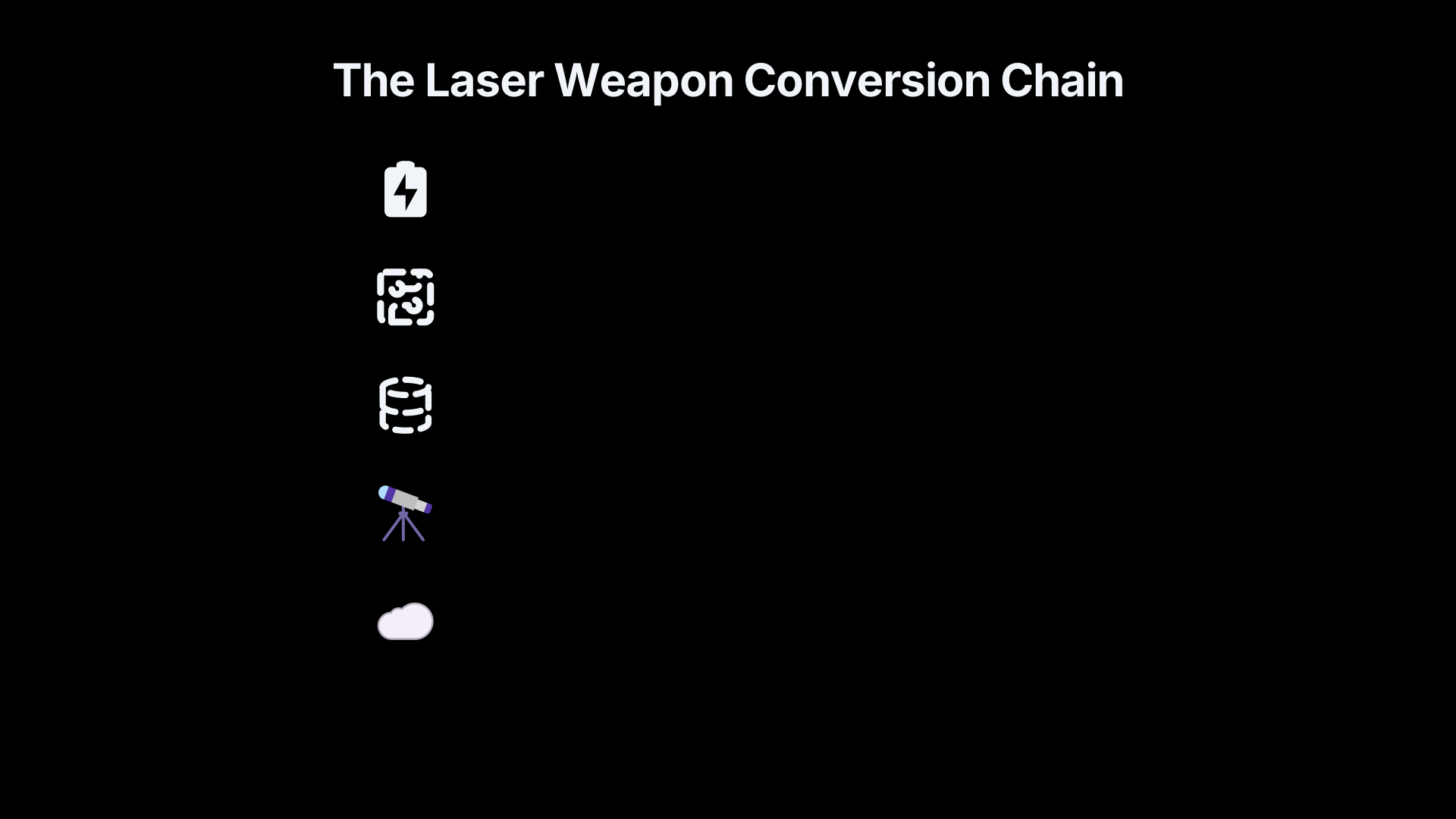
The conversion chain has penalties at every stage. Electrical power must be generated or stored, conditioned into the form needed by the laser source, converted into optical energy, routed through beam-combining and optical hardware, steered by a beam director, and finally delivered through the atmosphere. The US Defense Intelligence Agency’s high-energy laser assessment describes beam-control performance in terms of maximising irradiance at the focused spot and maintaining it on the aim point while enough fluence accumulates; it also notes that the focused spot may contain only about half the laser output before additional losses in the optical train and atmosphere.[Defense Intelligence Agency]dia.milDefense Intelligence AgencyState of the Art and Evolution of High-Energy Laser WeaponsMarch 4, 2022 — 31 Mar 2010 — The total power in th…
That is why engineering requirements are not secondary details. A system advertised as a 50 kW, 60 kW or 300 kW-class laser is not judged only by the rated optical output. It is judged by whether the host platform can supply the necessary electrical power, reject the waste heat, keep optics aligned, track real targets and recover quickly enough for repeated engagements.
Power Supply and Electrical Demand
The first hard requirement is power. Modern laser weapons are attractive partly because each shot may consume far cheaper energy than a missile, but “cheap per shot” does not mean “easy to power”. Current prototypes and projected future systems require increasing electrical power as they move from counter-drone and short-range targets towards harder, faster and more distant threats. A DSIAC overview of power generation and storage for directed-energy systems notes that power is needed not only for the laser energy itself but also for laser-diode cooling, power conditioning, illumination, pointing and tracking systems.[DSIAC]dsiac.dtic.milOpen source on dtic.mil.
This has a direct platform consequence. A warship has far more installed generating capacity and cooling volume than a small land vehicle, while an aircraft faces severe size, weight and power constraints. The same laser power that is plausible on a ship may become difficult on an armoured vehicle and much harder on an aircraft unless the system is lighter, more efficient and better integrated. Naval research therefore talks explicitly about reducing size, weight and power with cooling, often abbreviated as SWaP-C, to reduce the integration burden on ships.[onr.navy.mil]onr.navy.milCounter Directed Energy Weapons and High Energy LasersFor HEL, research leading to novel beam director fire control architectures, reduce…
Continuous Power Is Not the Same as Peak Power
Different directed-energy systems draw power in different ways. A high-energy laser used for sustained heating may need continuous or near-continuous power during dwell time. High-power microwave systems often use pulsed-power architectures, where stored energy is released in intense bursts. In both cases, the platform must do more than provide a nominal power rating. It must deliver usable power at the right voltage, timing and stability without disrupting other mission systems. Industry and defence engineering sources describe directed-energy weapons as requiring continuous or pulsed-power systems, switching and power-conditioning technologies to maximise output while limiting the impact on the host platform.[TE Connectivity]te.comOpen source on te.com.
This is one reason shipboard systems are often discussed as early deployment candidates. Ships can devote space to generators, power converters, batteries or flywheels more readily than small mobile platforms. Even so, ship integration is not automatic. Congressional reporting on US Navy shipboard lasers describes the High Energy Laser Counter-ASCM Program, or HELCAP, as including a beam-control testbed, a 300 kW-plus laser source, a prototype control system, and auxiliary prime power and cooling. In other words, the power and cooling equipment are named as key elements of the prototype, not background utilities.[EveryCRSReport]everycrsreport.comOpen source on everycrsreport.com.
Efficiency Decides How Much Heat Must Be Removed
Laser efficiency is a battlefield engineering issue because any electrical energy not converted into useful optical output becomes waste heat. Fibre lasers and solid-state lasers have improved greatly compared with older approaches, but they are still not perfect converters. Optica’s overview of high-energy lasers in defence noted that Lockheed Martin’s 30 kW electric fibre laser demonstration used substantially less electricity than more conventional solid-state designs, which reduced cooling needs and saved space.[Optica OPN]optica-opn.orgOptica OPNHigh-Energy Lasers: New Advances in Defense ApplicationsOptica OPNHigh-Energy Lasers: New Advances in Defense Applications
That relationship is crucial. A less efficient weapon may need a larger generator for the same beam output and a larger cooling system to handle the waste heat. A more efficient system can be smaller, easier to mount and better suited to repeated firing. For operators, the question is therefore not just “how powerful is the beam?” but “how much total platform power and thermal capacity does this beam demand?”
Cooling and Heat Management
Cooling is one of the least glamorous but most decisive requirements. High-energy lasers create heat inside the laser source, power electronics, beam-combining hardware and optical components. If that heat is not removed, it can damage components, distort optics, change the output wavelength, degrade beam quality and reduce pointing accuracy. An Australian Air and Space Power Centre paper explains the basic problem clearly: only part of the electrical power becomes light, while the rest becomes heat; uncontrolled thermal build-up affects beam stability, beam width, wavelength stability and the accuracy of the mechanical pointing system.[Air and Space Power Centre]airpower.airforce.gov.auAir and Space Power Centre Directed Energy WeaponsAir and Space Power Centre Directed Energy Weapons
This makes cooling part of lethality. A laser that overheats cannot sustain engagement tempo. It may have to pause between shots, reduce output, accept lower beam quality or risk component damage. GAO’s technology spotlight lists cooling requirements among the technological limitations that can restrict directed-energy effectiveness, alongside range and atmospheric conditions such as fog and storms.[GAO]gao.govgao 23 106717Science & Tech Spotlight: Directed Energy Weapons25 May 2023 — Challenges Technological limitations. DEWs are generally less effective…
Heat Limits Repeated Firing
The popular phrase “deep magazine” can be misleading. A laser does not run out of missiles in the usual sense, but it can run into power and heat limits. If the platform can generate electricity and remove heat continuously, it can keep engaging. If not, the practical magazine is limited by thermal recovery time.
Naval engineers therefore examine duty cycle: how long the weapon fires compared with how long it must cool or recharge. A paper on advanced cooling methods for naval laser directed-energy weapons notes that the size, weight and power costs of powering and cooling an unlimited-duty weapon determine whether such an approach is feasible, and uses a nominal duty cycle as a basis for comparing cooling approaches.[IMarEST]library.imarest.orgIMar ESTAdvanced Cooling Methods for Naval Laser DirectedIMar ESTAdvanced Cooling Methods for Naval Laser Directed
This is especially important for counter-drone defence. One slow drone may be manageable; a raid of many drones can force repeated engagements. The engineering question becomes whether the weapon can maintain enough shots per minute under real thermal conditions, not merely whether it can defeat one target at a test range.
Cooling Hardware Competes for Space
Cooling equipment has mass and volume. It may include liquid loops, heat exchangers, chillers, pumps, thermal storage, phase-change materials or integration with a ship’s existing cooling systems. Mobility Engineering’s discussion of thermal management for directed-energy weapons highlights a particular difficulty: waste heat can be relatively low-temperature, making it harder to remove efficiently with conventional methods, even though the total heat load is large.[mobilityengineeringtech.com]mobilityengineeringtech.comThermal Management for Directed Energy WeaponsThermal Management for Directed Energy Weapons
This creates a platform trade-off. More cooling capacity supports longer firing and faster recovery, but it adds weight, consumes space and increases maintenance complexity. Less cooling capacity makes the system easier to install but can reduce operational tempo. The trade-off is most severe on vehicles and aircraft, where every kilogram assigned to cooling is a kilogram not available for armour, fuel, payload, sensors or crew protection.
Beam Control Is the Difference Between Output and Effect
Power creates the beam, but beam control makes it useful. A high-energy laser must place energy on a small aim point and keep it there while damage accumulates. That requires optics, mirrors, sensors, gimbals, stabilisation, atmospheric compensation and fire-control software working together.
The Defense Intelligence Agency’s assessment gives a useful measure of success: the beam-control system must maximise average irradiance in the focused spot on the aim point and hold it there long enough for fluence to accumulate. This is a stricter standard than simply pointing a beam in the target’s general direction. A small pointing error spreads energy over the wrong surface, reducing the heating that causes damage.[Defense Intelligence Agency]dia.milDefense Intelligence AgencyState of the Art and Evolution of High-Energy Laser WeaponsMarch 4, 2022 — 31 Mar 2010 — The total power in th…
Beam quality also matters. If the output beam is distorted, poorly combined or optically unstable, more power at the laser source may not translate into more useful energy at the target. This is why manufacturers and laboratories emphasise beam directors, adaptive optics, beam-combining and precision tracking. Lockheed Martin describes beam control, adaptive optics, beam directors and thermal management as elements of mature directed-energy systems, while Northrop Grumman describes high power density, advanced beam control and precise targeting and tracking as requirements for extended-range missions.[Lockheed Martin]lockheedmartin.comOpen source on lockheedmartin.com.
Tracking Must Work While the Platform Moves
Real platforms are not laboratory benches. A ship rolls and vibrates. A land vehicle may fire from uneven ground. An aircraft flexes and manoeuvres. The target may also be moving, jinking or vibrating. The beam director must compensate for all of this while maintaining the required aim point.
That is why operational systems include sensors and fire control, not just a laser source. Raytheon says its high-energy laser systems support detection, tracking during manoeuvres and positive visual identification against threats including unmanned aerial systems, rockets, artillery and mortars. The UK’s DragonFire programme similarly emphasises accuracy and target engagement; the Ministry of Defence reported that DragonFire achieved the UK’s first high-power firing of a laser weapon against aerial targets at the Hebrides Range, and described the weapon as line-of-sight and precise enough to require coin-sized accuracy at kilometre scale.[RTX]rtx.comOpen source on rtx.com.
The practical point is simple: a directed-energy weapon is a fire-control problem as much as a power problem. The beam must remain aligned through vibration, target motion and atmospheric disturbance, or the energy does not accumulate where it is needed.
Beam Directors Are Integration Hardware
A beam director is the optical and mechanical assembly that points and shapes the beam. It may include mirrors, telescopes, apertures, sensors and stabilised mounts. It has to handle high optical power without damage, maintain alignment and move fast enough to follow the target.
This is one of the reasons governments fund beam-director research as a separate technical area. The Office of Naval Research lists work on novel beam-director fire-control architectures and advanced power architectures as priorities for high-energy laser development, especially where reduced SWaP-C can reduce platform integration impact.[onr.navy.mil]onr.navy.milCounter Directed Energy Weapons and High Energy LasersFor HEL, research leading to novel beam director fire control architectures, reduce…
DragonFire is a useful public example because it is often described through its accuracy rather than its exact power. Leonardo UK says DragonFire achieved the UK’s first high-power firing against aerial targets in trials delivered with Dstl, MBDA and QinetiQ. In interviews and programme descriptions, its beam director is treated as a central subsystem because the weapon must search, identify, track and then put energy accurately on target.[uk.leonardo.com]uk.leonardo.comDragon Fire – Laser Directed Energy WeaponDragon Fire – Laser Directed Energy Weapon
Fire Control Connects Sensors to Heating
The final requirement is integration: sensors, combat systems and the laser must act as one weapon. Detecting a drone on radar, identifying it with an electro-optical sensor, assigning the laser, selecting an aim point and holding the beam are separate steps. If they are slow or poorly connected, the target may move, the atmosphere may change or the engagement window may close.
US Navy programmes show this trend clearly. The Navy’s HELIOS system is significant not only because it is a high-energy laser but because it is intended as an integrated weapon system rather than a standalone demonstrator. Congressional reporting and Navy-focused reporting describe shipboard laser efforts in terms of combat-system integration, beam control, power and cooling rather than just optical output.[EveryCRSReport]everycrsreport.comOpen source on everycrsreport.com.
This matters because directed energy competes for decision time. A laser may be cheap per shot, but it still needs permission to fire, a clean line of sight, a stable track and enough dwell time. Fire-control software must decide whether the laser is the right effector or whether a missile, gun, jammer or high-power microwave system is better for that threat. GAO notes that battlefield use decisions can be challenging, especially because different directed-energy systems have different effects and risks.[GAO]gao.govgao 23 106717Science & Tech Spotlight: Directed Energy Weapons25 May 2023 — Challenges Technological limitations. DEWs are generally less effective…

Why Platform Integration Is the Real Bottleneck
The strongest directed-energy programmes are not just trying to make brighter lasers. They are trying to fit usable weapons into real platforms without overwhelming power systems, cooling capacity, maintenance crews or combat-system architecture.
This is why official assessments often sound cautious even when the technology has advanced. GAO reported that the US Department of Defense has made progress developing directed-energy capabilities but still faces challenges transitioning prototypes into acquisition programmes. Those transition problems are not only about whether a beam can damage a target in a test. They are about whether the whole system is mature, supportable and integrated enough for operational use.[GAO]gao.govgao 23 105868The Department of Defense (DOD) is currently developing directed energy weapons with the goal of defeating a range of threats…Read more…
The same pattern appears across land, naval and air concepts:
- Ships offer the best near-term integration base because they can carry larger generators, cooling systems and combat-system links, but they still face competition for space, electrical load and maintenance access.
- Ground vehicles benefit from mobility and proximity to drone threats, but power generation, cooling volume, dust, vibration and crew logistics are harder.
- Aircraft face the toughest SWaP-C problem because power, heat rejection and optical stability must be achieved under strict mass, drag and thermal constraints.
This is why a successful test firing is only one milestone. A fielded directed-energy weapon needs to fire repeatedly, reject heat, survive shock and weather, integrate with sensors, and maintain beam quality under operational stress.
The Engineering Test That Matters
Power, cooling and beam control determine whether directed energy is a practical weapon or a fragile demonstration. A laser may have a low cost per shot in electrical terms, but that advantage only matters if the host platform can keep supplying power, removing heat and holding the beam on target.
The most credible near-term directed-energy systems will therefore be judged by engineering endurance as much as peak power. Can they fire again quickly? Can they cool themselves during a busy engagement? Can their beam director maintain aim on a moving target from a moving platform? Can their power draw coexist with radar, communications and other weapons? Can operators maintain the system outside ideal test conditions?
Those questions are not peripheral. They are the difference between producing directed energy and delivering a military effect.
Amazon book picks
Further Reading
Books and field guides related to What the Beam Needs Behind the Scenes. Use these as the next step if you want deeper reading beyond the article.

Directed Energy Weapons
Covers the power, control, integration and operational challenges behind directed-energy systems.

Laser Fundamentals
Provides the underlying laser physics needed to understand weapon-scale systems.

Fundamentals of heat and mass transfer
Explains the cooling and thermal-management challenges that limit laser performance.

Power electronics
Directly relates to power conditioning and electrical delivery for high-energy systems.
eBay marketplace picks
Marketplace Samples
Example marketplace items related to this page. Use the search link to explore similar finds on eBay.




Endnotes
1.
Source: gao.gov
Title: gao 23 105868
Link:https://www.gao.gov/products/gao-23-105868
Source snippet
The Department of Defense (DOD) is currently developing directed energy weapons with the goal of defeating a range of threats...Read more...
2.
Source: gao.gov
Title: gao 23 106717
Link:https://www.gao.gov/products/gao-23-106717
Source snippet
Science & Tech Spotlight: Directed Energy Weapons25 May 2023 — Challenges Technological limitations. DEWs are generally less effective...
Published: May 2023
3.
Source: onr.navy.mil
Link:https://www.onr.navy.mil/organization/departments/code-35/division-353/directed-energy-weapons-cdew-and-high-energy-lasers
Source snippet
Counter Directed Energy Weapons and High Energy LasersFor HEL, research leading to novel beam director fire control architectures, reduce...
4.
Source: onr.navy.mil
Title: The U.S
Link:https://www.onr.navy.mil/organization/departments/code-35/division-353/directed-energy-weapons-uspl-and-atmospheric-characterization
Source snippet
Directed Energy Weapons: Ultra-Short Pulse Laser and...Navy DEWs include systems that use high-energy lasers (HEL) that emit photons and...
5.
Source: dsiac.dtic.mil
Link:https://dsiac.dtic.mil/articles/power-generation-and-storage-for-directed-energy-systems/
6.
Source: everycrsreport.com
Link:https://www.everycrsreport.com/files/2024-07-24_R44175_bd7aad12b8fb1d1589b9506a55c9ad6922b142a3.html
7.
Source: optica-opn.org
Title: Optica OPNHigh-Energy Lasers: New Advances in Defense Applications
Link:https://www.optica-opn.org/home/articles/volume_25/october_2014/features/high-energy_lasers_new_advances_in_defense_applica/
8.
Source: library.imarest.org
Title: IMar ESTAdvanced Cooling Methods for Naval Laser Directed
Link:https://library.imarest.org/record/7705/files/INEC_2020_Paper_100.pdf
9.
Source: mobilityengineeringtech.com
Title: Thermal Management for Directed Energy Weapons
Link:https://www.mobilityengineeringtech.com/component/content/article/37608-thermal-management-for-directed-energy-weapons
10.
Source: rtx.com
Link:https://www.rtx.com/raytheon/what-we-do/integrated-air-and-missile-defense/lasers
11.
Source: uk.leonardo.com
Title: Dragon Fire – Laser Directed Energy Weapon
Link:https://uk.leonardo.com/en/innovation/dragonfire
12.
Source: everycrsreport.com
Link:https://www.everycrsreport.com/reports/RL30540.html
13.
Source: mobilityengineeringtech.com
Title: 23128 compact thermal management solutions for mobile laser weapon systems
Link:https://www.mobilityengineeringtech.com/component/content/article/23128-compact-thermal-management-solutions-for-mobile-laser-weapon-systems
14.
Source: mobilityengineeringtech.com
Title: 46052 researchers test cooling solutions for directed energy weapons
Link:https://www.mobilityengineeringtech.com/component/content/article/46052-researchers-test-cooling-solutions-for-directed-energy-weapons
15.
Source: qinetiq.com
Title: dragonfire laser achieves another uk first
Link:https://www.qinetiq.com/en/news/dragonfire-laser-achieves-another-uk-first
16.
Source: qinetiq.com
Title: Laser Technologies
Link:https://www.qinetiq.com/en/what-we-do/research-and-development/directed-energy-systems/dragonfire
17.
Source: gao.gov
Link:https://www.gao.gov/video/directed-energy-weapons-dod-should-focus-transition-planning
18.
Source: dia.mil
Link:https://www.dia.mil/FOIA/FOIA-Electronic-Reading-Room/FileId/170045/
Source snippet
Defense Intelligence AgencyState of the Art and Evolution of High-Energy Laser WeaponsMarch 4, 2022 — 31 Mar 2010 — The total power in th...
Published: March 4, 2022
19.
Source: te.com
Link:https://www.te.com/en/industries/defense-military/insights/powering-the-future-of-directed-energy-weapons.html
20.
Source: airpower.airforce.gov.au
Title: Air and Space Power Centre Directed Energy Weapons
Link:https://airpower.airforce.gov.au/sites/default/files/2021-03/BPAF03_Directed-Energy-Weapons.pdf
21.
Source: lockheedmartin.com
Link:https://www.lockheedmartin.com/en-us/capabilities/directed-energy.html
22.
Source: GOV.UK
Title: advanced future military laser achieves uk first
Link:https://www.gov.uk/government/news/advanced-future-military-laser-achieves-uk-first
23.
Source: Wikipedia
Link:https://en.wikipedia.org/wiki/Gao
24.
Source: Wikipedia
Link:https://en.wikipedia.org/wiki/HELIOS
25.
Source: calhoun.nps.edu
Link:https://calhoun.nps.edu/server/api/core/bitstreams/5a81dcfa-356e-40c0-8b4c-021b96ed7860/content
26.
Source: prnewswire.com
Link:https://www.prnewswire.com/news-releases/lockheed-martin-receives-150-million-contract-to-deliver-integrated-high-energy-laser-weapon-systems-to-us-navy-300606676.html
Additional References
27.
Source: researchgate.net
Link:https://www.researchgate.net/publication/399863884_Laser-Based_Directed_Energy_Weapons_Technological_Capabilities_Material_Interaction_and_Strategic_Deployment_Pathways
28.
Source: droneshield.com
Link:https://www.droneshield.com/blog/a-counter-to-drone-[swarms
29.
Source: facebook.com
Link:https://www.facebook.com/avweek/posts/as-the-us-air-force-comes-within-weeks-of-the-first-operational-laser-weapons-th/10157699975222200/
30.
Source: researchgate.net
Link:https://www.researchgate.net/publication/263342808_Assessment_of_Long_Range_Laser_Weapon_Engagements_The_Case_of_the_Airborne_Laser
31.
Source: exail.com
Link:https://www.exail.com/fr/photonics/lasers/directed-energy-lasers
32.
Source: market.us
Link:https://market.us/report/directed-energy-weapons-market/
33.
Source: facebook.com
Link:https://www.facebook.com/theministryofdefence/videos/dragonfire-is-a-highly-advanced-laser-directed-energy-weapon-designed-and-built-/1172317644377460/
34.
Source: reddit.com
Link:https://www.reddit.com/r/europe/comments/19crko7/dragonfire_laser_uk_successfully_tests_weapon_as/
35.
Source: gandh.com
Link:https://gandh.com/laser-directed-energy-weapons
36.
Source: reddit.com
Link:https://www.reddit.com/r/interestingasfuck/comments/1qwa3pv/helios_the_60_kilowatt_highenergy_laser_weapon/
Topic Tree
Follow this branch
Parent topic
Directed EnergyRelated pages 11
- Atmosphere Why Bad Weather Matters for Laser Weapons
- Defence Layer Why Directed Energy Will Not Replace Missiles
- Dragon Fire What Dragon Fire Reveals About Battlefield Lasers
- Electronics Risk When Counter Drone Energy Hits the Wrong Electronics
- HELIOS Can Shipboard Lasers Defend at Sea?
- Laser vs Microwave Lasers or Microwaves: Which Threat Fits Which Beam?
- Lasers Why Laser Weapons Are Precise but Demanding
- Leonidas Why Anti Drone Microwaves Attract Investment
- +3 more in sidebar