Within Dazzle Damage
When Dazzling Is Enough to Stop a Drone
Temporary sensor interference can offer commanders a lower-force option, but the line between dazzling and damage is not always clean.
On this page
- Temporary interference versus permanent harm
- Escalation from warning to destruction
- How blinding laser law frames drone targeting
Page outline Jump by section
Introduction
In counter-drone operations, sensor dazzling can be the lawful minimum-force option when it achieves the military objective without causing unnecessary destruction. Rather than burning through a drone’s airframe or permanently damaging its electronics, a laser can temporarily overwhelm cameras, infrared imagers, or targeting optics, preventing the aircraft from observing, navigating, or conducting an attack. The attraction of dazzling is not simply technical efficiency; it aligns with long-standing principles of military necessity, proportionality, and the obligation to avoid excessive harm when a less destructive measure will suffice. At the same time, the legality of dazzling depends on how it is employed, because international law draws a sharp distinction between interfering with optical equipment and intentionally causing permanent blindness to human beings.[Wikipedia+2ICRC Databases]WikipediaProtocol on Blinding Laser WeaponsProtocol on Blinding Laser Weapons

Temporary Interference Versus Permanent Harm
The strongest legal case for dazzling exists when the intended effect is reversible sensor disruption rather than irreversible damage. A drone that relies on electro-optical cameras, infrared sensors, or optical seekers may become ineffective if those systems are saturated with light and can no longer provide usable imagery. If surveillance stops, targeting is interrupted, or navigation fails, the military objective may already have been achieved without destroying the platform.
From a governance perspective, this matters because the law of armed conflict generally favours achieving legitimate military effects with the least harmful means available. Destroying a drone may be lawful, but if temporary sensor interference can neutralise the threat with lower risks of debris, fire, collateral damage, or escalation, commanders have a strong operational reason to consider it first.
The distinction is especially important because the threshold between dazzling and damaging is not always clear. A laser powerful enough to overwhelm a sensor at one range may damage it at another. Technical studies and legal commentary have repeatedly noted that systems designed for anti-sensor effects can create permanent consequences if power levels, distance, exposure time, or targeting conditions change unexpectedly.[Insight]insight.dickinsonlaw.psu.eduBlinding Laser Weapons and Protocol IVby JM Strong · 1996 · Cited by 3 — ' Sensors are easily made ineffective by laser weapons.61…
When Dazzling Can Be the Least-Force Solution
A minimum-force approach is most persuasive in situations where the drone’s value comes from information gathering rather than physical attack.
Examples include:
- Reconnaissance drones collecting intelligence over military positions.
- Border or perimeter intrusions where the objective is to stop surveillance rather than destroy property.
- Sensitive urban environments where falling debris could endanger civilians.
- Infrastructure protection missions around airports, power stations, or public events where avoiding kinetic engagements is desirable.
In these circumstances, denying the drone the ability to see may be enough. If a camera-fed operator can no longer identify targets or maintain situational awareness, the mission may fail even though the aircraft remains airborne.
The logic resembles other non-kinetic counter-drone measures such as radio-frequency jamming or cyber takeover. The goal is not necessarily to eliminate the platform but to remove its operational usefulness. Counter-UAS literature increasingly treats disruption and denial as legitimate alternatives to destruction when they can achieve the same defensive outcome.[Robin Radar]robinradar.comallow you to detect, classify, and mitigate drones and unmanned aerial vehicles.Read more…
Escalation From Warning to Destruction
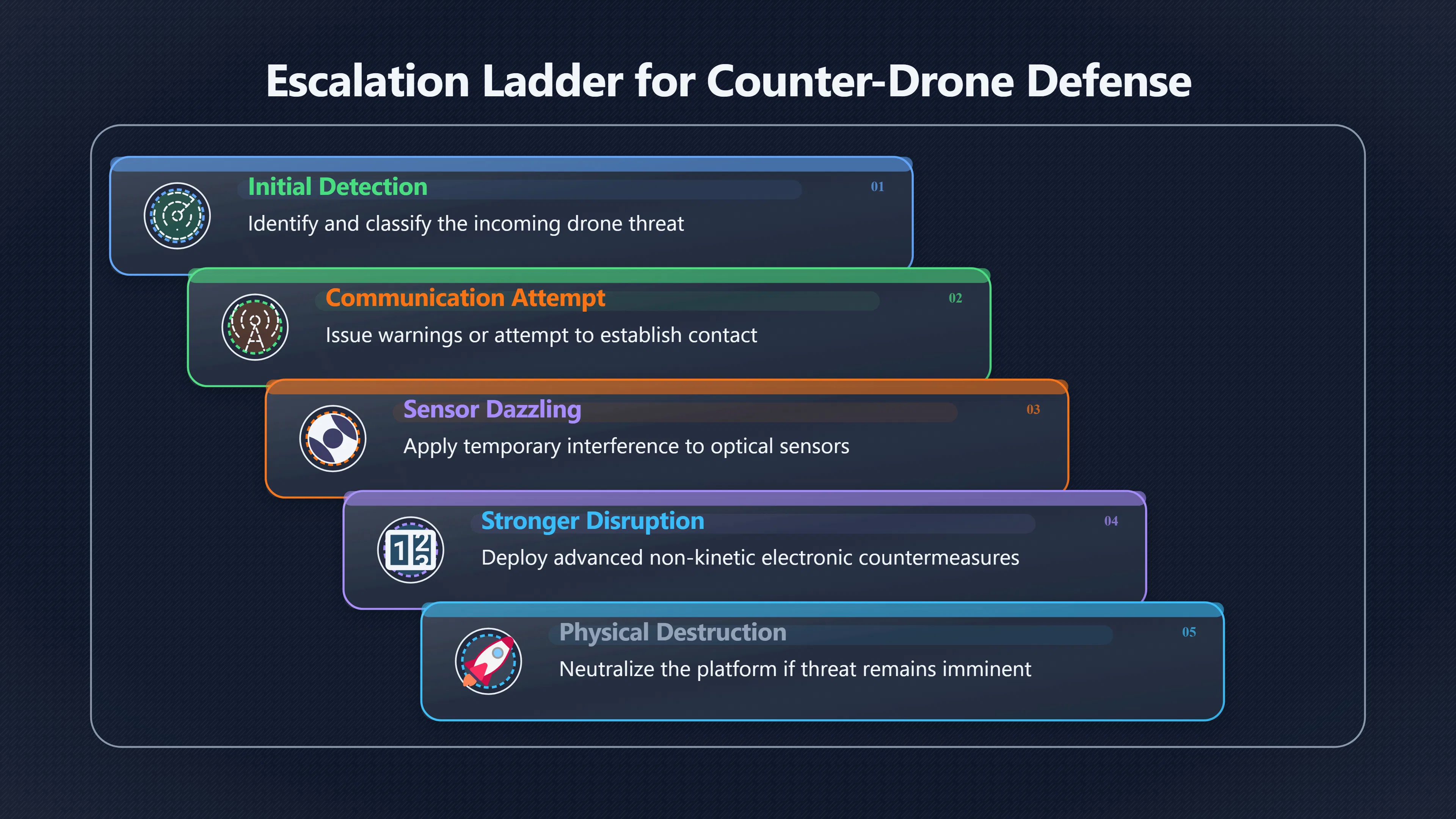
Many policy discussions treat dazzling as part of a graduated response rather than a standalone tactic. The practical question is often not whether dazzling is lawful, but whether it remains sufficient as the threat evolves.
A typical escalation ladder may involve:
- Detection and identification of the drone.
- Warnings or attempts at communication where feasible.
- Temporary sensor interference or other reversible countermeasures.
- Stronger non-kinetic disruption.
- Physical destruction if the threat persists or becomes imminent.
Under this model, dazzling occupies a middle ground. It can demonstrate defensive intent, interrupt hostile activity, and create an opportunity for the operator to disengage. If the drone continues its mission despite losing visual capability, commanders may conclude that stronger measures are necessary.
The key governance issue is that minimum force is context-dependent. A surveillance drone observing a military installation presents a different legal and operational problem from a one-way attack drone approaching a target. In the latter case, a temporary loss of imagery may not reliably eliminate the threat, making destruction more readily justifiable. The law does not require ineffective restraint; it requires force to remain connected to a legitimate military purpose and proportionate to the threat.[Emerald Publishing]emerald.comEmerald PublishingLegality of Drones under LOAC and International LawAdditionally, weapons that cause unnecessary suffering or superfluou…
How Blinding-Laser Law Frames Drone Targeting
The most important legal framework is the 1995 Protocol IV to the Convention on Certain Conventional Weapons, commonly known as the Protocol on Blinding Laser Weapons. It prohibits laser weapons specifically designed to cause permanent blindness to unenhanced human vision. States must also take feasible precautions to avoid such blindness when employing laser systems.[ICRC Databases+2ICRC Databases]ihl-databases.icrc.orgarticle 1ICRC DatabasesCCW Protocol (IV) on Blinding Laser Weapons, 1995 - Article 1It is prohibited to employ laser weapons specifically designed…
For counter-drone operations, one provision is especially significant. Protocol IV does not prohibit legitimate laser use against optical equipment, and it recognises that incidental visual effects may occur during lawful employment of laser systems. The treaty therefore distinguishes between deliberately blinding people and targeting equipment such as sensors, cameras, and optical devices.[Wikipedia]WikipediaProtocol on Blinding Laser WeaponsProtocol on Blinding Laser Weapons
This distinction helps explain why anti-sensor dazzling systems have remained legally acceptable while dedicated anti-personnel blinding weapons have been banned. A laser directed at a drone camera is generally evaluated differently from a laser directed at a person’s eyes. Nevertheless, operators must still account for foreseeable human exposure risks. A system intended for drone sensors could become legally problematic if employed in a manner likely to cause permanent eye injury to operators, bystanders, aircrew, or civilians.[Wikipedia+2Casebook]WikipediaProtocol on Blinding Laser WeaponsProtocol on Blinding Laser Weapons
The Grey Area Between Sensor Effects and Human Harm
The most persistent legal concern is that optical systems and human vision are linked. Drone cameras are designed to collect light, but so are human eyes. As a result, anti-sensor lasers can create risks beyond the intended target.
Legal and humanitarian discussions surrounding Protocol IV repeatedly highlighted this challenge. Experts noted that a system capable of dazzling optics at long range might produce much more severe effects if a person were exposed at shorter distances or under different conditions. This does not make all sensor-dazzling systems unlawful, but it places a burden on states and operators to incorporate safeguards, training, power controls, engagement procedures, and other precautions.[Wikipedia+2UNODA Disarmament]WikipediaProtocol on Blinding Laser WeaponsProtocol on Blinding Laser Weapons
For that reason, lawful minimum-force use is not determined solely by the intended target. It also depends on whether the system is designed and employed in a way that minimises foreseeable risks of permanent human blindness.
Why Commanders May Prefer Dazzling
When it works, dazzling offers a rare combination of operational effectiveness and restraint. It can:
- Deny surveillance without destroying equipment.
- Reduce risks from falling wreckage.
- Limit collateral damage in populated areas.
- Provide a reversible response when the threat level is uncertain.
- Support proportionality assessments by using a lower level of force than physical destruction.
These advantages explain continuing interest in anti-sensor laser systems for counter-drone missions. They occupy a policy space between passive observation and lethal engagement, giving decision-makers an option that may be sufficient to stop the threat while avoiding the consequences associated with kinetic force. The legal framework surrounding blinding lasers does not eliminate that option; instead, it shapes how it must be designed and employed so that temporary interference remains distinct from prohibited permanent blindness.[twz.com+2Wikipedia]twz.comLaser Dazzlers For Defending Tanks Against Marauding…18 Jul 2024 — Advanced laser dazzlers mounted on armored vehicles could automatic…
Amazon book picks
Further Reading
Books and field guides related to When Dazzling Is Enough to Stop a Drone. Use these as the next step if you want deeper reading beyond the article.
Countermeasures for Aerial Drones
Strong match for drone neutralization, proportional responses, sensor disruption, and counter-UAS concepts.

Directed Energy Weapons
Explains the laser physics underlying dazzling, sensor interference, and higher-energy destructive effects.

Effects of Directed Energy Weapons
Useful for understanding the spectrum between reversible interference and permanent damage effects.

An Introduction to Laser Weapon Systems
Provides context for escalation from temporary optical effects to destructive laser engagement.
eBay marketplace picks
Marketplace Samples
Example marketplace items related to this page. Use the search link to explore similar finds on eBay.

Endnotes
1.
Source: Wikipedia
Title: Protocol on Blinding Laser Weapons
Link:https://en.wikipedia.org/wiki/Protocol_on_Blinding_Laser_Weapons
2.
Source: ihl-databases.icrc.org
Title: Databases Customary IHL
Link:https://ihl-databases.icrc.org/en/customary-ihl/v1/rule86
Source snippet
ICRC DatabasesCustomary IHL - Rule 86. Blinding Laser WeaponsState practice establishes this rule as a norm of customary international la...
3.
Source: ihl-databases.icrc.org
Title: article 1
Link:https://ihl-databases.icrc.org/en/ihl-treaties/ccw-protocol-iv/article-1
Source snippet
ICRC DatabasesCCW Protocol (IV) on Blinding Laser Weapons, 1995 - Article 1It is prohibited to employ laser weapons specifically designed...
4.
Source: emerald.com
Link:https://www.emerald.com/books/monograph/14376/chapter/85330172/Legality-of-Drones-under-LOAC-and-International
Source snippet
Emerald PublishingLegality of Drones under LOAC and International LawAdditionally, weapons that cause unnecessary suffering or superfluou...
5.
Source: ihl-databases.icrc.org
Title: ccw protocol iv
Link:https://ihl-databases.icrc.org/en/ihl-treaties/ccw-protocol-iv
Source snippet
ICRC DatabasesCCW Protocol (IV) on Blinding Laser Weapons, 1995The review Conference adopted on 13.10.1995 a new Protocol IV prohibiting...
6.
Source: casebook.icrc.org
Link:https://casebook.icrc.org/a_to_z/glossary/laser-weapons
Source snippet
Laser weapons | How does law protect in war?In international humanitarian law, the use of laser weapons is prohibited when they a...
7.
Source: disarmament.unoda.org
Link:https://disarmament.unoda.org/en/updates/experts-reflect-origin-relevance-and-future-ccw-protocol-iv-blinding-laser-weapons
Source snippet
UNODA DisarmamentExperts reflect on the origin, relevance, and future of CCW...29 Dec 2022 — This led to the negotiation and adoption of...
8.
Source: twz.com
Link:https://www.twz.com/land/laser-dazzlers-for-defending-tanks-against-marauding-drones-are-an-untapped-countermeasure
Source snippet
Laser Dazzlers For Defending Tanks Against Marauding...18 Jul 2024 — Advanced laser dazzlers mounted on armored vehicles could automatic...
9.
Source: casebook.icrc.org
Title: united states memorandum law use lasers anti personnel weapons
Link:https://casebook.icrc.org/case-study/united-states-memorandum-law-use-lasers-anti-personnel-weapons
Source snippet
In fact, antipersonnel weapons are designed specifically to kill or disable enemy combatants and are not unlawful...Read more...
10.
Source: international-review.icrc.org
Link:https://international-review.icrc.org/sites/default/files/S0020860400089889a.pdf
Source snippet
Protocol on Blinding Laser Weaponsby L Doswald-Beck · Cited by 40 — See the report Blinding Weapons: reports of the meetings of experts c...
11.
Source: ihl-databases.icrc.org
Link:https://ihl-databases.icrc.org/es/customary-ihl/v2/rule86
Source snippet
Laser Weapons“It is prohibited to employ laser weapons specifically designed, as their sole combat function or as one of their combat fun...
12.
Source: unodaweb-meetings.unoda.org
Title: Protocol IV on Blinding Laser Weapons genesis history and relevance
Link:https://unodaweb-meetings.unoda.org/public/2022-11/Protocol%20IV%20on%20Blinding%20Laser%20Weapons-genesis%20history%20and%20relevance.pdf
Source snippet
• Focus: This presentation will reflect on the relevance of Protocol IV for how new...Read more...
13.
Source: insight.dickinsonlaw.psu.edu
Link:https://insight.dickinsonlaw.psu.edu/cgi/viewcontent.cgi?article=1403&context=psilr
Source snippet
Blinding Laser Weapons and Protocol IVby JM Strong · 1996 · Cited by 3 — ' Sensors are easily made ineffective by laser weapons.61...
14.
Source: robinradar.com
Link:https://www.robinradar.com/resources/10-counter-drone-technologies-to-detect-and-stop-drones-today
Source snippet
allow you to detect, classify, and mitigate drones and unmanned aerial vehicles.Read more...
Additional References
15.
Source: aph.gov.au
Link:https://www.aph.gov.au/Parliamentary_Business/Committees/Joint/Completed_Inquiries/jsct/reports/report5/chapter2
Source snippet
Australian Parliament HouseCHAPTER 22.4 Protocol IV does not restrict the use of laser systems in combat. Article 3 specifically recognis...
16.
Source: lyocon.com
Link:https://www.lyocon.com/applications/defense/
Source snippet
DefenseLaser dazzling technology is a cutting-edge, non-lethal defense solution designed to counter a broad spectrum of threats in both c...
17.
Source: qinetiq.com
Link:https://www.qinetiq.com/en/what-we-do/mission-support-and-operations/cyber-and-intelligence/cema/electromagnetic-activity/counter-drone-systems
Source snippet
Obsidian™ Counter Drone systemOur counter drone technology is specifically designed to detect, identify and track small/micro drones. Lea...
18.
Source: hrw.org
Link:https://www.hrw.org/reports/1995/General1.htm
Source snippet
blinding laser weaponsHuman Rights Watch believes that blinding as a method of warfare is illegal under the international legal and human...
19.
Source: unidir.org
Link:https://unidir.org/event/exploring-directed-energy-weapons-and-the-implications-of-their-use-under-international-law/
Source snippet
Exploring Directed Energy Weapons and the Implications...15 Nov 2023 — One type of DEW, namely blinding laser weapons, has been banned a...
20.
Source: securityanddefence.pl
Link:https://securityanddefence.pl/Testing-the-efficiency-of-laser-technology-to-destroy-the-rogue-drones%2C127360%2C0%2C2.html
Source snippet
Testing the efficiency of laser technology to destroy...by MZ Chaari · 2020 · Cited by 17 — Counter-drone technology, also known as coun...
21.
Source: whatconvention.org
Link:https://whatconvention.org/en/ratifications/1604
Source snippet
Aug 23, 2010; Argentina. -. Oct 21, 1998; Australia. -. Aug 22, 1997; Austria. -. Jul 27, 1998.Read more...
22.
Source: fraunhofer.de
Link:https://www.fraunhofer.de/en/research/current-research/defense-against-drones.html
Source snippet
Fraunhofer is developing technology designed to serve as a defense against unmanned...Read more...
23.
Source: stopkillerrobots.org
Link:https://www.stopkillerrobots.org/wp-content/uploads/2014/05/international-piv-memo-final.pdf
Source snippet
vented human suffering before the weapons were fully developed and deployed.Read more...
24.
Source: researchgate.net
Link:https://www.researchgate.net/publication/378122862_Counter_Drone_Technology_A_Review
Source snippet
ResearchGate(PDF) Counter Drone Technology: A Reviewby H Gonzalez-Jorge · 2024 · Cited by 25 — It enables the integration of a range of s...
Topic Tree