Within Airbase Zones
When Aircraft Movement Makes Microwave Shots Unsafe
Taxiing, landing and maintenance aircraft can turn a safe microwave firing sector into a no-fire zone within seconds.
On this page
- Why moving aircraft change the hazard picture
- Taxi, landing and maintenance scenarios
- Practical hold and abort decisions
Page outline Jump by section
Introduction
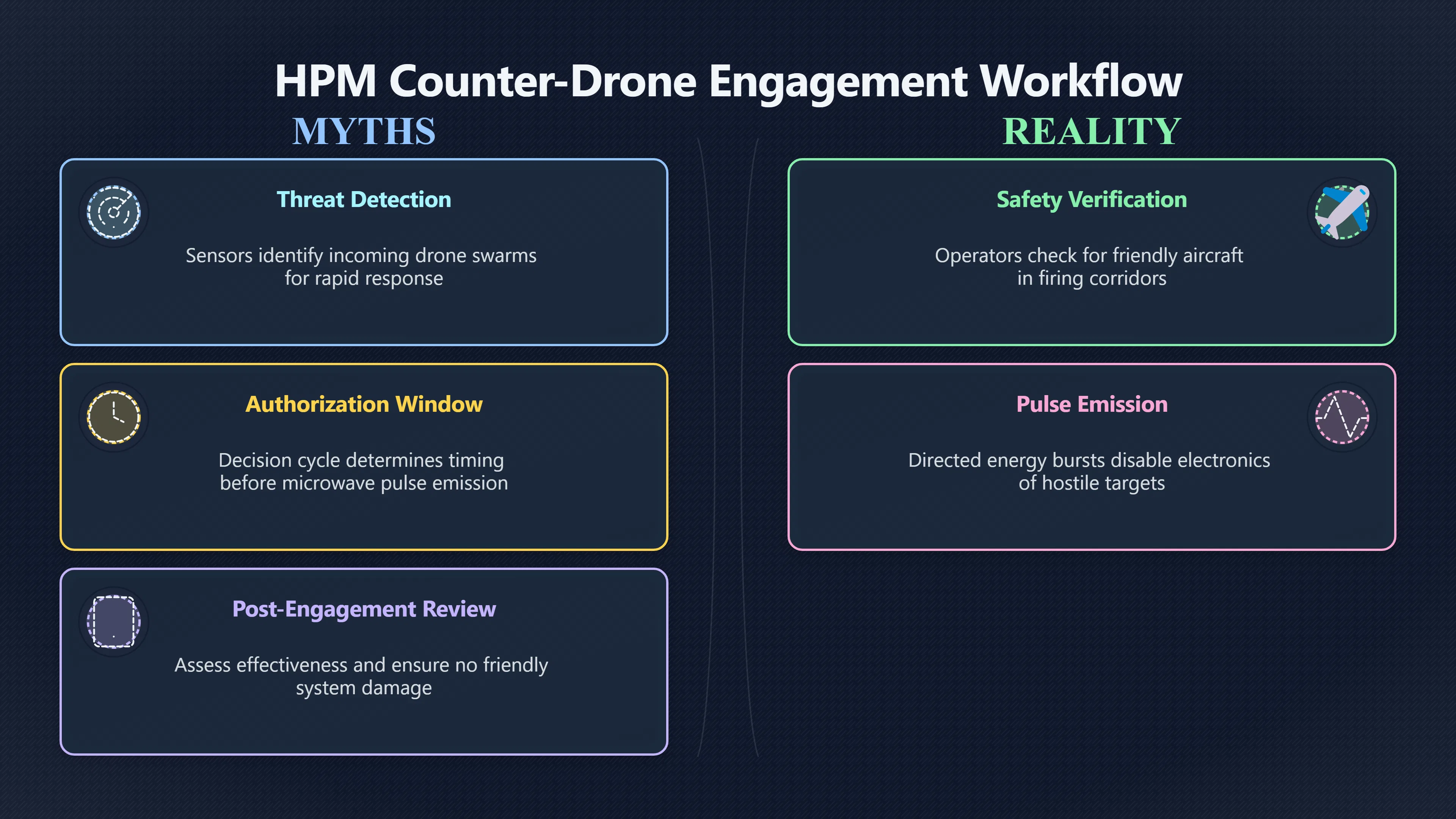
High-power microwave (HPM) counter-drone weapons are attractive for airbase defence because they can disable multiple drones with a single burst of electromagnetic energy. The same characteristic that makes them effective against drone swarms, however, creates a unique operational problem: aircraft do not stay still. A firing sector that appears clear when a target is detected can become unsafe moments later if an aircraft begins taxiing, enters final approach, is towed from a maintenance area, or starts an engine run. Because HPM effects are intended to couple energy into electronics, operators must continuously account for friendly aircraft movement rather than treating safety as a fixed geometric boundary.[robinradar.com+2wpafb.af.mil]robinradar.comThe EMP interferes with radio links and…
 Within the broader issue of microwave exclusion zones, aircraft movement is one of the most difficult variables to manage. Static maps and pre-planned firing sectors are useful, but they can be invalidated in seconds by routine airfield activity.
Why Moving Aircraft Change the Hazard Picture
Unlike a parked aircraft inside a designated protected area, a moving aircraft introduces uncertainty into the engagement timeline. High-power microwave systems are often designed for rapid response against fast-appearing drone threats. Systems such as THOR were developed specifically to defeat multiple airborne targets quickly during base-defence scenarios.[wpafb.af.mil+2airuniversity.af.edu]wpafb.af.milenemy drone operators may soon face the power of thorThe system provides non-kinetic defeat of multiple targets.Read more…
The challenge is that microwave engagements are not judged solely by where the drone is located. Operators must also consider where friendly aircraft may be when the pulse is emitted and where they may move during the engagement decision cycle. Even short delays between detection, authorisation and firing can alter the safety picture.
Several factors make moving aircraft especially significant:
- Aircraft carry dense concentrations of avionics, sensors, radios and mission systems.
- Aircraft orientation changes continuously while taxiing or manoeuvring, altering how electromagnetic energy may couple into exposed systems.
- Airfields contain multiple aircraft types with different levels of electromagnetic hardening and certification.
- Maintenance states vary. An aircraft connected to test equipment may present a different risk profile than one configured for flight.[NATO Store+2Wikipedia]sto.nato.intNATO StoreElectromagnetic Compatibility in the Defense Systems of…The study has focussed on three areas of EMC design, development and…
The result is that microwave exclusion zones must function as dynamic control volumes rather than fixed boundaries painted onto an airfield map.
Taxi, Landing and Maintenance Scenarios
Taxiing Aircraft
Taxiways frequently intersect or pass near likely counter-drone engagement sectors. An aircraft moving from a parking apron to a runway can unexpectedly enter a previously acceptable firing corridor.
This creates a timing problem. A drone swarm may present a fleeting engagement opportunity, yet operators may be forced to delay or cancel a shot because a friendly aircraft is crossing the affected area. The wider-area nature of many microwave systems makes this more restrictive than some alternative counter-drone methods that engage targets individually.[Wikipedia+2Wikipedia]WikipediaTHOR (weaponTHOR (weapon
A taxiing aircraft also produces prediction uncertainty. Operators must evaluate not only the aircraft’s current position but its projected position during the engagement window.
Aircraft on Approach or Departure
Landing and take-off phases create particularly sensitive conditions because aircraft are airborne but remain close to the airfield and often within the volume where base-defence systems may operate.
Civil and military aviation already devote significant effort to electromagnetic compatibility and protection against high-intensity radiated fields because avionics performance can be affected by strong electromagnetic environments. Aircraft certification and defence standards therefore treat intense electromagnetic exposure as a serious engineering consideration rather than a theoretical concern.[Wikipedia]WikipediaHigh-intensity radiated fieldHigh-intensity radiated field
For a microwave counter-drone operator, an arriving aircraft can transform a clear engagement sector into a no-fire area within minutes. The same applies to departures, particularly during initial climb when aircraft remain relatively close to the airfield.

Maintenance and Ground Servicing
Maintenance activity often creates the least predictable aircraft exposure conditions.
An aircraft undergoing diagnostics may be connected to laptops, test equipment, data-loading devices or temporary maintenance systems. Access panels may be open and components partially disconnected. Ground crews may also position vehicles and electronic support equipment around the aircraft. In practical terms, the electromagnetic environment becomes more complex and potentially more vulnerable than during routine flight operations.[reports.nlr.nl]reports.nlr.nlPower Line Communications for Avionics Systemsby J Lansink Rotgerink · 2023 — This paper presents the results of a measurement campaign t…
A maintenance aircraft that is safe because it is parked outside an engagement sector may suddenly become a concern if it is towed, repositioned or begins engine-run procedures during a drone incident.
Why Prediction Is Harder Than It Appears
A common assumption is that airfield controllers always know where aircraft are located. In reality, microwave engagement decisions must account for future movement, not merely present location.
Several sources of uncertainty complicate decisions:
- Aircraft may receive revised taxi instructions.
- Emergency aircraft can be given priority routing.
- Recovery operations may alter landing sequences.
- Ground vehicles towing aircraft can change direction unexpectedly.
- Multiple aircraft may converge on the same movement area during high-tempo operations.
At a busy airbase, the operational picture can change faster than a static safety assessment can remain valid.
This is especially important because many HPM concepts are intended to engage multiple drones simultaneously. The same broad-area effect that increases effectiveness against swarms also increases the need for confidence that friendly electronics will not enter the engagement volume unexpectedly.[wpafb.af.mil+2airuniversity.af.edu]wpafb.af.milenemy drone operators may soon face the power of thorThe system provides non-kinetic defeat of multiple targets.Read more…
Practical Hold and Abort Decisions
Because aircraft movement can rapidly invalidate a firing solution, airbases generally need decision processes that favour restraint when uncertainty increases.
Typical operational responses include:
Temporary hold orders. Operators delay engagement until aircraft clear the affected sector.
Dynamic exclusion zones. Safety boundaries expand or shift based on real-time aircraft movement rather than remaining fixed.
Automatic track integration. Airfield surveillance and aircraft tracking data can be incorporated into counter-drone command systems so that developing conflicts are identified before a shot is authorised.
Abort authority. Engagements may be cancelled at the final stage if an aircraft enters a protected corridor, even when a drone remains within range.
These decisions can appear frustrating during a drone attack because they may reduce opportunities to engage hostile targets. However, the alternative risk is that a defensive system designed to protect aircraft could expose friendly aircraft electronics to unnecessary electromagnetic energy.
The Core Trade-Off for Airbase Defenders
Aircraft movement highlights a fundamental tension in microwave airbase defence. Counter-drone systems are valued because they can react quickly and affect multiple targets at once. Yet airbases are environments where aircraft, support equipment and personnel are constantly moving.
As a result, microwave exclusion zones cannot be treated as static safety bubbles. They must continuously adapt to taxi routes, approach paths, maintenance activity and changing flight operations. In practice, the most difficult decision is often not whether a drone can be engaged, but whether a friendly aircraft might enter the hazard picture before the microwave pulse is fired. The faster and busier the airfield, the more frequently that question can turn an otherwise valid engagement into a no-fire decision.[robinradar.com+2Wikipedia]robinradar.comThe EMP interferes with radio links and…
Amazon book picks
Further Reading
Books and field guides related to When Aircraft Movement Makes Microwave Shots Unsafe. Use these as the next step if you want deeper reading beyond the article.
Drone Warfare
Offers context on drone threats that drive adoption of counter-drone systems, including directed-energy defenses.

Directed Energy Weapons
Provides foundational directed-energy concepts useful for understanding safety controls and exclusion-zone thinking.

Introduction to Electronic Warfare Modeling and Simulation
Helps readers understand operational decision-making, electromagnetic effects, and engagement environments around military systems.
The Pentagon's Brain
Discover the definitive history of DARPA, the Defense Advanced Research Project Agency, in this Pulitzer Prize finalist from the author o...
eBay marketplace picks
Marketplace Samples
Example marketplace items related to this page. Use the search link to explore similar finds on eBay.

Endnotes
1.
Source: robinradar.com
Link:https://www.robinradar.com/resources/10-counter-drone-technologies-to-detect-and-stop-drones-today
Source snippet
The EMP interferes with radio links and...
2.
Source: wpafb.af.mil
Title: enemy drone operators may soon face the power of thor
Link:https://www.wpafb.af.mil/News/Article-Display/Article/1969142/enemy-drone-operators-may-soon-face-the-power-of-thor/
Source snippet
The system provides non-kinetic defeat of multiple targets.Read more...
3.
Source: airuniversity.af.edu
Title: army partners with air forces thor for base defense
Link:https://www.airuniversity.af.edu/News/Display/Article/2511792/army-partners-with-air-forces-thor-for-base-defense/
Source snippet
Army partners with Air Force's THOR for base defense23 Feb 2021 — THOR is a prototype directed energy weapon used to disable the electron...
4.
Source: sto.nato.int
Link:https://www.sto.nato.int/document/electromagnetic-compatibility-in-the-defense-systems-of-future-years/
Source snippet
NATO StoreElectromagnetic Compatibility in the Defense Systems of...The study has focussed on three areas of EMC design, development and...
5.
Source: Wikipedia
Title: High-intensity radiated field
Link:https://en.wikipedia.org/wiki/High-intensity_radiated_field
6.
Source: reports.nlr.nl
Link:https://reports.nlr.nl/items/b827c812-d954-4a5b-9b02-d0011d20b2f3
Source snippet
Power Line Communications for Avionics Systemsby J Lansink Rotgerink · 2023 — This paper presents the results of a measurement campaign t...
7.
Source: Wikipedia
Title: THOR (weapon)
Link:https://en.wikipedia.org/wiki/THOR_%28weapon%29
8.
Source: Wikipedia
Title: Epirus Leonidas
Link:https://en.wikipedia.org/wiki/Epirus_Leonidas
9.
Source: publications.sto.nato.int
Title: (HPM) impulses on the mechanical integrity of Unmanned Aerial
Link:https://publications.sto.nato.int/publications/STO%20Meeting%20Proceedings/STO-MP-SET-315/MP-SET-315-24.pdf
Source snippet
Disruption to Destruction Assessing theby K Karcz · Cited by 2 — Furthermore, our research outcomes provide insights into the consequence...
Additional References
10.
Source: researchgate.net
Link:https://www.researchgate.net/publication/401707891_Cost-Effectiveness_Analysis_of_Counter-Unmanned_Aircraft_Systems_Technologies_A_Comparative_Study_of_Kinetic_Electronic_Warfare_and_Directed_Energy_Countermeasures
Source snippet
Cost-Effectiveness Analysis of Counter-Unmanned Aircraft...9 Mar 2026 — This quantitative study conducted a comprehensive cost-effective...
11.
Source: droneshield.com
Link:https://www.droneshield.com/blog/a-counter-to-drone-swarms-high-power-microwave-weapons
Source snippet
A Counter to Drone Swarms: High-Power Microwave...HPM weapons work by emitting directed bursts of electromagnetic energy, disabling the...
12.
Source: incompliancemag.com
Title: air force unveils new microwave weapon named thor that can kill drones
Link:https://incompliancemag.com/air-force-unveils-new-microwave-weapon-named-thor-that-can-kill-drones/
Source snippet
Air Force Unveils New Microwave Weapon Named 'Thor'...2 Jul 2019 — Scientists from the Air Force Research Laboratory at Kirtland Air For...
13.
Source: afresearchlab.com
Link:https://afresearchlab.com/counter-swarm-high-power-weapon/
Source snippet
A target is identified, the silent weapon discharges in a nanosecond and the impact...Read more...
14.
Source: facebook.com
Link:https://www.facebook.com/unboxfactory/posts/the-us-military-has-successfully-tested-a-next-[generation
Source snippet
rowave (HPM) weapon capable of disabling dozens of drones at once...
15.
Source: youtube.com
Title: HIRF Requirements and Design Protection with Billy Martin
Link:https://www.youtube.com/watch?v=tIXJWhqBKIA
Source snippet
THOR counter drone microwave weapon AFRL THOR (Tactical High-power Operational Responder) Destroys Swarms of Enemy Drones AFResearchLab...
16.
Source: defencefinancemonitor.com
Title: non kinetic counter uas with high
Link:https://www.defencefinancemonitor.com/p/non-kinetic-counter-uas-with-high
Source snippet
Non-Kinetic Counter-UAS with High Power Microwave8 Dec 2025 — HPM systems work by emitting powerful pulses of radiofrequency energy that...
17.
Source: youtube.com
Link:https://www.youtube.com/watch?v=3Hs48Ueiun8
Source snippet
HIRF Requirements and Design Protection with Billy Martin...
18.
Source: youtube.com
Title: Epirus Leonidas: High-Power Microwave for Counter-Electronics
Link:https://www.youtube.com/watch?v=vLA826fH4Vc
Source snippet
Engineering for Electromagnetic Compatibility in Aerospace and Defense Electronics...
19.
Source: gao.gov
Title: gao 22 105705
Link:https://www.gao.gov/products/gao-22-105705
Source snippet
Science & Tech Spotlight: Counter-Drone Technologies15 Mar 2022 — Counter-drone technology can detect unauthorized or unsafe drones and...
Topic Tree