Within Directed Energy
When Counter Drone Energy Hits the Wrong Electronics
Wide-area electromagnetic effects can create hard choices when friendly or civilian electronics are nearby.
On this page
- Why wider beams are less discriminating
- Friendly systems inside the effect area
- Civilian infrastructure and rules of use
Page outline Jump by section
Introduction
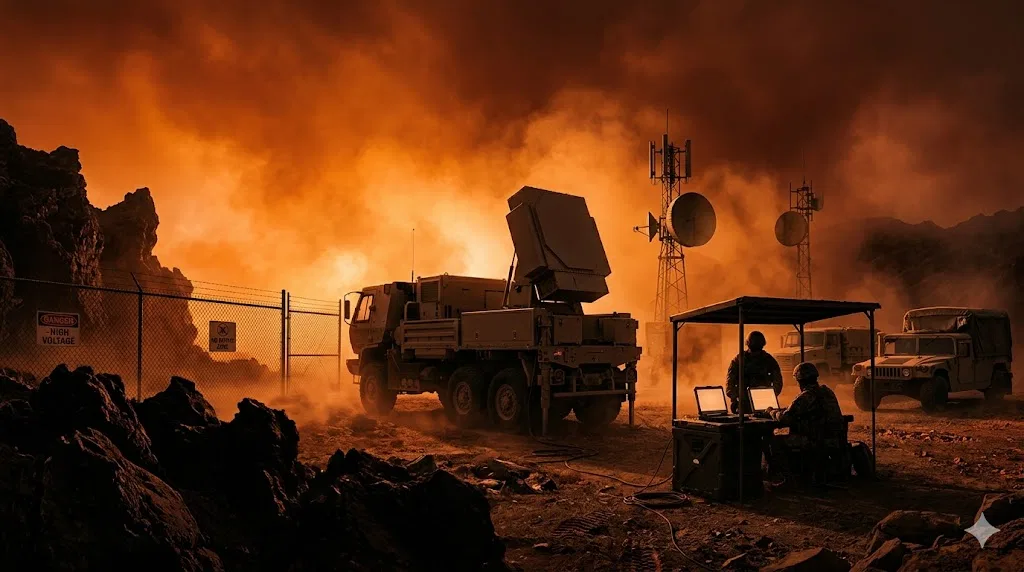
Collateral effects are the awkward trade-off behind one of the most attractive promises of directed energy weapons: defeating drones and other electronic targets without firing a missile or spraying fragments. High-power microwave and millimetre-wave systems can affect several drones at once, but that same wide-area effect can also put friendly radios, vehicles, sensors, aircraft systems, medical devices or nearby civilian infrastructure inside the hazard area. The core risk is not simply “damage” in the explosive sense. It is electronic disruption: induced currents, upset circuits, degraded communications, corrupted navigation, temporary shutdowns, or permanent component failure. The US Government Accountability Office states the problem plainly: wider-beam directed energy weapons, including high-power microwave and millimetre-wave systems, may affect all assets in an area, “whether friend or foe”.[GAO]gao.govgao 23 106717Science & Tech Spotlight: Directed Energy Weapons25 May 2023 — For example, wider beam DEWs, such as high power microwave or millimete…
That makes collateral risk a command-and-control problem as much as an engineering problem. A laser can be narrowly aimed, but it may still create risks to aircraft, satellites or eyesight if the beam misses or propagates beyond the target. A microwave system may be more useful against a drone swarm, but less discriminating around friendly electronics. In real deployments, the question is not only whether a weapon can stop the hostile drone. It is whether it can do so without disabling the systems the defenders rely on to identify, communicate, navigate, evacuate, land aircraft, or keep a hospital, port, airport or base functioning.
Why wider beams are less discriminating
High-power microwave weapons are attractive for counter-drone defence because they attack the electronic dependency that small unmanned aircraft cannot easily avoid. The US Office of Naval Research describes high-power microwave weapons as systems that create beams across radio and microwave frequencies to couple with electronics inside targeted systems, causing damage or disruption from which the system cannot recover in time to complete its mission.[Office of Naval Research]onr.navy.milOffice of Naval Research Directed Energy Weapons: High Power MicrowavesOffice of Naval ResearchDirected Energy Weapons: High Power MicrowavesMarch 19, 2022 — HPM weapons create beams of electromagnetic energy… Raytheon’s Phaser description captures the operational appeal: operators focus a wide, arcing energy beam on drones, sending a short high-power burst intended to destroy their electronics and drop multiple drones at once.[RTX]rtx.comPhaser High-Power Microwave System | RaytheonThe Phaser high-power microwave system uses directed energy to down drones—single ones or…
The same physics that makes this useful against swarms makes it hard to treat as a perfectly surgical tool. A microwave beam does not need to punch a visible hole through a drone skin; it needs to couple energy into vulnerable wiring, antennas, seams, circuit boards or sensors. Anything else in the same beam path, sidelobe, reflection path or near-field zone that presents a suitable coupling route may also experience an effect. That does not mean every exposed device will fail. It means the outcome depends on distance, frequency, pulse shape, shielding, cable geometry, antenna orientation, grounding, component tolerance and the precise electromagnetic environment.
This is different from the popular image of directed energy as a neat invisible bullet. A narrow laser and a high-power microwave system sit on different points of the discrimination-versus-coverage trade-off. A laser can apply energy to a small aim point, which helps limit collateral electronic effects, but it normally engages one target at a time and must hold energy on the target long enough. A microwave system can cover a volume and defeat multiple drones together, but the “covered volume” may include things the operator did not intend to attack. GAO therefore treats battlefield use as a distinct challenge, not just a question of whether the technology works.[GAO]gao.govgao 23 106717Science & Tech Spotlight: Directed Energy Weapons25 May 2023 — For example, wider beam DEWs, such as high power microwave or millimete…
A useful way to think about the risk is to separate three layers:
- Primary beam effects: electronics deliberately placed inside the main lobe of the energy beam may be disrupted or damaged.
- Spillover and sidelobes: energy outside the idealised beam shape can still matter near sensitive systems or at short range.
- Coupling pathways: cables, antennas, seams, vents and unshielded wiring can turn an external electromagnetic field into damaging internal voltages or currents.
The result is a weapon that can be highly valuable in a clear battlespace but much harder to authorise in a cluttered one. A defending force may want exactly the wide-area effect when a swarm approaches a remote base. The same setting becomes more problematic near friendly vehicles, civil radar, airport navigation systems, emergency communications or critical infrastructure control rooms.
Friendly systems inside the effect area
The most immediate collateral risk is to the defender’s own equipment. Modern units are dense with electronics: tactical radios, satellite communications terminals, drone controllers, blue-force tracking devices, radars, electro-optical sensors, vehicle computers, electronic warfare equipment, medical monitors, logistics scanners and personal devices. A counter-drone microwave shot that saves a convoy but disrupts its communications or navigation can still create operational harm.
Military engineers already treat the electromagnetic environment as a safety and readiness issue. Electromagnetic environmental effects, often shortened to E3, cover the impact of electromagnetic conditions on military platforms and systems, including electromagnetic compatibility, interference, vulnerability, radiation hazards and electrostatic discharge. Specialist guidance emphasises that systems must work not only in isolation but alongside surrounding equipment in the same electromagnetic environment.[Absolute EMC]absolute-emc.comE3 Electromagnetic Environmental EffectsAbsolute EMCE3 is Electromagnetic Environmental Effects14 Jan 2021 — The impact of the electromagnetic environment upon the operational c… Directed energy weapons intensify that familiar problem because they intentionally create powerful fields near friendly assets.
For high-power microwave counter-drone systems, friendly-risk management therefore has to be designed into the whole engagement chain rather than added as a warning label. Operators need to know where friendly antennas, aircraft, vehicles, command posts and dismounted personnel are before firing. The system needs defined aim sectors, exclusion zones, interlocks, power settings, waveform controls and abort criteria. It also needs realistic testing against the defender’s own equipment, because a “safe” shot in a range geometry may behave differently on a ship deck, urban street, airbase perimeter or vehicle convoy with multiple reflective surfaces.
Recent counter-drone systems advertise greater operator control, but public claims should be read carefully. Epirus describes its Leonidas system as a solid-state high-power microwave system using gallium nitride semiconductors for counter-electronics effects, with emphasis on manoeuvrability, safety and operator control.[Epirus]epirusinc.comEpirusEpirus Leonidas High-Power Microwave: Directed Energy…Leonidas is a solid-state, high-power HPM system, utilizing Gallium Nitrid… That kind of software-defined control may reduce risk by shaping effects and limiting exposure, but it does not abolish the basic collateral question: what else is in the affected area, and how vulnerable is it?
The problem is especially sharp in mixed formations where friendly drones are present. A force defending against hostile small unmanned aircraft may also be flying its own reconnaissance drones, loitering munitions, relay drones or counter-drone interceptors. A microwave effect intended to defeat enemy drones could also degrade friendly unmanned systems unless identification, timing and airspace control are disciplined. That creates a practical dilemma: the wider the beam and the faster the engagement, the more important it becomes to know which airborne objects are friendly before the shot.
Civilian infrastructure changes the rules of use
The collateral problem becomes more politically and legally sensitive when directed energy is used near civilian infrastructure. Airports, ports, oil facilities, stadiums, data centres and power sites increasingly worry about drones, but they are also full of systems that cannot tolerate casual electromagnetic disruption. Reuters reported in June 2026 that demand for counter-drone systems is growing beyond the battlefield, including at airports, oil fields, ports and data centres, while civil-airport use remains constrained because kinetic and jamming-style technologies raise safety and regulatory concerns.[Reuters]reuters.comThese systems are increasingly being deployed beyond military use to protect civilian infrastructure such as airports, oil fields, ports…
Airports show the dilemma clearly. A drone near a runway is dangerous, but so is a defensive system that interferes with aircraft communications, navigation, landing aids or alerting systems. The US Federal Aviation Administration requires certified airports to include an approved unmanned aircraft response plan in their airport certification manual, including procedures for interruption of airport operations and safe return to normal operations.[Federal Aviation Administration]faa.govuas detection mitigation responseuas detection mitigation response That emphasis on procedure matters because many counter-drone tools are not simply “switch on and solve it” technologies. They may create secondary hazards if used at the wrong time, in the wrong sector or without coordination with air traffic control.
The risk is not theoretical. Reuters reported that US government counter-drone testing in 2025 disrupted commercial air traffic, including an El Paso airport closure linked to laser-based tests at Fort Bliss and separate faulty aircraft alerts near Reagan Washington National Airport attributed to electromagnetic interference from equipment used by government agencies.[Reuters]reuters.comus government counterof drone testing disrupted dc flightsus government counterof drone testing disrupted dc flights Those incidents were not necessarily high-power microwave weapon firings, but they illustrate the same governance issue: counter-drone systems can interact with aviation safety systems in ways that matter even when no hostile drone is destroyed.
Civilian infrastructure also raises proportionality and liability questions. If a directed energy system protects a refinery from a hostile drone but disrupts nearby emergency communications, hospital equipment, rail signalling, port cranes or cellular service, the operational success may still be judged unacceptable. UK parliamentary evidence on domestic drone threats warned that technology alone would not allow airports to respond robustly while legal ambiguities remain around liability, insurance, operating parameters, decision triggers and decision-making responsibility.[UK Parliament Committees]committees.parliament.ukOpen source on parliament.uk.
This is why the civilian rule set tends to be more cautious than the battlefield rule set. In war, a commander may accept a greater chance of friendly electronic disruption to prevent an attack. In a peacetime airport or city-centre setting, the same shot may require explicit legal authority, pre-planned coordination, spectrum approval, evacuation zones, public-safety integration and a clear understanding of who is accountable if the defensive effect damages unrelated systems.
The hard part is predicting which electronics will fail
Electronic collateral effects are difficult to predict because vulnerability is uneven. Two devices standing side by side may respond differently to the same field. One may be shielded, grounded and filtered; another may have an exposed cable, antenna or cheap circuit board that couples energy efficiently. Even a drone’s susceptibility can vary with its wiring layout, component quality, orientation, battery state and whether the energy enters through an antenna, seam or harness.
A 2026 multi-physics simulation study of high-power microwave counter-unmanned aircraft systems modelled exactly this uncertainty. It combined electromagnetic propagation, antenna patterns, coupling to unshielded drone wiring harnesses and semiconductor damage probability, then used 10,000 Monte Carlo trials to account for variables such as transmitter power, pointing error, target wire orientation, polarisation mismatch and component damage thresholds. In one baseline case, the model estimated a kill probability of about 51 per cent at 20 metres and 13 per cent at 40 metres; in pulsed operation, the estimated 90 per cent kill range extended substantially under the paper’s assumptions.[arXiv]arxiv.orgOpen source on arxiv.org.
For collateral risk, the important lesson is not the exact range figure. It is the uncertainty structure. If the same variables determine whether a hostile drone fails, they also help determine whether a friendly device nearby is safe, disrupted or damaged. Field strength alone is not enough. Risk assessment needs geometry, frequency, waveform, exposure duration, shielding, cable routing, device criticality and the operational consequence of temporary malfunction.
This is why electromagnetic compatibility testing is central to serious deployment. The aim is not merely to ask whether the weapon meets its own performance specification. It is to ask whether the weapon, the platform carrying it and nearby mission systems can operate together without unacceptable interference. Military platforms already struggle with “co-site” electromagnetic complexity because ships, aircraft and vehicles pack many radios, radars, antennas, navigation receivers and electronic warfare systems into limited space.[EM3WORKS]em3works.comelectromagnetic environmental effects 2electromagnetic environmental effects 2 Adding a high-power directed energy emitter increases both the value and the burden of that integration work.
Lasers are more precise, but not risk-free
High-energy lasers are often described as the more discriminating directed energy option because they can put energy onto a small spot rather than flooding an area with radio-frequency energy. That is broadly true for electronic collateral risk. A laser aimed at a drone motor, wing root or sensor is less likely than a broad microwave beam to affect every electronic device in a volume.
But laser discrimination has its own failure modes. Congressional Research Service reporting on Navy shipboard lasers notes potential collateral risks to aircraft, satellites and human eyesight if a beam misses or continues beyond the target; it also notes that the frequencies used by some solid-state lasers can cause permanent eye damage at ranges greater than those needed to damage targeted objects.[Every CRS Report]everycrsreport.comOpen source on everycrsreport.com. For electronics, lasers can also damage optical sensors, cameras and seeker heads, including friendly or civilian sensors if tracking, identification or backstop controls fail.
This contrast matters because “directed energy” is not one risk category. A commander choosing between a laser and a high-power microwave system is not simply choosing between old and new technology. They are choosing between different collateral patterns:
- Laser: more spatially precise, but line-of-sight dependent, weather-sensitive, and potentially hazardous to eyes, aircraft, satellites and optical sensors.
- High-power microwave: better suited to wide-area electronic defeat and swarms, but harder to confine around friendly or civilian electronics.
- Conventional interceptor: more familiar legal and operational controls, but with debris, blast, fragmentation and magazine-depth costs.
A layered defence may need all three, but the rules of use should not pretend they pose the same collateral problem.
When “non-kinetic” does not mean harmless
Directed energy systems are sometimes described as low-collateral because they do not rely on explosive blast or fragments. That can be true in comparison with missiles or guns, especially when the target is a small drone near a populated area. But “non-kinetic” is not the same as “no harm”. Electronic systems are part of the safety fabric of modern life. Disrupting them can have physical consequences even when nothing explodes.
The GAO’s counter-drone technology spotlight explains that mitigation systems can include jamming, nets, lasers and projectiles, and that interference signals can break the communications link between a drone and its operator.[GAO]gao.govgao 22 105705gao 22 105705 High-power microwave systems go beyond ordinary jamming because they may damage or upset electronics directly, including drones that are autonomous or resistant to command-link interference. That is their advantage, but it also means their effect is less like shouting over a radio channel and more like imposing a powerful electromagnetic stress on vulnerable circuitry.
The human consequences depend on context. At a remote military test range, a disrupted laptop or spare radio may be a tolerable loss. At an airport, a false cockpit alert or navigation anomaly can force aborted landings and airport closures. Near a hospital, emergency services hub or power substation, even temporary failures can create cascading risk. In a city, the same electromagnetic effect may intersect with phones, vehicles, traffic systems, security cameras, payment networks and public communications.
This is why collateral assessment should include both direct and indirect effects. The direct effect asks what electronics may fail. The indirect effect asks what happens next. A drone falling harmlessly in a field is different from a drone falling onto a road, fuel tank, crowd or runway. A radio outage during a calm maintenance window is different from one during an evacuation or active attack. The weapon effect is only the start of the risk chain.
Practical controls that reduce friendly-electronics risk
The safest deployments treat high-power directed energy as a controlled electromagnetic operation, not just a weapon shot. That means combining engineering safeguards, tactical procedures and legal authority before the system is needed under pressure.
The most important controls are usually procedural rather than glamorous:
- Defined engagement sectors: operators should know where the weapon may fire, where it must not fire, and what lies beyond or beside the beam.
- Friendly system mapping: command posts, radios, radars, vehicles, aircraft, medical systems and civilian infrastructure should be included in the risk picture.
- Power and waveform discipline: lower settings, shorter bursts or narrower effects may be appropriate when full-area defeat is unnecessary.
- Exclusion zones: people and sensitive equipment may need to be kept outside defined exposure areas, with limits informed by radio-frequency safety guidance such as ICNIRP exposure standards.[icnirp.org]icnirp.orgOpen source on icnirp.org.
- Electromagnetic compatibility testing: the weapon should be tested with the actual platform and nearby mission systems, not only against target drones.
- Airspace and spectrum coordination: especially near airports, ports and urban infrastructure, directed energy use should be tied to response plans and communications with relevant authorities.
- Post-shot checks: after firing, operators should verify not only whether the target was defeated, but whether friendly systems remain functional.
These controls do not remove the risk. They make the risk visible enough to manage. The hard cases are those where a hostile drone gives defenders little time and the environment is crowded with systems that cannot easily be moved. In those cases, the decision may become a choice between different kinds of collateral harm: allowing the drone to continue, using a kinetic interceptor, using a jammer, using a laser, or accepting the electromagnetic risk of a microwave engagement.
The real policy question is where to draw the firing boundary
Collateral effects from directed energy weapons are not a reason to dismiss the technology. They are a reason to be precise about where it belongs. A high-power microwave system may be highly sensible for defending a remote base, naval vessel, desert test site or isolated critical asset against drone swarms. It may be much harder to justify near a busy airport terminal, hospital district, dense port or mixed civilian-military airspace unless the operating authority, exclusion zones and electromagnetic compatibility evidence are unusually strong.
This is the central critique of friendly-electronics risk: directed energy changes the form of collateral damage rather than eliminating it. Instead of fragments and blast radius, planners must think about beam geometry, coupling, system vulnerability, spectrum use, false alerts, sensor damage, communication loss and cascading infrastructure effects. That is less visible than a crater, but it can still be operationally decisive.
The best use of these weapons will therefore depend less on slogans such as “low cost per shot” or “non-kinetic” and more on disciplined rules of use. The defender needs to know what the system can hit, what else it might affect, what nearby electronics are essential, and what failure would be acceptable under the circumstances. Directed energy may become a valuable counter-drone layer, but its safest deployments will be the ones that treat friendly electronics as part of the battlespace, not as an afterthought.
Amazon book picks
Further Reading
Books and field guides related to When Counter-Drone Energy Hits the Wrong Electronics. Use these as the next step if you want deeper reading beyond the article.


Introduction to Modern Ew Systems
Provides context on electromagnetic effects and interference.

Fleet Tactics And Naval Operations, Third Edition
First published 2018. Subjects: Naval tactics.
Lasers, Death Rays, and the Long, Strange Quest for the Ultim...
Explains benefits and risks of directed-energy systems.
eBay marketplace picks
Marketplace Samples
Example marketplace items related to this page. Use the search link to explore similar finds on eBay.


Endnotes
1.
Source: gao.gov
Title: gao 23 106717
Link:https://www.gao.gov/products/gao-23-106717
Source snippet
Science & Tech Spotlight: Directed Energy Weapons25 May 2023 — For example, wider beam DEWs, such as high power microwave or millimete...
Published: May 2023
2.
Source: onr.navy.mil
Title: Office of Naval Research Directed Energy Weapons: High Power Microwaves
Link:https://www.onr.navy.mil/organization/departments/code-35/division-353/directed-energy-weapons-high-power-microwaves
Source snippet
Office of Naval ResearchDirected Energy Weapons: High Power MicrowavesMarch 19, 2022 — HPM weapons create beams of electromagnetic energy...
Published: March 19, 2022
3.
Source: rtx.com
Link:https://www.rtx.com/raytheon/what-we-do/integrated-air-and-missile-defense/phaser-high-power-microwave
Source snippet
Phaser High-Power Microwave System | RaytheonThe Phaser high-power microwave system uses directed energy to down drones—single ones or...
4.
Source: absolute-emc.com
Title: E3 Electromagnetic Environmental Effects
Link:https://absolute-emc.com/article/E3-Electromagnetic-Environmental-Effects
Source snippet
Absolute EMCE3 is Electromagnetic Environmental Effects14 Jan 2021 — The impact of the electromagnetic environment upon the operational c...
5.
Source: reuters.com
Link:https://www.reuters.com/business/aerospace-defense/drone-strikes-beyond-battlefield-pump-up-market-technology-repel-them-2026-06-18/
Source snippet
These systems are increasingly being deployed beyond military use to protect civilian infrastructure such as airports, oil fields, ports...
6.
Source: reuters.com
Title: us government counterof drone testing disrupted dc flights 2025 2026 02 11
Link:https://www.reuters.com/business/aerospace-defense/us-government-counterof-drone-testing-disrupted-dc-flights-2025-2026-02-11/
7.
Source: committees.parliament.uk
Link:https://committees.parliament.uk/writtenevidence/102702/html/
8.
Source: arxiv.org
Link:https://arxiv.org/html/2602.08477v1
9.
Source: arxiv.org
Link:https://arxiv.org/abs/2602.08477
10.
Source: em3works.com
Title: electromagnetic environmental effects 2
Link:https://em3works.com/en/electromagnetic-environmental-effects-2/
11.
Source: gao.gov
Title: gao 22 105705
Link:https://www.gao.gov/products/gao-22-105705
12.
Source: icnirp.org
Link:https://www.icnirp.org/cms/upload/publications/ICNIRPrfgdl2020.pdf
13.
Source: gao.gov
Link:https://www.gao.gov/video/directed-energy-weapons-dod-should-focus-transition-planning
14.
Source: gao.gov
Link:https://www.gao.gov/assets/830/825926.pdf
15.
Source: gao.gov
Link:https://www.gao.gov/assets/b-163058-094104.pdf
16.
Source: gao.gov
Title: 08 467sp
Link:https://www.gao.gov/assets/gao-08-467sp.pdf
17.
Source: gao.gov
Title: nsiad 97 134
Link:https://www.gao.gov/assets/nsiad-97-134.pdf
18.
Source: gao.gov
Link:https://www.gao.gov/assets/nsiad-88-160.pdf
19.
Source: gao.gov
Title: pemd 84 3
Link:https://www.gao.gov/assets/pemd-84-3.pdf
20.
Source: gao.gov
Link:https://www.gao.gov/assets/132828.pdf
21.
Source: gao.gov
Title: nsiad 89 158
Link:https://www.gao.gov/assets/nsiad-89-158.pdf
22.
Source: gao.gov
Link:https://www.gao.gov/assets/670/662229.txt
23.
Source: committees.parliament.uk
Link:https://committees.parliament.uk/writtenevidence/102679/html/
24.
Source: rtx.com
Link:https://www.rtx.com/raytheon/what-we-do/advanced-technology/high-power-microwaves
25.
Source: reuters.com
Link:https://www.reuters.com/world/europe/russia-says-serbia-drills-show-nato-trying-squeeze-belgrade-like-boa-constrictor-2026-06-04/
26.
Source: electronic.se
Title: standards methods and issues of destructive high power microwave testing
Link:https://www.electronic.se/2015/05/26/standards-methods-and-issues-of-destructive-high-power-microwave-testing/
27.
Source: epirusinc.com
Link:https://www.epirusinc.com/electronic-warfare
Source snippet
EpirusEpirus Leonidas High-Power Microwave: Directed Energy...Leonidas is a solid-state, high-power HPM system, utilizing Gallium Nitrid...
28.
Source: faa.gov
Title: uas detection mitigation response
Link:https://www.faa.gov/airports/new_entrants/uas_detection_mitigation_response
29.
Source: everycrsreport.com
Link:https://www.everycrsreport.com/files/2024-07-24_R44175_bd7aad12b8fb1d1589b9506a55c9ad6922b142a3.html
30.
Source: everycrsreport.com
Link:https://www.everycrsreport.com/reports/R46925.html
31.
Source: everycrsreport.com
Link:https://www.everycrsreport.com/files/2024-07-11_R46925_4c1e5a38ad3d6906a3ea03e0972e08d8979659f3.html
32.
Source: everycrsreport.com
Link:https://www.everycrsreport.com/reports/R46458.html
33.
Source: everycrsreport.com
Link:https://www.everycrsreport.com/reports/R44175.html
34.
Source: everycrsreport.com
Link:https://www.everycrsreport.com/reports/R48477.html
35.
Source: everycrsreport.com
Title: National Defense
Link:https://www.everycrsreport.com/topics/national-defense.html
36.
Source: Wikipedia
Title: Epirus Leonidas
Link:https://en.wikipedia.org/wiki/Epirus_Leonidas
37.
Source: epirusinc.com
Link:https://www.epirusinc.com/
38.
Source: medium.com
Link:https://medium.com/%40Epirus/epirus-leonidas-smaller-smarter-safer-473a45b77ca5
39.
Source: GOV.UK
Title: countering drone threats to shipping
Link:https://www.gov.uk/government/publications/countering-drone-threats-to-shipping/countering-drone-threats-to-shipping
40.
Source: science.gc.ca
Title: directed energy weapons
Link:https://science.gc.ca/site/science/en/safeguarding-your-research/guidelines-and-tools-implement-research-security/emerging-technology-trend-cards/directed-energy-weapons
41.
Source: scoop.market.us
Title: directed energy weapons statistics
Link:https://scoop.market.us/directed-energy-weapons-statistics/
Additional References
42.
Source: eda.europa.eu
Link:https://eda.europa.eu/docs/documents/Electromagnetic_Effects.pdf
Source snippet
DefaultElectromagnetic EffectsThe goal of EMC is the correct operation, in the same electromagnetic environment, of different equipments...
43.
Source: youtube.com
Link:https://www.youtube.com/watch?v=HUVyrR3J8z8
Source snippet
Laser and Microwave Weapons - Directed-Energy Weapon Programs, Potential, and Issues...
44.
Source: youtube.com
Title: Laser and Microwave Weapons
Link:https://www.youtube.com/watch?v=JGzL3fZgPZY
Source snippet
The Microwave Cannons Built to Stop Drone Swarms...
45.
Source: fcc.gov
Link:https://www.fcc.gov/engineering-technology/electromagnetic-compatibility-division/radio-frequency-safety/faq/rf-safety
46.
Source: researchgate.net
Link:https://www.researchgate.net/publication/334070738_High-Power_Microwave_Energy_as_Weapon
47.
Source: researchgate.net
Link:https://www.researchgate.net/publication/4229403_Research_on_high_power_microwave_weapons
48.
Source: robinradar.com
Link:https://www.robinradar.com/resources/10-counter-drone-technologies-to-detect-and-stop-drones-today
49.
Source: researchgate.net
Link:https://www.researchgate.net/publication/401596360_Shaping_Modern_Warfare_The_Strategic_Role_of_High-Power_Microwave_Directed_Energy_Weapons_in_Multi-Domain_Operations
50.
Source: droneshield.com
Link:https://www.droneshield.com/blog/a-counter-to-drone-swarms-high-power-microwave-weapons
51.
Source: researchgate.net
Link:https://www.researchgate.net/publication/355076469_Analysis_of_Electromagnetic_Pulse_Effects_Under_High-Power_Microwave_Sources
Topic Tree
Follow this branch
Parent topic
Directed EnergyRelated pages 11
- Atmosphere Why Bad Weather Matters for Laser Weapons
- Defence Layer Why Directed Energy Will Not Replace Missiles
- Dragon Fire What Dragon Fire Reveals About Battlefield Lasers
- Engineering What the Beam Needs Behind the Scenes
- HELIOS Can Shipboard Lasers Defend at Sea?
- Laser vs Microwave Lasers or Microwaves: Which Threat Fits Which Beam?
- Lasers Why Laser Weapons Are Precise but Demanding
- Leonidas Why Anti Drone Microwaves Attract Investment
- +3 more in sidebar