Within Threat Boundary
Why Small Drones Are Laser Friendly Targets
Small drones are the most credible targets for 60 kW ship lasers because they are slow, fragile, and often exposed long enough to heat.
On this page
- What Makes Small Drones Vulnerable
- How Dwell Time Creates a Kill Window
- Where Drone Hardening Changes the Equation
Page outline Jump by section
Introduction
Small drones are the most favourable targets for a 60 kW-class naval laser because they give the weapon something every laser needs: time. A high-energy laser does not destroy a target through impact. It must keep concentrated heat on a vulnerable spot long enough for damage to accumulate. The slower the target, the lighter its structure, and the longer it remains exposed within the beam, the easier that process becomes. This is why naval laser programmes such as HELIOS and similar systems are repeatedly demonstrated against unmanned aerial vehicles rather than against the most demanding missile threats. The decisive factor is often not raw laser power alone but the ability to maintain sufficient dwell time—the period during which energy remains focused on the same point of the target.[dia.mil+2RTX]dia.milThe purpose ofState of the Art and Evolution of High-Energy Laser WeaponsMarch 4, 2022 — 31 Mar 2010 — High Energy Laser (HEL) weapons, they require a…

What Makes Small Drones Vulnerable
A laser weapon functions more like a precision blowtorch than a projectile. Damage occurs when enough thermal energy accumulates on a specific location. Lightweight drones are unusually susceptible because they are built around low-mass structures, exposed sensors, thin composite skins, small electric motors, batteries, and electronics that can be degraded by concentrated heating. The amount of energy required to create a mission kill is therefore often far lower than for larger aircraft or hardened missiles.[dia.mil+2Defence Science Review]dia.milThe purpose ofState of the Art and Evolution of High-Energy Laser WeaponsMarch 4, 2022 — 31 Mar 2010 — High Energy Laser (HEL) weapons, they require a…
Several characteristics work in the laser’s favour:
- Low structural mass: Thin airframes heat rapidly compared with thick metal structures.
- Exposed critical components: Cameras, navigation sensors, antennas, and control electronics are often externally accessible.
- Limited thermal protection: Most small drones are designed for weight and cost efficiency rather than resistance to directed-energy attack.
- Predictable flight behaviour: Surveillance and loitering drones frequently maintain stable flight paths, reducing tracking difficulty.[MDPI+2Defence Science Review]mdpi.comStudy on the Performance of Laser Device for Attacking…by J Wu · 2024 · Cited by 5 — In order to test the performance of laser dev…
The result is that a laser does not necessarily need to vaporise an entire drone. Damaging a sensor, disrupting a flight-control component, igniting a battery, or weakening a structural element may be sufficient to render the aircraft ineffective. This distinction is important because it shortens the required heating period.[Defence Science Review]com.plpdf 216776 135052Defence Science ReviewDEFENCE SCIENCE REVIEWby A Karkadakattil · 2026 · Cited by 1 — Objectives: This review aims to evaluate the current…

How Dwell Time Creates a Kill Window
The central challenge for any high-energy laser is dwell time. Unlike a missile, which delivers most of its destructive energy in an instant, a laser must continuously deposit energy onto the target. Defence research has long described this process as requiring a finite period to accumulate enough heat at the aim point to achieve the desired effect.[dia.mil]dia.milThe purpose ofState of the Art and Evolution of High-Energy Laser WeaponsMarch 4, 2022 — 31 Mar 2010 — High Energy Laser (HEL) weapons, they require a…
Small drones often provide that opportunity because they move relatively slowly and remain visible for longer periods. A drone conducting reconnaissance, loitering over a ship, or approaching on a modest attack profile may remain within the laser’s engagement envelope long enough for the beam director to maintain a stable aim point and steadily increase temperature on the target.[RTX]rtx.comHigh-Energy Lasers | RaytheonThis directed energy technology enables detection of threats, tracking during maneuvers, and positive vis…
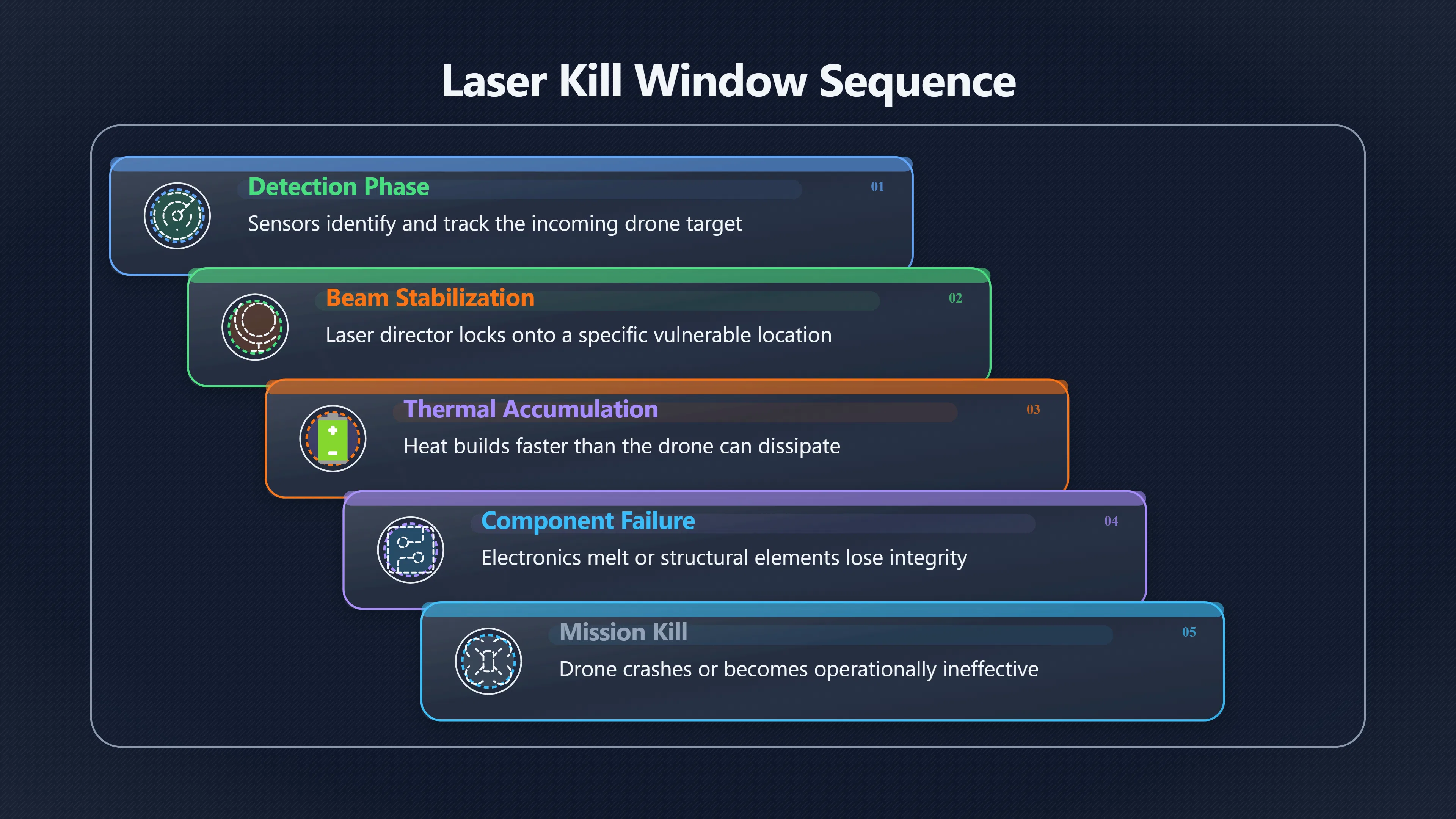
This creates a practical kill window:

- The drone is detected and tracked.
- The beam is stabilised on a vulnerable location.
- Heat accumulates faster than the target can dissipate it.
- Components fail, deform, ignite, or lose functionality.
- The drone crashes, withdraws, or becomes operationally ineffective. dia.mil
The slower the target and the more accurately the laser can maintain focus, the more energy reaches the intended point. This is one reason naval laser developers place enormous emphasis on beam control, tracking precision, and maintaining lock on manoeuvring targets. Office of Naval Research
A useful comparison is between a quadcopter and a sea-skimming anti-ship missile. The drone may remain observable for tens of seconds or longer, while a missile travelling hundreds of metres per second can cross the same engagement space in only a few seconds. Even if both are theoretically vulnerable to heat, the available dwell time is radically different. dia.mil
Why Tracking Is Easier Against Drones
Maintaining beam placement is as important as generating power. If the laser wanders across the target, heating spreads over a larger area and destructive effects take longer to appear. High-speed manoeuvring targets therefore impose severe demands on tracking systems. The US Navy’s research priorities specifically highlight improved tracking accuracy against fast and manoeuvring threats as a continuing requirement. Office of Naval Research
Small drones reduce this burden. Many operate at modest speeds and perform relatively gentle manoeuvres compared with missiles designed to evade interception. Their slower angular motion allows tracking systems to keep the beam concentrated on one location rather than constantly reacquiring the target. Office of Naval Research
This is one reason why recent naval and military laser demonstrations continue to focus heavily on counter-drone missions. The combination of manageable tracking demands and favourable dwell times produces a target set that aligns with current laser capabilities. GAO
Real-World Evidence From Counter-Drone Programmes
The pattern visible across directed-energy development programmes is striking. Government assessments, military demonstrations, and industry presentations consistently identify drones as among the most practical near-term targets for high-energy lasers. The US Government Accountability Office notes that directed-energy programmes are being developed specifically with threats such as drones in mind, while industry demonstrations repeatedly showcase counter-UAS engagements. GAO+2GAO
Recent naval testing has reflected the same emphasis. Public reporting on HELIOS trials and related laser systems has centred on drone engagements rather than routine demonstrations against advanced anti-ship missiles. Likewise, the UK’s DragonFire laser has publicly demonstrated successful engagements against fast drone targets during testing, reinforcing the view that unmanned aircraft currently represent the most realistic operational target set for shipboard lasers in this power class. Tom’s Hardware
These demonstrations do not prove that every drone can be destroyed instantly. They do show that the combination of laser power, beam quality, tracking precision, and target vulnerability is now sufficient to make many small UAVs a credible and repeatable engagement class. Tom’s Hardware
Where Drone Hardening Changes the Equation
The fact that drones are favourable targets does not mean they are defenceless. Laser effectiveness depends on maintaining heat faster than the target can absorb, reflect, disperse, or survive it. Any measure that lengthens the required dwell time reduces the laser’s advantage. dia.mil
Potential hardening approaches include:
- Reflective or low-absorption surface treatments.
- Thermal shielding around critical components.
- Redundant sensors and flight-control systems.
- Faster manoeuvring profiles.
- Rotating or tumbling flight behaviour that prevents continuous heating of one spot.
- Structural designs that continue flying despite localised damage. Naval Postgraduate School+2AeroMorning.com
None of these measures makes a drone immune. Instead, they increase the amount of energy and time required to achieve a mission kill. Because lasers are fundamentally dwell-time weapons, even modest increases in survivability can have disproportionate effects during combat, especially when a ship must engage multiple targets in succession. Analysts frequently identify dwell-time requirements as one of the major constraints on laser performance during saturation attacks. linkedin.com
The Practical Boundary for 60 kW Naval Lasers
For a 60 kW-class naval laser, small drones sit near the centre of the weapon’s most favourable engagement envelope. They are light enough to be damaged by concentrated heating, slow enough to track, and often exposed long enough for the beam to remain on target. Those characteristics create the dwell-time margin that laser weapons need to work reliably. dia.mil+2RTX
This does not mean lasers are only anti-drone weapons, nor that every drone is easy to defeat. It does mean that small UAVs represent the clearest intersection between current laser power levels and the physical realities of thermal engagement. In the broader discussion of 60 kW naval lasers, the importance of small drones is therefore not merely that they are common threats. It is that they give the laser enough time to turn light into damage. dia.mil+2GAO
Amazon book picks
Further Reading
Books and field guides related to Why Small Drones Are Laser-Friendly Targets. Use these as the next step if you want deeper reading beyond the article.
The Kill Chain
Covers the evolution of precision warfare, sensors, networks, and emerging threats including unmanned systems.
Army of None
Explains how unmanned systems are employed and countered, providing context for why small drones are attractive targets for advanced defe...
Drone Warfare
Provides background on drone capabilities, proliferation, and operational use cases that drive counter-drone development.
New Fire
Places emerging military technologies, including autonomous and networked systems, into the broader future-warfare context.
eBay marketplace picks
Marketplace Samples
Example marketplace items related to this page. Use the search link to explore similar finds on eBay.




Endnotes
2.
Source: rtx.com
Link:https://www.rtx.com/raytheon/what-we-do/integrated-air-and-missile-defense/lasers
Source snippet
High-Energy Lasers | RaytheonThis directed energy technology enables detection of threats, tracking during maneuvers, and positive vis...
3.
Source: gao.gov
Title: gao 23 105868
Link:https://www.gao.gov/products/gao-23-105868
Source snippet
Directed Energy Weapons: DOD Should Focus on...Apr 17, 2023 — The Department of Defense (DOD) is currently developing directed energy...
4.
Source: mdpi.com
Link:https://www.mdpi.com/2673-3269/5/4/28
Source snippet
Study on the Performance of Laser Device for Attacking...by J Wu · 2024 · Cited by 5 — In order to test the performance of laser dev...
5.
Source: onr.navy.mil
Link:https://www.onr.navy.mil/organization/departments/code-35/division-353/directed-energy-weapons-cdew-and-high-energy-lasers
Source snippet
Office of Naval ResearchCounter Directed Energy Weapons and High Energy LasersThe intent is to increase accuracy in all weather condition...
6.
Source: linkedin.com
Link:https://www.linkedin.com/pulse/technical-evolution-operational-integration-light-based-robi-sen-hhdoc
Source snippet
her, dwell time, beam quality, target material, tracking stability...
7.
Source: gao.gov
Title: gao 23 106717
Link:https://www.gao.gov/products/gao-23-106717
Source snippet
Science & Tech Spotlight: Directed Energy Weapons25 May 2023 — They also generally have a shorter range than conventional weapons, and we...
Published: May 2023
8.
Source: aeromorning.com
Link:https://aeromorning.com/en/directed-energy-counter-drone-rf-vs-laser-drone-hardening/
Source snippet
Directed-Energy Counter-Drone: RF vs Laser...4 days ago — Comparison of counter-drone directed-energy systems: RF RapidDestroyer vs MBDA...
9.
Source: linkedin.com
Link:https://www.linkedin.com/pulse/photonic-shield-defining-future-laser-based-weapons-matt-kuppers-dxvkf
Source snippet
pot to melt through it) means that in a high-saturation...Read more...
10.
Source: gao.gov
Link:https://www.gao.gov/assets/830/825926.pdf
Source snippet
Directed Energy WeaponsDirected energy weapons (DEW) use concentrated electromagnetic energy to combat enemy forces and assets. These wea...
11.
Source: gao.gov
Link:https://www.gao.gov/video/directed-energy-weapons-dod-should-focus-transition-planning
Source snippet
Directed Energy Weapons DOD Should Focus on Transition...DOD spends about $1 billion annually on directed energy--concentrated electroma...
12.
Source: defencesciencereview.com.pl
Title: pdf 216776 135052
Link:https://www.defencesciencereview.com.pl/pdf-216776-135052?filename=Laser-Based-[Directed-Ener
Source snippet
Defence Science ReviewDEFENCE SCIENCE REVIEWby A Karkadakattil · 2026 · Cited by 1 — Objectives: This review aims to evaluate the current...
13.
Source: tomshardware.com
Title: uk confirms dragonfire laser weapon for royal navy destroyers by 2027
Link:https://www.tomshardware.com/tech-industry/uk-confirms-dragonfire-laser-weapon-for-royal-navy-destroyers-by-2027
Source snippet
This follows a £316 million ($414 million) contract awarded to MBDA UK for the first two production units. DragonFire, a 50 kW-class lase...
14.
Source: nps.edu
Title: JDE 7 2 Johnson
Link:https://nps.edu/documents/10180/142489929/JDE_7-2_Johnson.pdf
Source snippet
UAV, requiring a long dwell time and high energy for an HEL system to cause damage. A BAMS UAV is most vulnerable during launch and...Re...
Additional References
15.
Source: researchgate.net
Link:https://www.researchgate.net/publication/395192454_AI-Based_Predictive_Laser_Beam_Control_for_UAV_Interception_in_Directed_Energy_Weapon_Systems_Using_Velocity-Based_Trajectory_Prediction
Source snippet
ResearchGate(PDF) AI-Based Predictive Laser Beam Control for UAV...9 Aug 2025 — The predictive model achieves a tracking accuracy of 94...
16.
Source: lockheedmartin.com
Link:https://www.lockheedmartin.com/en-us/capabilities/directed-energy.html
Source snippet
Directed Energy | Lockheed MartinExperience the potential of our laser weapons and directed energy weapon technologies, providing afforda...
17.
Source: facebook.com
Link:https://www.facebook.com/themilitarychannelusa/posts/read-for-decades-laser-weapons-were-the-stuff-of-science-fiction-relegated-to-mo/122206937342902462/
Source snippet
READ 💬: For decades, laser weapons were...“The HELIOS program is the first of its kind, and brings together laser weapon, long-range [in...
18.
Source: thesun.co.uk
Link:https://www.thesun.co.uk/news/33175795/navy-helios-laser-drone-warship/
Source snippet
HELIOS, standing for High Energy Laser with Integrated Optical-dazzler and Surveillance, aims to bolster the Navy's defensive capabilitie...
19.
Source: facebook.com
Link:https://www.facebook.com/groups/775801081313358/posts/1048134997413297/
Source snippet
US Navy's Helios laser weapon targets drones and...The 150kW laser can: destroy drones (2 seconds), disable small boats (5 seconds), and...
20.
Source: securityanddefence.pl
Link:https://securityanddefence.pl/Testing-the-efficiency-of-laser-technology-to-destroy-the-rogue-drones%2C127360%2C0%2C2.html
Source snippet
Testing the efficiency of laser technology to destroy...by MZ Chaari · 2020 · Cited by 17 — We will study the concept of the laser beam...
21.
Source: realcleardefense.com
Title: war at the speed of light the emerging role of directed energy weapons 1176974
Link:https://www.realcleardefense.com/articles/2026/04/16/war_at_the_speed_of_light_the_emerging_role_of_directed-energy_weapons_1176974.html
Source snippet
The Emerging Role of Directed-Energy Weapons16 Apr 2026 — Certainly, directed-energy weapons may be key to inexpensively countering missi...
22.
Source: unmannedairspace.info
Title: us gao report directed energy weapon technical maturity levels still lagging
Link:https://www.unmannedairspace.info/counter-uas-systems-and-policies/us-gao-report-directed-energy-weapon-technical-maturity-levels-still-lagging/
Source snippet
directed energy weapon technical maturity levels still laggingUS GAO report: directed energy weapon technical maturity levels still lagging...
23.
Source: youtube.com
Link:https://www.youtube.com/watch?v=cEdgipGA6L0
24.
Source: aspistrategist.org.au
Title: war at the speed of light the emerging role of directed energy weapons
Link:https://www.aspistrategist.org.au/war-at-the-speed-of-light-the-emerging-role-of-directed-energy-weapons/
Source snippet
the emerging role of directed-energy weapons15 Apr 2026 — Certainly, directed-energy weapons may be key to inexpensively countering missi...
Topic Tree