Within Directed Energy
Can Shipboard Lasers Defend at Sea?
The US Navy's HELIOS tests show why shipboard lasers are promising but operationally incremental.
On this page
- Why ships are attractive laser platforms
- Testing against unmanned aerial targets
- Salt air, motion and clutter at sea
Page outline Jump by section
Introduction
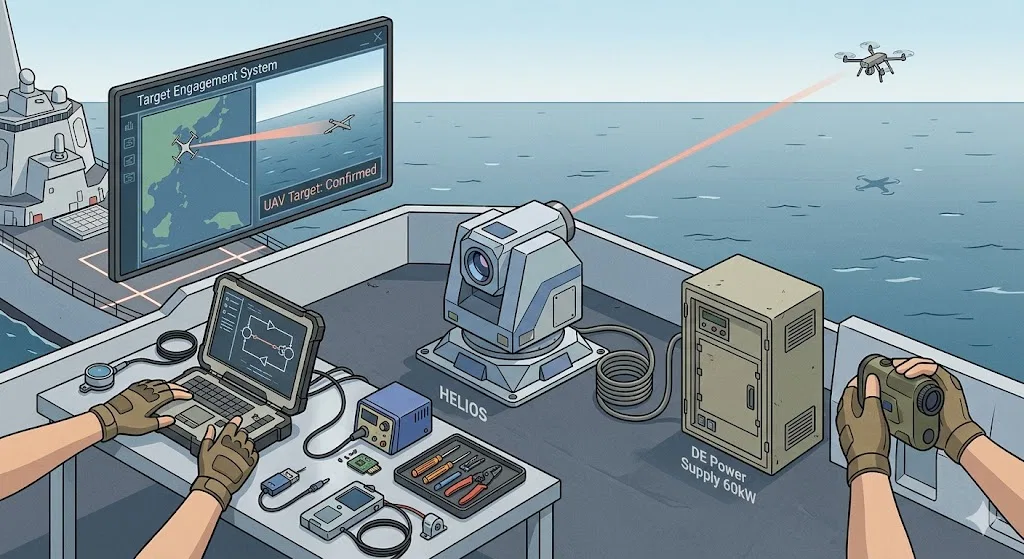
HELIOS is the clearest public case of how shipboard lasers are moving from laboratory promise to cautious naval practice. The US Navy’s High Energy Laser with Integrated Optical-dazzler and Surveillance system, fitted to the destroyer USS Preble, has been tested at sea against unmanned aerial targets and is designed to add a low-cost, speed-of-light defensive layer for drones, small boats and sensors. The important point is not that lasers are about to replace missiles. It is that a real warship has begun proving a laser can be integrated with naval combat systems, fired in maritime conditions and used as part of layered defence. That makes HELIOS significant, but still incremental: its value is strongest against certain close-range, lower-end threats, while weather, ship power, cooling, beam control and target saturation continue to limit what lasers can do at sea.[Media - Lockheed Martin+2Every CRS Report]news.lockheedmartin.comLockheed MartinMedia - Lockheed Martin - Releases…
Why ships are attractive laser platforms
Surface warships are unusually logical places to try high-energy lasers. Compared with aircraft, small vehicles or dismounted systems, a destroyer has more space, electrical generation, cooling capacity, sensors and command systems. It also has a practical defensive problem: missiles, drones and small craft can arrive in numbers, while a ship’s missile cells and gun ammunition are finite. A laser does not create a deep magazine by magic, but it can keep firing as long as the ship can provide power, cooling and enough time on target. GAO describes this basic attraction in broad directed-energy terms: lasers can offer lower per-shot costs and, in some situations, firing capacity limited more by power than by carried ammunition.[GAO]gao.govScience & Tech Spotlight: Directed Energy Weapons | U.S. GAOScience & Tech Spotlight: Directed Energy Weapons | U.S. GAO…
HELIOS is not simply a laser bolted to the deck. Lockheed Martin describes it as a 60-plus kilowatt-class system delivered to the Navy in 2022, intended as the first tactical laser weapon system integrated into existing ships. Congressional Research Service reporting identifies it as Surface Navy Laser Weapon System Increment 1: a 60 kW-class high-energy laser with growth potential, an optical dazzler and surveillance functions in a single integrated weapon system.[Media - Lockheed Martin]news.lockheedmartin.comLockheed MartinMedia - Lockheed Martin - Releases…
That integration matters. A shipboard laser needs to be cued by sensors, pointed accurately, deconflicted with other weapons and fitted into the ship’s combat management process. CRS notes that HELIOS is integrated with the Aegis Combat System on a Flight IIA Arleigh Burke-class destroyer, giving it a more ambitious role than earlier dazzler-only or demonstration systems. The practical aim is to give commanders another response option between doing nothing, jamming or dazzling, using a gun, or spending a missile.[Every CRS Report]everycrsreport.comEvery CRS Reportwww.everycrsreport.comEvery CRS Reportwww.everycrsreport.com

What HELIOS adds beyond earlier naval laser trials
The Navy had already tested shipboard lasers before HELIOS. CRS traces the line from the earlier Laser Weapon System on USS Ponce and the Laser Weapon System Demonstrator on USS Portland to HELIOS and related Navy laser efforts. In 2020, Portland used its laser demonstrator to disable an unmanned aerial vehicle in an at-sea test, but HELIOS is more important as a fleet-integration step because it is tied to an operational destroyer rather than existing only as a stand-alone demonstration.[Every CRS Report]everycrsreport.comEvery CRS Reportwww.everycrsreport.comEvery CRS Reportwww.everycrsreport.com
HELIOS also combines three roles that are often discussed separately. At higher power, it is meant to damage or destroy selected targets such as drones and small craft. At lower power, its optical dazzler function is intended to interfere with electro-optical sensors, especially those carried by unmanned systems. Its surveillance function can feed visual and targeting information back into the wider combat system. This combination is why HELIOS is best understood as a defensive sensor-and-effector package, not just a “laser cannon”.[Every CRS Report]everycrsreport.comEvery CRS Reportwww.everycrsreport.comEvery CRS Reportwww.everycrsreport.com
The weapon’s power level also helps explain its realistic place in the Navy’s roadmap. A 60 kW-class laser is credible for some drones and small surface threats, but more demanding targets, especially anti-ship cruise missiles, require much harder beam-control, tracking and lethality performance. CRS reports that the Navy’s High Energy Laser Counter-ASCM Program is focused on technical challenges such as atmospheric turbulence, automatic target identification, aim-point selection, low-jitter tracking in clutter and higher-power laser development.[Every CRS Report]everycrsreport.comEvery CRS Reportwww.everycrsreport.comEvery CRS Reportwww.everycrsreport.com
Testing against unmanned aerial targets
The most important public HELIOS evidence came from the Pentagon’s FY2024 Director, Operational Test and Evaluation reporting. The Center for Countermeasures said it supported the Navy’s demonstration on USS Preble to verify and validate HELIOS functionality, performance and capability against an unmanned aerial vehicle target, and collected imagery of the engagements to support performance evaluation.[Dote]dote.osd.milDOT&E FY2024 Annual Report - DOT&E Managed - CCM…
That wording is careful. It confirms an at-sea demonstration against a UAV target, but it does not disclose the full engagement geometry, weather, range, target type, number of attempts, failure rate, rules of the trial or how representative the target was of a hostile drone. Navy Times reported that Preble fired HELIOS in fiscal 2024 and that the DOT&E report did not provide the date, time or location of the firing.[Navy Times]navytimes.comNavy Times US Navy hits drone with HELIOS laser in successful testNavy Times US Navy hits drone with HELIOS laser in successful test
Later reporting added that Lockheed Martin’s chief executive said HELIOS neutralised four drone threats in a Navy-operated counter-UAS demonstration at sea. That suggests testing is moving from single-target proof towards more operationally useful scenarios, but the public record still leaves major details unresolved: whether the drones approached one at a time or together, how fast they were moving, what altitude they used, how many shots were required and what environmental conditions applied.[The War Zone]twz.comOpen source on twz.com.
The best reading is therefore measured optimism. HELIOS has demonstrated something real on a deployed destroyer against unmanned aerial targets. It has not publicly demonstrated that a single laser can defeat a dense, mixed raid of drones, missiles and decoys in poor maritime weather. That distinction is central to understanding lasers at sea.
Salt air, motion and clutter at sea
A laser weapon has to do more than generate power. It must keep enough energy on a precise aim point long enough to cause the desired effect. At sea, that is harder than the simple phrase “speed of light” suggests. The target may be moving, the ship is moving, the air column between ship and target is changing, and the beam may pass through water vapour, salt particles, smoke, dust or rain.
CRS is unusually direct about these limits. Shipboard lasers are line-of-sight weapons, so they cannot hit over-the-horizon targets or targets hidden behind waves, ship structure or other objects. Marine air can absorb and scatter laser light, while turbulence can defocus the beam. Water vapour is especially relevant in maritime environments, although designers can choose wavelengths that reduce absorption and use adaptive optics to compensate for some turbulence. Even so, CRS states that lasers may work poorly or not at all in rain or fog.[Every CRS Report]everycrsreport.comEvery CRS Reportwww.everycrsreport.comEvery CRS Reportwww.everycrsreport.com
There is also the problem of “thermal blooming”. If a laser heats the air along its path, the beam can defocus, reducing energy at the target. CRS notes that this can be especially awkward for targets coming straight at the ship on a constant bearing, because the laser keeps firing through roughly the same column of air. In such cases, conventional systems such as interceptor missiles or close-in weapon systems may still be better suited.[Every CRS Report]everycrsreport.comEvery CRS Reportwww.everycrsreport.comEvery CRS Reportwww.everycrsreport.com
The sea also creates a tracking problem. Small drones and fast craft can be hard to distinguish against horizon clutter, spray, reflections and other moving objects. HELIOS is therefore as much a beam-control and fire-control challenge as a power challenge. The laser must acquire the target, pick a useful aim point, hold that aim point with very low jitter and assess whether enough damage has been done before switching to the next target.
What HELIOS can realistically defend against
HELIOS is most compelling against threats where the cost and magazine problem is sharpest: unmanned aerial systems, small boats and hostile sensors. A drone that is cheap, slow enough, close enough and structurally vulnerable is a good laser target. A small boat’s exposed sensor, engine component or fuel area may also be vulnerable, depending on geometry and range. An optical sensor on a drone or vessel can be dazzled or degraded without necessarily destroying the whole platform.
The harder question is missiles. Industry and Navy discussion has often pointed towards anti-ship cruise missile defence as a long-term goal, but public evidence supports caution. Seapower reported that HELIOS replaced Preble’s forward Mk 15 Close-In Weapon System and quoted Lockheed’s Paul Lemmo and Brendan Scanlon-related programme discussion through Tyler Griffin? More usefully, the same report said the 60 kW system was described as scalable up to 120 kW with additional fibre-optic modules, and Lockheed’s Joe Ottaviano? said modelling suggested the 60–120 kW range could be effective against an anti-ship cruise missile, with real-world test data still needed.[Seapower]seapowermagazine.orgSeapower HELIOS Laser Weapon System Delivered for Installation on USS PrebleSeapowerHELIOS Laser Weapon System Delivered for Installation on USS Preble - Seapower…
That is not the same as proven fleet missile defence. CRS describes HELIOS as focused on UAVs, small boats, ISR sensors, combat identification and battle damage assessment, while higher-power and more specialised work is aimed at anti-ship cruise missile defeat. The likely near-term role is therefore layered defence: use HELIOS where it is suitable, preserve missiles for more stressing threats, and avoid pretending that a 60 kW-class shipboard laser replaces hard-kill interceptors.[Every CRS Report]everycrsreport.comEvery CRS Reportwww.everycrsreport.comEvery CRS Reportwww.everycrsreport.com

Why “low cost per shot” is true but incomplete
The most quoted advantage of lasers is cost per shot. Once installed, a laser engagement may consume far less in immediate energy cost than a missile shot. That matters for naval defence because expensive interceptors are a poor economic match for cheap drones. Breaking Defense reported senior Navy concern that shooting down relatively cheap drones with multi-million-dollar missiles does not make sense over time, which is why directed energy remains attractive despite slow fielding.[Breaking Defense]breakingdefense.comBreaking Defense…
But cost per shot is not the whole cost of the capability. The ship must pay the price in installation space, topside placement, electrical power, cooling, maintenance, training, software integration and opportunity cost. Rear Adm. Fred Pyle told a Surface Navy Association audience that lasers require space, weight, power and cooling, all of which can be challenging on current surface combatants. CRS also notes that future laser cost estimates are limited because the Department of Defense lacks previous shipboard laser programmes of record from which to draw reliable logistics and life-cycle comparisons.[Breaking Defense]breakingdefense.comBreaking Defense…
This is why HELIOS should be judged as an added defensive layer, not a cheap miracle. If it can take selected drones out of the engagement queue, it can save missiles for harder targets. If the weather is poor, the raid is too dense, the target is too far away, or the beam cannot dwell long enough, the ship still needs missiles, guns, electronic warfare and decoys.
Why progress remains incremental
The strongest evidence that HELIOS matters is also evidence that the Navy is moving slowly. One destroyer with an integrated laser is a major technical step, but it is not fleet-wide adoption. Breaking Defense reported in 2025 that Adm. Daryl Caudle, then commander of US Fleet Forces Command, said the Navy should be embarrassed that it had not scaled directed-energy weapons across ships despite decades of experimentation. His criticism was not that lasers are useless; it was that the transition from successful demonstrations to dependable fielded capability has been too slow.[Breaking Defense]breakingdefense.comBreaking DefenseState of Navy's shipboard laser efforts is embarrassing, says top fleet commander - Breaking Defense…
That frustration matches HELIOS’s actual status. It has been delivered, installed and tested. It appears to have engaged drones successfully at sea. It is integrated in a way earlier systems were not. Yet the public evidence still points to a weapon being learned, refined and operationally bounded rather than a mature replacement for the ship’s existing self-defence suite.
For readers trying to understand directed energy weapons, HELIOS is therefore a useful corrective to both hype and dismissal. It shows that shipboard lasers are no longer just futuristic sketches. It also shows why naval warfare rarely changes in a single leap. At sea, a laser must survive the environment, fit the ship, work with the combat system, handle real targets and earn the crew’s trust. HELIOS has begun that process; it has not finished it.
Amazon book picks
Further Reading
Books and field guides related to Can Shipboard Lasers Defend at Sea?. Use these as the next step if you want deeper reading beyond the article.

Directed Energy Weapons
Directly addresses military laser systems and operational use.

The Naval Institute guide to world naval weapons systems
First published 1989. Subjects: Handbooks, manuals, Weapons systems, Naval Ordnance.

Fleet Tactics And Naval Operations, Third Edition
First published 2018. Subjects: Naval tactics.
eBay marketplace picks
Marketplace Samples
Example marketplace items related to this page. Use the search link to explore similar finds on eBay.
Endnotes
1.
Source: news.lockheedmartin.com
Link:https://news.lockheedmartin.com/2022-08-18-Lockheed-Martin-Delivers-Integrated-Multi-Mission-Laser-Weapon-System-to-the-Navy
Source snippet
Lockheed MartinMedia - Lockheed Martin - Releases...
2.
Source: gao.gov
Title: Science & Tech Spotlight: Directed Energy Weapons | U.S. GAO
Link:https://www.gao.gov/products/gao-23-106717
Source snippet
Science & Tech Spotlight: Directed Energy Weapons | U.S. GAO...
3.
Source: navy.mil
Title: laser trailblazer navy conducts historic test of new laser weapon system
Link:https://www.navy.mil/Press-Office/News-Stories/Article/2998829/laser-trailblazer-navy-conducts-historic-test-of-new-laser-weapon-system/
4.
Source: onr.navy.mil
Link:https://www.onr.navy.mil/organization/departments/code-35/division-353/directed-energy-weapons-cdew-and-high-energy-lasers
5.
Source: history.navy.mil
Link:https://www.history.navy.mil/research/library/online-reading-room/title-list-alphabetically/n/navy-shipboard-lasers.html
6.
Source: optics.org
Link:https://optics.org/news/lockheed-martin-delivers-helios-laser-system-to-us-navy
7.
Source: everycrsreport.com
Title: Every CRS Reportwww.everycrsreport.com
Link:https://www.everycrsreport.com/files/2024-07-24_R44175_bd7aad12b8fb1d1589b9506a55c9ad6922b142a3.html
8.
Source: dote.osd.mil
Link:https://www.dote.osd.mil/Portals/97/pub/reports/FY2024/dotemanaged/2024ccm.pdf?ver=D-vOCYOvFw2JDQfuzsd-gA%3D%3D
Source snippet
DOT&E FY2024 Annual Report - DOT&E Managed - CCM...
9.
Source: seapowermagazine.org
Title: Seapower HELIOS Laser Weapon System Delivered for Installation on USS Preble
Link:https://seapowermagazine.org/helios-laser-weapon-system-delivered-for-installation-on-uss-preble/?print=print
Source snippet
SeapowerHELIOS Laser Weapon System Delivered for Installation on USS Preble - Seapower...
10.
Source: navytimes.com
Title: Navy Times US Navy hits drone with HELIOS laser in successful test
Link:https://www.navytimes.com/news/your-navy/2025/02/04/us-navy-hits-drone-with-helios-laser-in-successful-test/
11.
Source: twz.com
Link:https://www.twz.com/sea/uss-preble-used-helios-laser-to-zap-four-drones-in-expanding-testing
12.
Source: breakingdefense.com
Link:https://breakingdefense.com/2024/01/its-hard-navy-needs-to-be-realistic-about-laser-weapons-admiral-says/
Source snippet
Breaking Defense...
13.
Source: breakingdefense.com
Link:https://breakingdefense.com/2025/01/state-of-navys-shipboard-laser-efforts-is-embarrassing-says-top-fleet-commander/
Source snippet
Breaking DefenseState of Navy's shipboard laser efforts is embarrassing, says top fleet commander - Breaking Defense...
14.
Source: twz.com
Title: trump class battleships could get megawatt lasers navys top officer
Link:https://www.twz.com/news-features/trump-class-battleships-could-get-megawatt-lasers-navys-top-officer
15.
Source: Wikipedia
Link:https://en.wikipedia.org/wiki/Helios
16.
Source: dote.osd.mil
Title: 2024Annual Report
Link:https://www.dote.osd.mil/Portals/97/pub/reports/FY2024/other/2024Annual-Report.pdf
17.
Source: seapowermagazine.org
Link:https://seapowermagazine.org/lockheed-martin-delivers-helios-laser-weapon-system-to-navy-for-testing/?print=print
18.
Source: lockheedmartin.com
Link:https://www.lockheedmartin.com/en-us/careers/index.html
19.
Source: lockheedmartin.com
Link:https://www.lockheedmartin.com/en-us/index.html
20.
Source: lockheedmartin.com
Title: more than a laser helios is an integrated weapon system
Link:https://www.lockheedmartin.com/en-us/news/features/2021/more-than-a-laser-helios-is-an-integrated-weapon-system.html
21.
Source: lockheedmartin.com
Link:https://www.lockheedmartin.com/content/dam/lockheed-martin/rms/documents/directed-energy/HELIOS_Infographic_FINAL.pdf
22.
Source: lockheedmartin.com
Link:https://www.lockheedmartin.com/en-us/capabilities/directed-energy.html
23.
Source: everycrsreport.com
Link:https://www.everycrsreport.com/reports/R44175.html
24.
Source: peaceliteracy.org
Link:https://www.peaceliteracy.org/helios
Additional References
25.
Source: youtube.com
Title: Editors Picks: Are High-Energy Laser Weapons Ready To Fulfil Their Potential?
Link:https://www.youtube.com/watch?v=UNzIsizlKP4
Source snippet
US Navy Deploys Its HELIOS High-Energy Laser System In Operation Fury Against Iran | News18...
26.
Source: youtube.com
Title: Iran War Day 11: US HELIOS Laser Flips Drone Warfare — $20K vs 50¢
Link:https://www.youtube.com/watch?v=o-h6DiYJhVM
Source snippet
Editors Picks: Are High-Energy Laser Weapons Ready To Fulfil Their Potential?...
27.
Source: youtube.com
Title: Why HELIOS is set to be a key defensive asset for US Navy warships?
Link:https://www.youtube.com/watch?v=hVnIiE2W2a0
Source snippet
HELIOS laser tested from Arleigh Burke-class destroyer USS Preble...
28.
Source: youtube.com
Title: HELIOS laser tested from Arleigh Burke-class destroyer USS Preble!
Link:https://www.youtube.com/watch?v=y49-0nwmJYs
Source snippet
Iran War Day 11: US HELIOS Laser Flips Drone Warfare — $20K vs 50¢...
29.
Source: instagram.com
Link:https://www.instagram.com/p/DXPtQ9OCJAa/
30.
Source: instagram.com
Link:https://www.instagram.com/reel/DF3OhYlyxSs/
31.
Source: reddit.com
Link:https://www.reddit.com/r/UkrainianConflict/comments/1r3edik/lockheed_martin_developed_an_antidrone_laser/
32.
Source: linkedin.com
Link:https://www.linkedin.com/posts/wearehii_navy-helios-laser-aboard-uss-preble-zaps-activity-7292965955733786628-dmLJ
33.
Source: researchgate.net
Link:https://www.researchgate.net/publication/229735078_Navy_High_Energy_Laser_Weapon_System
34.
Source: missiledefenseadvocacy.org
Link:https://www.missiledefenseadvocacy.org/wp-content/uploads/2015/04/Navy-Lasers-CRS.pdf
Topic Tree
Follow this branch
Parent topic
Directed EnergyRelated pages 11
- Atmosphere Why Bad Weather Matters for Laser Weapons
- Defence Layer Why Directed Energy Will Not Replace Missiles
- Dragon Fire What Dragon Fire Reveals About Battlefield Lasers
- Electronics Risk When Counter Drone Energy Hits the Wrong Electronics
- Engineering What the Beam Needs Behind the Scenes
- Laser vs Microwave Lasers or Microwaves: Which Threat Fits Which Beam?
- Lasers Why Laser Weapons Are Precise but Demanding
- Leonidas Why Anti Drone Microwaves Attract Investment
- +3 more in sidebar