Within Directed Energy
Lasers or Microwaves: Which Threat Fits Which Beam?
Lasers and microwaves solve different problems, so the best choice depends on precision, target count and risk tolerance.
On this page
- One narrow aim point versus wider area effects
- Single targets, swarms and electronics
- Precision, collateral effects and engagement choice
Page outline Jump by section
Introduction
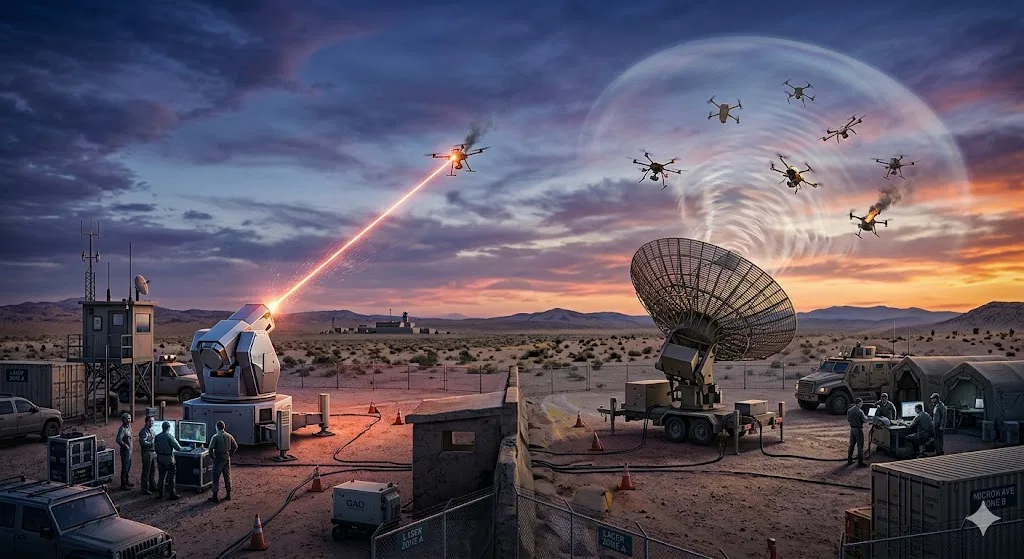
Lasers and high-power microwaves are both directed energy weapons, but they are not interchangeable air-defence tools. A laser is best understood as a precise, line-of-sight heat weapon: it concentrates energy on a small aim point until a sensor, motor, skin, wing or casing fails. A high-power microwave system is better understood as a counter-electronics weapon: it emits radio-frequency energy intended to disrupt or damage electronic systems, often across a wider area. That difference drives the whole choice. Lasers suit deliberate engagements against single visible targets where precision and controlled collateral effects matter. Microwaves suit raids by multiple cheap drones, especially when the defender values speed and area coverage more than fine discrimination. Official assessments increasingly treat both as useful layers, not as replacements for missiles, guns or electronic warfare.[GAO]gao.govgao 23 106717Science & Tech Spotlight: Directed Energy Weapons25 May 2023 — For example, wider beam DEWs, such as high power microwave or millimete…
One Narrow Aim Point Versus Wider-Area Effects
The most important practical difference is not that one weapon is “better” than the other. It is that they put energy into targets in very different ways.
A high-energy laser has to see, track and hold a beam on the right part of the target. Against a drone, that may mean heating a propeller, motor housing, battery area, sensor window or structural component until it fails. This makes the laser attractive where the defender needs a clean engagement: a ship protecting itself near civilian vessels, an airbase worried about where wreckage may fall, or a commander who wants to disable one object without filling the air with fragments. The UK’s DragonFire programme shows the appeal clearly: the Ministry of Defence says the system can hit a £1 coin from a kilometre away, costs about £10 per shot in energy terms, and is being moved towards Royal Navy Type 45 destroyers from 2027 after high-speed drone trials.[GOV.UK]GOV.UKBoost for Armed Forces as new laser weapon takes down…November 20, 2025 — 20 Nov 2025 — Britain's ground-breaking DragonFire laser has…
That precision comes with a burden. The laser needs adequate power, cooling, beam quality, target tracking and dwell time. It may also be degraded by rain, fog, smoke, dust, turbulence or heat shimmer, because the atmosphere can scatter, absorb or distort the beam before enough energy reaches the target. This does not mean lasers are useless in bad weather; military research tries to manage those effects. But it does mean air-defence planners cannot treat laser range on a clear test day as a fixed combat radius in all climates.[Defence Science Review+2Optica Publishing Group]defencesciencereview.com.plDefence Science ReviewDEFENCE SCIENCE REVIEWJanuary 17, 2026 — by A Karkadakattil · 2026 · Cited by 1 — In clear air, high-energy lasers…
High-power microwave systems reverse many of those trade-offs. They are aimed at electronics rather than a physical burn-through point. The US Office of Naval Research describes high-power microwaves as beams across radio and microwave frequencies intended to interact with electronics, either causing damage or temporary disruption from which the target cannot recover in time. ONR also highlights broad beams, wide-area coverage and comparatively simple targeting as advantages.[Office of Naval Research]onr.navy.milOpen source on navy.mil.
That wider-area effect is exactly why microwave systems are interesting against drone swarms, and exactly why they raise discrimination concerns. The US Government Accountability Office notes that wider-beam directed energy weapons, including high-power microwave or millimetre-wave systems, may affect assets in an area whether they are friend or foe. In air defence, that is a serious policy and operational question: the same feature that makes a microwave pulse attractive against many hostile drones can make it harder to use near friendly radios, civilian electronics, hospital equipment, aircraft systems or one’s own drones.[GAO]gao.govgao 23 106717Science & Tech Spotlight: Directed Energy Weapons25 May 2023 — For example, wider beam DEWs, such as high power microwave or millimete…
Single Targets, Swarms and Electronics
A helpful way to compare the two technologies is to ask what the defender is trying to stop.
For a single drone, loitering munition or exposed sensor, a laser may be the more elegant tool. It can be pointed at one object, adjusted in effect, and fired again as long as the platform has power and thermal capacity. South Korea’s laser programme, for example, has been framed around cheap shots against North Korean drones, with Reuters reporting that the system is intended to burn drone engines or electronic equipment over roughly 10 to 20 seconds.[Reuters]reuters.comSouth Korea to deploy 'Star Wars' laser weapons targeting North Korean dronesSouth Korea to deploy 'Star Wars' laser weapons targeting North Korean drones
For many drones arriving together, the equation changes. A laser that must dwell on one target at a time can be forced into a queue: detect, track, burn, assess, move to the next. More power can shorten the dwell time, but it does not eliminate the need to allocate beam time and tracking attention target by target. That is why military interest in microwave systems rises sharply when the scenario shifts from a lone drone to a swarm.[Defence Science Review]defencesciencereview.com.plDefence Science ReviewDEFENCE SCIENCE REVIEWJanuary 17, 2026 — by A Karkadakattil · 2026 · Cited by 1 — In clear air, high-energy lasers…
The clearest recent examples are counter-swarm demonstrations. The US Air Force Research Laboratory said its THOR high-power microwave demonstrator was “exceptionally effective” against a drone swarm, citing a wide beam, high peak powers and a fast-moving gimbal. In the UK, a radio-frequency directed energy weapon demonstrator has been tested against drone swarms; Defence Equipment and Support says such weapons can neutralise targets up to one kilometre away with near-instant effect and an estimated energy cost below 10p per shot.[AFRL+2Defence Equipment & Support]afrl.af.milRLAFRL conducts swarm technology demonstrationRLAFRL conducts swarm technology demonstration
Industry demonstrations point in the same direction, though they should be read as company claims unless independently verified in detail. Epirus said its Leonidas high-power microwave system disabled 61 of 61 drones in a 2025 live-fire event, including 49 drones in one pulse. That is precisely the kind of “one-to-many” engagement that lasers struggle to match, because the microwave weapon is trying to couple energy into electronics across a broader field rather than drill heat into one aim point at a time.[Epirus]epirusinc.comOpen source on epirusinc.com.
The electronics dependence of modern small drones makes this especially relevant. Many cheap drones are vulnerable not because they are physically fragile, but because they rely on autopilots, cameras, receivers, wiring, processors and motor controllers. A microwave effect that upsets those systems can defeat the platform without needing to cut a wing or explode a warhead. Yet that same logic also explains the countermeasures: shielding, filtering, hardened electronics, autonomous navigation, fibre-optic control links and tactics that spread or sequence attacks can all complicate the microwave defender’s job.
Precision, Collateral Effects and Engagement Choice
The air-defence choice is therefore a risk-management choice, not just a technology choice.
A laser is usually easier to justify where precision is the controlling requirement. If a drone is close to a friendly position, a radar mast, a civilian facility or a mixed air picture, a narrow beam gives the defender more confidence about what is being engaged. It also offers scalable effects: dazzling or damaging an optical sensor is different from burning through a structure. That can matter in crowded airspace where the defender may not want every engagement to produce immediate uncontrolled debris.
A microwave system is usually more attractive where the target set is numerous, cheap and electronically soft. If a swarm is closing on a base, port, radar site or ship, the defender may care less about selecting one exact impact point and more about stopping many objects before they saturate guns and missiles. This is why senior US commanders have spoken about high-power microwaves as part of layered defence against drone swarms. In March 2024, US Central Command’s General Michael Kurilla told lawmakers that swarms make high-power microwave investment important, while also stressing that no single layer is perfect.[Defense News]defensenews.comcentral commands kurilla eyes drone countering lasers for middle eastcentral commands kurilla eyes drone countering lasers for middle east
The collateral-effects question cuts both ways. Conventional interceptors may scatter fragments, miss, or cost far more than the drone they kill. Lasers may reduce that explosive-fragment hazard but still require a safe line of fire, a clean enough beam path and attention to eye and sensor safety. Microwaves may avoid blast and fragments, but their area effect can create uncertainty around friendly or civilian electronics. That is why “low collateral” should not be treated as a universal property of directed energy. It depends on where the beam goes, what else is in the beam, what frequencies and powers are used, and how the system is authorised.
A compact decision rule is useful:
Air-defence problemLaser fitMicrowave fitOne visible drone or munitionStrong, especially when precision mattersPossible, but may be excessive if only one target is presentMany small drones arriving togetherLimited by target-by-target dwell and trackingStrong, especially against electronically vulnerable swarmsNeed to minimise effects outside one aim pointStrongerWeaker, unless the engagement area is tightly controlledBad weather, smoke, dust or turbulenceMore vulnerable to beam degradationGenerally less weather-sensitive, but still range- and geometry-limitedFriendly electronics nearbyUsually easier to confineRequires careful exclusion zones and rules of engagementMagazine depth and shot costStrong if power and cooling are availableStrong if power, pulse generation and safety constraints are manageable
Why Neither Beam Replaces the Rest of Air Defence
The strongest case for lasers and microwaves is economic endurance. Missiles can cost hundreds of thousands or millions of pounds per shot, while directed energy systems are often described in terms of very low electrical shot cost. DragonFire is publicly described at about £10 per shot, and the UK radio-frequency demonstrator at below 10p per shot. Those figures are powerful because drone warfare can impose a cruel exchange ratio: a defender may be forced to fire an expensive interceptor at a cheap aircraft.[GOV.UK+2Defence Equipment & Support]GOV.UKBoost for Armed Forces as new laser weapon takes down…November 20, 2025 — 20 Nov 2025 — Britain's ground-breaking DragonFire laser has…
But “cheap per shot” is not the same as “cheap air defence”. The system itself must be bought, integrated, powered, cooled, protected, maintained and connected to sensors and command systems. It must also work under field conditions rather than only in controlled trials. The US Army’s experience with Stryker-mounted 50-kilowatt laser prototypes is a cautionary example: Breaking Defense reported in May 2024 that soldiers testing the systems in the Middle East were not overwhelmingly positive, a reminder that mobility, power management, heat, dust, training and reliability can matter as much as beam physics.[Breaking Defense]breakingdefense.comBreaking Defense Army soldiers not impressed with Strykers outfitted with 50Breaking Defense Army soldiers not impressed with Strykers outfitted with 50
Nor do lasers and microwaves solve the same targets. A larger, faster or hardened missile may require more laser power, longer dwell, better tracking and a favourable aspect. A microwave weapon may be excellent against some drones but less decisive against shielded electronics, hardened military systems or threats whose critical components are less exposed to coupling. The Congressional Research Service therefore frames directed energy as a set of potential capabilities for missions such as short-range air defence, counter-uncrewed aircraft systems and counter-rocket, artillery and mortar defence, rather than as a universal shield.[EveryCRSReport]everycrsreport.comHTML… weapons include high-energy laser (HEL) and high-powered microwave (HPM) weapons. HEL weapons might be used by grou…
The most credible future is layered. Conventional radars and electro-optical sensors detect and classify threats. Jamming may break command links where drones depend on them. Lasers may pick off individual drones, sensors or munitions with precision. Microwaves may blunt massed drone attacks. Guns and missiles remain necessary for weather, range, hardened targets and targets that must be killed immediately with proven effects. The policy intervention is not to choose one fashionable beam, but to assign each weapon to the engagement where its physics and risks make sense.
The Practical Bottom Line
For air defence, lasers answer the question: “Can I put controlled energy on this particular target long enough to break it?” Microwaves answer a different question: “Can I disrupt enough electronics in this target group quickly enough to stop the raid?” The first question favours precision, accountability and controlled engagement. The second favours speed, swarm defence and tolerance for broader effects.
That distinction should shape procurement, testing and rules of engagement. Laser trials should be judged not only by spectacular shoot-downs, but by performance in haze, rain, maritime spray, dust, clutter, heat and repeated engagements. Microwave trials should be judged not only by how many drones fall, but by what else was exposed, how tightly effects can be bounded, how reliably different drone designs are affected, and how safely the system can operate near friendly equipment.
The best air-defence architecture is therefore not “laser versus microwave” in the abstract. It is a layered design in which lasers are used where a narrow, precise beam is the safer and more efficient answer, and microwaves are used where the threat is numerous, electronic and time-compressed. The decisive policy question is not which beam wins the technology contest, but which engagement conditions make each beam worth firing.
Amazon book picks
Further Reading
Books and field guides related to Lasers or Microwaves: Which Threat Fits Which Beam?. Use these as the next step if you want deeper reading beyond the article.
The Kill Chain
Places directed-energy systems within the broader context of modern air defense, drones, and future warfare.
Army of None
Covers emerging defense technologies, drone threats, and the operational environment in which laser and microwave defenses are increasing...

Directed Energy Weapons
Directly compares and explains major directed-energy technologies, including lasers and high-power microwave systems.
Skunk Works
This classic history of America's high-stakes quest to dominate the skies is "a gripping technothriller in which the technology is real"...
eBay marketplace picks
Marketplace Samples
Example marketplace items related to this page. Use the search link to explore similar finds on eBay.
Endnotes
1.
Source: gao.gov
Title: gao 23 106717
Link:https://www.gao.gov/products/gao-23-106717
Source snippet
Science & Tech Spotlight: Directed Energy Weapons25 May 2023 — For example, wider beam DEWs, such as high power microwave or millimete...
Published: May 2023
2.
Source: everycrsreport.com
Link:https://www.everycrsreport.com/files/2024-07-11_R46925_4c1e5a38ad3d6906a3ea03e0972e08d8979659f3.html
Source snippet
HTML... weapons include high-energy laser (HEL) and high-powered microwave (HPM) weapons. HEL weapons might be used by grou...
3.
Source: GOV.UK
Link:https://www.gov.uk/government/news/boost-for-armed-forces-as-new-laser-weapon-takes-down-high-speed-drones
Source snippet
Boost for Armed Forces as new laser weapon takes down...November 20, 2025 — 20 Nov 2025 — Britain's ground-breaking DragonFire laser has...
Published: November 20, 2025
4.
Source: reuters.com
Link:https://www.reuters.com/world/uk/uk-beefs-up-royal-navy-[counter-drone
Source snippet
This initiative is part of Britain's efforts to enhance its naval defenses, particularly against drone threats. The DragonFire system is...
5.
Source: opg.optica.org
Link:https://opg.optica.org/ao/abstract.cfm?URI=ao
Source snippet
In particular, precipitation, along with...Read more...
6.
Source: onr.navy.mil
Link:https://www.onr.navy.mil/organization/departments/code-35/division-353/directed-energy-weapons-high-power-microwaves
7.
Source: reuters.com
Title: South Korea to deploy ‘Star Wars’ laser weapons targeting North Korean drones
Link:https://www.reuters.com/world/asia-pacific/south-korea-deploy-starwars-laser-weapons-targeting-north-korean-drones-2024-07-11/
8.
Source: GOV.UK
Link:https://www.gov.uk/government/news/british-soldiers-take-down-drone-swarm-in-groundbreaking-use-of-radio-wave-weapon
9.
Source: dst.defence.gov.au
Title: defence.gov.au INSIGHT S PAPER
Link:https://www.dst.defence.gov.au/sites/default/files/events/documents/Insights%20Paper%20-%20Direct%20Energy%20F1.pdf
10.
Source: everycrsreport.com
Link:https://www.everycrsreport.com/reports/R46925.epub
11.
Source: army.mil
Title: developing lasers that pierce fog dust to destroy targets
Link:https://www.army.mil/article/195650/army_developing_lasers_that_pierce_fog_dust_to_destroy_targets
12.
Source: onr.navy.mil
Link:https://www.onr.navy.mil/organization/departments/code-35/division-353/directed-energy-weapons-cdew-and-high-energy-lasers
13.
Source: military.com
Title: top general mideast calls microwave weapons [layered defense]({{ ‘layered-defense/’ | relative_url }}) against drone swarms
Link:https://www.military.com/daily-news/2024/03/08/top-general-mideast-calls-microwave-weapons-layered-defense-against-drone-swarms.html
14.
Source: gao.gov
Title: gao 23 105868
Link:https://www.gao.gov/products/gao-23-105868
15.
Source: gao.gov
Link:https://www.gao.gov/assets/gao-23-106717.pdf
16.
Source: airpower.airforce.gov.au
Title: airforce.gov.au Directed Energy Weapons
Link:https://airpower.airforce.gov.au/sites/default/files/2021-03/BPAF03_Directed-Energy-Weapons.pdf
17.
Source: defencesciencereview.com.pl
Link:https://www.defencesciencereview.com.pl/pdf-216776-135052?filename=Laser-Based-Directed-Ener.pdf
Source snippet
Defence Science ReviewDEFENCE SCIENCE REVIEWJanuary 17, 2026 — by A Karkadakattil · 2026 · Cited by 1 — In clear air, high-energy lasers...
Published: January 17, 2026
18.
Source: defensenews.com
Title: central commands kurilla eyes drone countering lasers for middle east
Link:https://www.defensenews.com/[battlefield
19.
Source: afrl.af.mil
Title: RLAFRL conducts swarm technology demonstration
Link:https://www.afrl.af.mil/News/Article-Display/Article/3396995/afrl-conducts-swarm-technology-demonstration/
20.
Source: des.mod.uk
Title: british army drone radiofrequency weapon
Link:https://des.mod.uk/british-army-drone-radiofrequency-weapon/
21.
Source: epirusinc.com
Link:https://www.epirusinc.com/press-releases/epirus-leonidas-high-power-microwave-defeats-49-drone-swarm-100-of-drones-flown-at-live-fire-demonstration
22.
Source: breakingdefense.com
Title: Breaking Defense Army soldiers not impressed with Strykers outfitted with 50
Link:https://breakingdefense.com/2024/05/army-soldiers-not-impressed-with-strykers-outfitted-with-50-kilowatt-lasers-service-official-says/
23.
Source: facebook.com
Title: army soldiers not impressed with strykers outfitted with 50 kilowatt lasers serv
Link:https://www.facebook.com/BreakingDefense/posts/army-soldiers-not-impressed-with-strykers-outfitted-with-50-kilowatt-lasers-serv/964293342369739/
24.
Source: usfk.mil
Link:https://www.usfk.mil/What-We-Do/Exercises/Freedom-Shield/?dvpTag=Thor&videoid=904340
25.
Source: linkedin.com
Link:https://www.linkedin.com/posts/epirus_epirus-leonidas-high-power-microwave-defeats-activity-7371575751776608256-i0zZ
26.
Source: uk.leonardo.com
Link:https://uk.leonardo.com/en/innovation/dragonfire
27.
Source: Wikipedia
Title: Directed energy weapon
Link:https://en.wikipedia.org/wiki/Directed-energy_weapon
28.
Source: Wikipedia
Title: Epirus Leonidas
Link:https://en.wikipedia.org/wiki/Epirus_Leonidas
29.
Source: unmannedairspace.info
Title: epirus leonidas defeats 49 drone swarm with one electromagnetic burst
Link:https://www.unmannedairspace.info/counter-uas-systems-and-policies/epirus-leonidas-defeats-49-drone-swarm-with-one-electromagnetic-burst/
30.
Source: science.gc.ca
Title: directed energy weapons
Link:https://science.gc.ca/site/science/en/safeguarding-your-research/guidelines-and-tools-implement-research-security/emerging-technology-trend-cards/directed-energy-weapons
31.
Source: lockheedmartin.com
Link:https://www.lockheedmartin.com/en-us/capabilities/directed-energy.html
Additional References
32.
Source: online.nps.edu
Title: ph4858 directed energy weapons
Link:https://online.nps.edu/-/ph4858-directed-energy-weapons
Source snippet
NPS OnlinePH4858: Directed Energy Weapons - NPS OnlineTopics include an introduction to laser physics, history of DE, advantages/disadvan...
33.
Source: youtube.com
Title: Laser and Microwave Weapons
Link:https://www.youtube.com/watch?v=JGzL3fZgPZY
Source snippet
Why The Pentagon Is Spending Billions To Bring Laser Weapons To The Battlefield...
34.
Source: youtube.com
Title: Why The Pentagon Is Spending Billions To Bring Laser Weapons To The Battlefield
Link:https://www.youtube.com/watch?v=pc_iLCI5RVk
Source snippet
DragonFire Arrives: The Royal Navy's Laser Revolution...
35.
Source: researchgate.net
Link:https://www.researchgate.net/publication/358274981_C277_Recent_Trends_in_High_Power_Microwave_Counter_Measure_Against_Drone_Swarm_Attack
36.
Source: researchgate.net
Link:https://www.researchgate.net/publication/334050459_Directed_Energy_Weapons
37.
Source: researchgate.net
Link:https://www.researchgate.net/publication/403676537Laser-Based_Directed_Energy_Weapons_Technological_Capabilities_Material_Interaction_and_Strategic[Deployment
38.
Source: researchgate.net
Link:https://www.researchgate.net/publication/270219569_The_Impact_of_Radio_Frequency_Directed_Energy_Weapons_RF_DEW_on_the_Modern_Battlefield
39.
Source: droneshield.com
Link:https://www.droneshield.com/blog/a-counter-to-drone-swarms-high-power-microwave-weapons
40.
Source: apollo-laser.com
Link:https://apollo-laser.com/
41.
Source: realcleardefense.com
Link:https://www.realcleardefense.com/2024/05/17/army_soldiers_not_impressed_with_laser_mounted_strykers_1032247.html
Topic Tree
Follow this branch
Parent topic
Directed EnergyRelated pages 11
- Atmosphere Why Bad Weather Matters for Laser Weapons
- Defence Layer Why Directed Energy Will Not Replace Missiles
- Dragon Fire What Dragon Fire Reveals About Battlefield Lasers
- Electronics Risk When Counter Drone Energy Hits the Wrong Electronics
- Engineering What the Beam Needs Behind the Scenes
- HELIOS Can Shipboard Lasers Defend at Sea?
- Lasers Why Laser Weapons Are Precise but Demanding
- Leonidas Why Anti Drone Microwaves Attract Investment
- +3 more in sidebar